

On a sweltering set of days in early August 2024, Harvard had its annual Crimson Combine.
The event, which typically hosts four birth years, had camps for 2009-12-born players. New England prep coaches were scattered throughout the Bright-Landry Hockey Center.
At that time, the ‘10s were just entering the spotlight as 14U players. The Crimson Combine is typically my first glimpse at the 14U class.
I found it peculiar when I looked at the rosters, and an ‘11 was among the forwards: Max Prudovsky. It was odd because the ‘11s had their own camp. He must be real good, right?
So, so right.
Prudovsky, who had been playing a birth year up with the Boston Junior Eagles during the winter, dazzled. He dangled through bigger, older defenders with ease. He was deceptive with pucks, keeping his head up and getting the opposition to move where he wanted to create a passing lane. His shot was elite.
But that wasn’t it. Prudovsky, who had just turned 13 a week before the camp, was the hardest worker on the backcheck. He wasn’t just showing an ability to defend — he played like it was central to his game. Some of his best possessions came from forcing turnovers.
“He didn’t just fit in over the two days,” I wrote at the time. “He was one of the best players.”
This was on an ice sheet where top ‘10s like current U.S. National Team Development Program and BC commit forward Sam Lee (Woburn, Mass.) were competing, too.
“He just has a high motor,” Billy Jaffe, his former head coach with the Junior Eagles, said. “There are people like that in all facets of the world. These high-motor people that a lot of us mere mortals can’t understand. We think we’re there and then you see that there’s another level.”
If his compete was that high at an August hockey camp, what was it normally?
I would soon find out — both how high that motor could go and how its limits have been tested since the beginning.
Growing up in Newton, Prudovsky was fortunate to live right near MaxPro Hockey Club, which does skill work and is led by former pro Max Gratchev.
So at 6 years old, Prudovsky’s parents brought him over. He’s been there ever since.
“You think of a regular 6-year-old, and for some reason, right from the get-go, he was the complete opposite,” Gratchev said.
There was maturity. He understood what Gratchev and the other coaches were teaching. For most young kids, understandably, it can take two to three months (or more) to implement a new skill or technique. To perfect it and then use it in games takes time.
READ MORE: How are first-year locals adjusting to the QMJHL?
That was not the case with Prudovsky.
“With him, his processing was almost immediate,” Gratchev said. “You teach him something, you explain it, you show it to him and on the first or second time, he’s almost got it down to perfection. It’s been that way since Day 1.
“That’s very rare.”
This allowed Prudovsky to build on his skill set quicker than everyone else. He could process things so fast that Gratchev didn’t have to spend too much time reinforcing past lessons.
“There are kids that you can push, and they want to keep going and skating and training even after they’ve been on the ice for four hours,” Gratchev said. “He falls into that category.
“He’s got the heart, and you can push him for six hours, and he’ll come off the ice, and he’ll want more. He’ll want to go in the weight room or go and do plyometrics. It’s just the makeup of the kid. That’s the secret sauce.”
Prudovsky is another example of the new kind of youth sports athlete. While he played a little bit of soccer when he was younger, hockey has been the main event.
“At 6 years old, when the kid comes to you and looks you in the eye and tells you that his goal is to play in the NHL and not just be an average player, but one of the best in the world, you take a look at the kid, and he’s got the heart, and he’s got the athletic ability,” Gratchev said. “From there, everything’s in place. You can mold him.”
Playing a two-way game with responsible defense usually falls by the wayside for most younger players. Add in players with Prudovsky’s ability to dangle and sift through defensemen, and it’s like getting a CVS receipt that isn’t a mile long.
It’s rare.
But at MaxPro, one of the first things emphasized to players is the other side of the puck. How to use their body in one-on-one puck battles. Stick placement in the defensive zone. The best angles to take when racing for a loose puck.
“If you’re the best defensive player, at first you’re going to help your team,” Gratchev said. “But individually, on the offensive side, you’re not going to have the puck for only a minute. You’re going to double or quadruple the amount of time you have the puck.
“That means you’re doubling or quadrupling the amount of time that you’re showcasing your skill and making plays.”
Once Prudovsky figured out that, as a center, he could have the puck more by playing high-end defense, he bought in.
LOCALS IN JUNIORS: 10 USHL standouts from October | 15 QMJHL standouts
“I try to work even harder on defense and play as physical as I can in the right areas, and then don’t really focus on the points,” Prudovsky said. “I love to have the puck on my stick, but it’s about taking care of the defensive zone first and then letting the offense come to me.”
That theme continued with the Junior Eagles, where Jaffe and the coaches made it clear that if you didn’t play defense, you weren’t playing.
“We became a very, very robust defensive team,” Jaffe said. “To the point where our kids worked so hard defensively — and he would, too. There were times he backchecked his ass off. He would do a lot of good stuff defensively. He has it in him.”
It also helped that Prudovsky took to hard coaching.
“It’s obvious that he wants to be a great player,” said Ian Moran, his current coach with the Junior Eagles 15O team. “You can give him crap and coach him hard and have real expectations on what he can do and what he wants to do, which makes it a ton of fun.”
All of this has put Prudovsky in the upper echelon. Now, it comes down to what he does with it.
Prudovsky has always been the top player on his teams. Even on that Junior Eagles team, which featured current Lee and other top ‘10s, Prudovsky was a go-to guy.
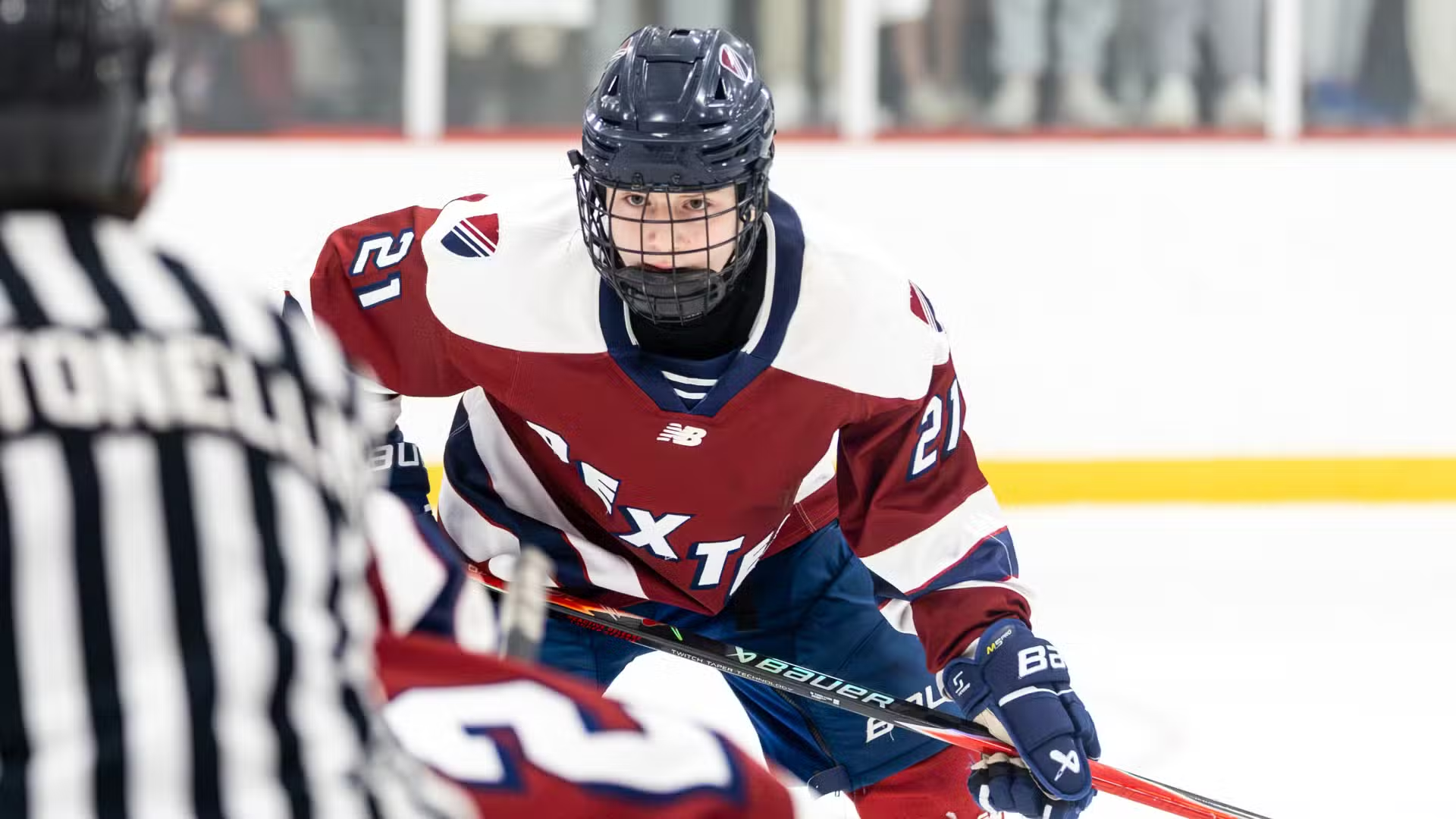
But that wasn’t the case as a freshman on Dexter Southfield’s team last winter. Countless seniors and juniors were ahead of him on the depth chart.
“I was really happy to make the team, but obviously tough to play with so many older guys,” Prudovsky said. “Especially the second half of the year, I just kept battling through it and sitting through it. I kept trying to earn [head coach Danny Donato’s] trust and then got moved up a bit to the second power play and started playing more. It taught me a lot about character and resilience.”
Prudovsky still found a way to be productive, notching 10 goals and 22 points in 30 games, which was impressive given his limited time.
Not playing much won’t be the case this season. Almost everyone ahead of him on last year’s depth chart graduated or left for juniors. Prudovsky is unquestionably the team’s No. 1 center. He will play in all situations.
“I go back to coaching guys like Ryan Donato and Matt Boldy — he’s going to have a target on his back,” Donato said. “I can hear the pregame speeches from every team already in my head that say, 'That’s the player. Let’s make sure we put a body on him.' He’s going to have to be ready for that.”
READ MORE: The Krayers have been through a lot in junior hockey. Now, it’s paying off
It’s a big season for the 15-year-old. The NTDP will be watching his every move. The same will be true for QMJHL executives, who will hope to make their pitch to get him into their league and onto their team.
“The best kid in the age group that I’ve seen is Cam Pelle, the defenseman with Pittsburgh Pens Elite,” Moran said. “But you could easily make the argument that Max is the No. 1 forward. There might be kids who score a little bit more or are bigger right now and can physically dominate.
“But when it comes down to it, he’s the guy to go to if you have a defensive zone draw down a goal or up a goal, or you’re protecting a lead, or you need a goal in the offensive zone.”
Even as colleges recruit older players, Prudovsky is the kind of prospect the high-end schools have no issue courting and committing so early. He’ll be eligible to speak with schools on Jan. 1, and he can commit to a school starting next Aug. 1.
What makes Prudovsky so exciting is the multiple kinds of player he could become. He’s a high-end, top-line producer who can just as easily kill penalties and take on other teams' best players.
He grew up watching and idolizing Sidney Crosby and Nikita Kucherov. He tagged Patrick Kane as his favorite player.
“Macklin Celebrini looks like a really good comparison,” Gratchev said. “He plays really well on the defensive side of the puck. But his vision, the way he moves the puck, the way he opens up the ice for his teammates, I think that is a really good sticking point for Max’s style as well.”
Boston Bruins forward and former Mount St. Charles and Boston College star James Hagens gets tossed around the rinks as a comp for Prudovsky. Both are 5-foot-11.
“He’s different than Hagens,” Moran said. “He’s different than those kinds of guys because he’s responsible defensively, and most of those guys have to learn that. He’s just a really competitive kid who expects to win at everything.”
Prudovsky is at the age where the possibilities are limitless. At this rate, he looks like a first-round pick in 2029, which is when he becomes eligible for the NHL Draft.
BOYS PREP PREVIEWS: Brunswick | Winchendon | Cushing | Salisbury | Kimball Union | Hotchkiss | Williston | Taft | Holderness | Phillips Exeter | Dexter Southfield | St. Paul's
“He’s got a chance to play for a long time,” Moran said.
But none of that is guaranteed. What is guaranteed, though, is that Prudovsky has the one intangible that should keep him separate from the pack.
He will stop at nothing to realize his potential.