
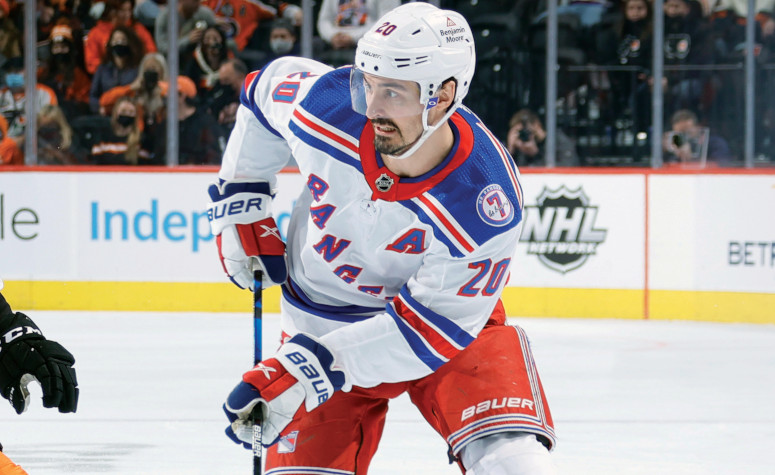

Not even a year ago, Chris Kreider joined New England Hockey Journal’s TV show to discuss the New York Rangers’ progress in a rebuild.
“I think we’ve taken one step back to take a few forward,” the Boxford, Mass., native said in March 2021 before the team finished fifth out of eight teams in the East Division.
The Rangers, who haven’t qualified for the Stanley Cup playoffs in an uninterrupted season since 2017, entered a new era this season as Boston University product and former Blueshirts captain Chris Drury (Trumbull, Conn.) was hired as president and general manager and 2017-18 Jack Adams Award winner Gerard Gallant followed him in to lead the bench.
What a difference a year makes. Kreider’s club is competing as one of the best in hockey as New York became just the fourth National Hockey League team and second in the Metropolitan Division to reach the 50-point mark.
“It’s funny to say, but I think the biggest key to team success is team success,” said Kreider, a product of Masconomet Regional High School and Phillips Andover who went on to star at Boston College. “It’s been a group effort. Guys have really bought into their roles and committed to winning games and doing whatever it takes. We’ve had that good feeling back in the room through almost the first half. We enjoy winning and want more of it.”
Though Kreider is quick to deflect praise to veteran Mika Zibanejad, fellow linemate Kaapo Kakko — the team’s No. 2 overall pick in 2019 — and the rest of an outstanding supporting cast, New York’s fourth-year alternate captain has enjoyed another NHL All-Star worthy campaign himself.
After finishing last season as the only NHL player with at least 20 goals and 100 hits, Kreider reached the 20-goal mark this year on Jan. 3. He ranked fourth with his team-leading 24 tallies entering the week of Jan. 17, thanks in large part to his ability to deflect shots and create rebounds.
On Jan. 13, Kreider became the first Rangers forward selected to play in consecutive NHL All-Star Games since Wayne Gretzky in 1996-97 and 1997-98. He was joined on the Metro squad by teammate and former Harvard star defenseman Adam Fox, the reigning Norris Trophy winner.
“I play with some incredible players, so my job is pretty simple, right? Just get to the front of the net and screen or jump on loose change,” Kreider said. “That’s where the majority of goals are scored, so there’s definitely been an emphasis and a recommitment to getting pucks in the blue paint. That seems to be how we’ve generated offense and tends to be where I hang out.”
Gallant is no stranger to successful starts, as he led the expansion Vegas Golden Knights to the Stanley Cup Final in their first NHL season in 2017-18. His demands of a hard-working team have led to immediate success on Broadway, as well as the opportunity for Kreider to play to his strengths in order to continue the team’s winning ways.
Kreider has made his mark in all situations. His 12 power-play goals at the time of his NHL All-Star nod ranked second only to Edmonton Oilers center Leon Draisaitl and were the most by a Ranger through 37 games since Marian Gaborik in 2009-10.
“(Gallant) wants his team to come in waves, generate momentum and create good scoring chances by playing four lines,” Kreider said. “He’s asking us to play a playoff-style, in my mind. Of course, the special teams units always contribute a great amount to success throughout the season. It’s definitely something we take a lot of pride in as a team.”
Kreider and Zibanejad have teamed on the power play, developing the year-over-year chemistry that is common among top units in the league. Gallant has long known about the 30-year-old winger’s presence since his time on the Florida and Vegas benches.
“When you’re coaching against (the Rangers), you’re trying to make a game plan for Kreider, Zibanejad, (Artemi) Panarin, those types of guys,” Gallant told the New York media on Jan. 15. “He’s a veteran guy and an important player who has always been a powerful forward. He’s having a great year so far.”
Kreider capped off that night’s 3-2 win over Philadelphia with the deciding goal, his third goal (and second game-winner) in two games, and seventh in 10 games dating back to Dec. 17. He became the 12th player in Rangers history and ninth-ever Massachusetts native to score 200 career goals in the NHL during that streak.
Kreider also has added penalty killing to his list of duties this season, playing the role for the first time since ending his decorated BC career with two national championships and three consecutive Beanpot and Hockey East tournament titles under the legendary Jerry York (Watertown, Mass.).
He essentially refamiliarized himself on the job, but the unit — which is ultimately backstopped by the second-year goaltending tandem of Igor Shesterkin and Alexandar Georgiev — ranked third in the league through most of January.
“It definitely brings a different perspective and offers a new challenge, a new way to help the team,” Kreider said. “Sometimes you can generate chances on the power play and don’t feel like you’ve done enough. The penalty kill is different because you can get a good feeling from the kill whether you’re getting looks or not.”
The penalty kill certainly has changed since Kreider’s days as an Eagle. His position on that unit has allowed him to work closely with two more of New York’s outstanding defensemen in 21-year-old K’Andre Miller and Jacob Trouba, who played collegiately at Wisconsin and Michigan, respectively.
“Killing penalties has changed a lot over the last decade because it’s a ‘copycat league,’ but it’s brought me back a little bit,” Kreider said. “There was a lot of pressure at BC. Things are a little different when they’re set up, but there’s definitely still an element of that. It’s a similar feeling when you’re pressuring and trying to get your feet going.”
This season has been a shining example of the well-rounded game that Kreider can play. He has added tools to his toolbox for one of the NHL’s best teams, which features a strong balance of experienced players and up-and-comers. His all-around game has led to confidence in his play and trust throughout the room.
“He’s definitely been a dominant player this year,” Fox said. “Around the net, he’s been making plays, he’s big defensively and he’s been killing penalties. He’s been the young guy on the team and now he’s an older guy, so I think he knows how to handle the room well and he steps up when we need him.”