
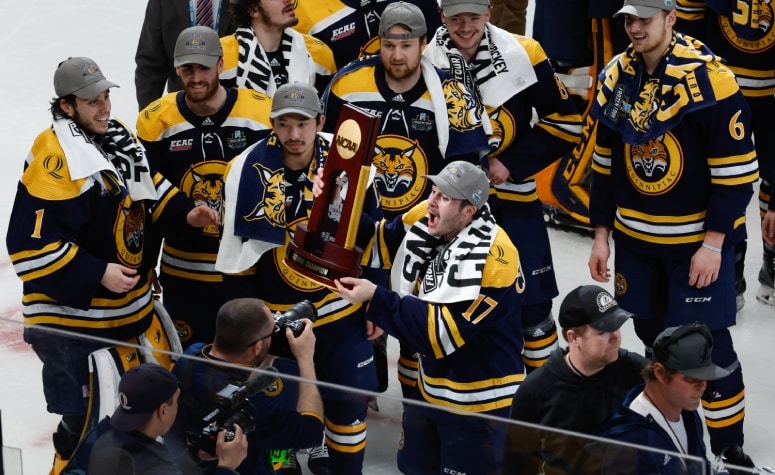

There is a first time for everything.
For the Quinnipiac men’s hockey team, oh, what a first time it was.
In the first Frozen Four title game to go to overtime since 2011, the Bobcats delivered a finish for the ages.
Sophomore Jacob Quillan scored just 10 seconds into the extra session to propel Quinnipiac to its first-ever national championship via a 3-2 win over top-seeded Minnesota on Saturday night at Amalie Arena in Tampa, Fla.
The Bobcats overcame a 2-0 deficit and ultimately clinched the win, their 34th of the season (34-4-3). It came in a matchup of Quinnipiac’s best-in-the-nation defense (1.55 goals allowed per game entering Saturday) and Minnesota’s top offense (4.26 goals per game).
Here are three reasons Quinnipiac clinched the national championship.
Calming the nerves and dominating the dot
In his postgame press conference, head coach Rand Pecknold (Bedford, N.H.) made things crystal clear. His team was ready for the ultimate moment.
But things didn’t start that way.
Less than five minutes into the second period, Minnesota held a 2-0 lead. The score could've been much worse for Quinnipiac.
“You're always concerned when you're down 2-0 against the No. 1 team in the nation. There was a lot,” Pecknold said. “They were causing the struggles for us. And then pucks were hitting our sticks and bouncing.”
Eventually, the Bobcats overcame the early nerves and settled into the game.
“We just tried to calm it down,” Quinnipiac sophomore Cristophe Tellier said. “Hold onto the puck a little longer, establish our game plan, move our feet and it worked out for us.”
The game turned around in a flash.
After outshooting Minnesota 11-6 in the second period, Quinnipiac’s final frame was nothing short of dominant — even before Pecknold pulled goaltender Yaniv Perets with 3:28 left in regulation to create a 6-on-4 power-play, extra-attacker situation that led to sophomore Collin Graf’s (Lincoln, Mass.) late tying goal.
Quinnipiac held Minnesota to 15 shots on net for the game and just six after the first period. It was the lowest-ever total in an NCAA title game.
The Bobcats’ shot margin in the final frame was 14-2, but even more importantly was an incredible 16-5 in the faceoff circle.
Quillan, the top center, lost just one of the last seven draws he took to finish the game 12-6 in that department. It was a stark contrast from his 2-9 effort during Thursday’s semifinal against Michigan, but a pair of first-period goals and an assist on freshman Sam Lipkin’s game-winner in the third still helped his eventual Most Outstanding Player resume.
“It's everything,” Quillan said of winning draws, especially against such a high-powered offensive team that had been 22-0-0 when leading after two periods this season. “It's assertive play. We take pride in being detailed in the dot. We're detailed in the dot. It helps out a lot.”
Winning plays made the difference
Wondering how important a faceoff can be? Oh, just take a look at the game and championship-winning goal.
Pecknold gave all the credit to assistant coach Joe Dumais for the set play that started with Quillan winning a draw to senior captain and defenseman Zach Metsa who stretched a pass to freshman winger Sam Lipkin streaking into the offensive zone. Quillan redirected Lipkin’s hard pass while driving to the net for the goal.
“We don't have a million, but we have faceoff plays on all nine dots,” Pecknold said. “That one was Joe Dumais. It's his play. We have different responsibilities, who is calling different things. But I gotta give Joe credit for that one.”
https://twitter.com/NCAAIceHockey/status/1644899642621009920?s=20
The Bobcats’ top players shined in the biggest moment, saying that the play could not have been executed any better.
“You just attack the middle and Lipper made an unbelievable pass back to Quills,” said Metsa, who assisted on all three goals. “Crazy finish. I had a great view of it. It was awesome to watch.”
It might not have ever happened unless Pecknold called timeout to pull Perets, setting up the extra-man opportunity for the tying goal.
The coach is no stranger to goalie pulls. He pulled the trigger even earlier in hopes of sparking his team in an eventual 7-4 loss to Michigan in last year’s Allentown Regional Championship, but the decision came back to bite.
STANDING OUT: Why Collin Graf became the player he did this season
Even still, there was no hesitation this time around.
“I almost did it earlier. As we all know, I like to pull the goalie,” Pecknold said. “I just feel like you're going to wait a little bit, go 6-on-5. Why not do it 6-on-4? Especially with an O-zone draw, you probably need possession as we got. And we practice it. … You have to be prepared. We found a way.”
Pecknold described the game-tying goal itself as a freshman making a strong effort and executing an extra-attacker play. It all led to Graf taking a shot from the left circle that went in with 2:47 left.
“If you watch that goal, we score that goal because Sam Lipkin is doing exactly what he's told to do,” Pecknold said. “He's hiding off the back post. And the goalie (Minnesota’s Justen Close) knows that. And he cheats the pass. And (Graf) beats him with the five-holer.”
Making history after a long journey to the top
It would be hard to find a coach — anywhere, in any sport — who has done more to build a program than Pecknold.
After spending time as an assistant at his alma mater, Division 3 Connecticut College, Pecknold literally started Quinnipiac’s program in 1994-95 and has never left the bench since.
He has been at the helm for all the highs and lows of building the juggernaut that is seen today. He led the program even before it joined Division 1 in the MAAC (now Atlantic Hockey) and has seen everything through, guiding the Bobcats to nine NCAA tournaments and three Frozen Fours, losing in two national title games before coming out with Saturday’s victory.
https://twitter.com/NCAAIceHockey/status/1644911443328876544?s=20
This amazing end, a national championship? Pecknold never could have imagined it when he first stepped into the job.
“It wasn't even a thought. It was a grind,” Pecknold said. “I worked, my life was 12-hour increments. We practiced at midnight. I had a teaching job (at North Haven High School). I'd get home from school, my job, I'd sleep (from) 3:00 to 6:00. I'd get up. I had to go recruit because we weren't very good. I didn't have enough players. … We were a bad D3 team. …
“It's incredible to do what we've done and be where we are. Just excited to get it done.”
There was plenty of history made.
The Bobcats’ 34-win total was the highest for a national champion since 2016 when North Dakota beat another Pecknold-led Quinnipiac squad in order to raise the trophy.
Their four losses were the fewest by any champ since Maine’s famous 41-2-2 team in 1993 that included dominant freshman Paul Kariya and now-Bruins head coach Jim Montgomery.
It was as true a team effort as one could find.
“It's unreal,” Quillan said. “I mean, we're such a close group of guys. Everyone is best friends on the team. I love every single one of these guys. We put our sweat and tears in every day, working at the rink. And we had a tough way to get to the final, but we battled every day. Feels unbelievable.”
After beating Hockey East finalist Merrimack in their opening NCAA game, the Bobcats had to beat the Big Ten’s Ohio State, Michigan and Minnesota to finish their national tournament run. They outscored that trio of teams by a combined 12-5 margin.
FROZEN FOUR: How Quinnipiac won its semifinal game over Michigan
Locally, Quinnipiac is the sixth current ECAC Hockey member ever to win a national championship and the first since Yale and Union went back-to-back in 2013 and 2014. The first of those games was a head-to-head matchup between Yale and Quinnipiac.
Following UMass in 2021, it is the second New England club in three years to emerge with the title.