


The state of hockey sticks is forever changing. Wood is ancient history, composite is in, and stick manufacturers are continuously seeking to get ahead of the curve.
They are accomplishing this in a variety of ways: by putting the power of customization directly into the players’ hands, hunting for the next technological breakthrough, or even selling directly to consumers.
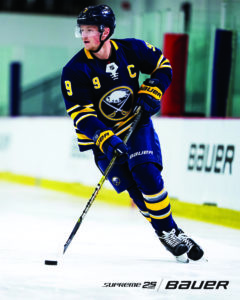
For example, Bauer is launching its new MyBauer custom platform in early 2019. While MyBauer has existed for a decade, the latest iteration will feature a whole new level of customization.
“Kids are more in tune with their product and the gear they want to use,” Bauer global brand manager Tyson Teplitsky said.
“Every kid is looking for an edge and has a better understanding of what they like and don’t like in sticks. Plus, all kids know that National Hockey League players personalize and customize their sticks. Our new MyBauer is going to allow players to truly customize their sticks from the ground up, very similar to what NHL players do.”
Consumers will no longer be locked into getting a stick from one of Bauer’s three families — Supreme (high kick point/square shaft/reactive blade), Nexus (mid kick point/hybrid shaft/responsive blade) and Vapor (low kick point/round shaft/stiff blade).
 Instead, they’ll be able to mix and match components.
First, they’ll pick a kick point. After that, they’ll select a shaft shape. Next, they’ll choose the construction of the blade core, although for this Bauer has built into the program limitations to ensure consumers maximize the performance of their sticks.
“Based on what kick point they choose, we are going to give them three options of blade cores to choose from,” Teplitsky said. “At retail, our Vapor sticks have a stiff blade core because a low kick stick works well with a stiff blade. You want all of the energy to be on and off the stick very quickly. On a Supreme stick, we use a soft blade core, which works well with a high kick point because you want the puck to hold the blade a little longer to allow all of the energy to transfer from the top of the stick down through the bottom. Nexus sits in the middle. So, we won’t give them an option of a low kick with a super soft blade because we know it wouldn’t perform well. But we do want to give them options and there will be some crossover. For example, you can get the low kick with a square shaft with a Nexus blade core.”
The fourth and final new customization option is consumers can choose the same custom curve used by Patrick Kane (Chicago Blackhawks), Jamie Benn (Dallas Stars), Nikita Kucherov (Tampa Bay Lightning), David Pastrnak (Boston Bruins) or Patrik Laine (Winnipeg Jets).
On top of these four things, consumers can still customize their sticks using the options already available on MyBauer, including selecting a grip, a flex and a color, and getting a personalized name bar.
The last detail with these customized sticks is they will have a unique, standalone graphic on it.
“It won’t tie to any of our families,” Teplitsky noted.
To promote its new program, Bauer will be sending some of the stick components to its retail partners, who will have a fit area in their stores where consumers can experience the options for themselves. Consumers also will be able to talk with floor staff, who will be trained and given a fit manual by Bauer.
“It will be similar to what our NHL reps do when they go into the field and talk with our NHL players,” Teplitsky said.
True Hockey, which can customize a stick based on every individual player’s needs at the pro level, has its eyes on doing the same at the retail level in the near future.
It already started moving in that direction with its new junior stick line, UFlex, which is a hybrid of a traditional inventory product and a customized stick.
“The junior players are smaller and growing, and depending on the age group, you can have a drastic difference between height and weight within the same age group,” True Hockey senior marketing and business development manager Dave McNally said.
“We’ve created a stick line which allows players in the 8- to 12-year-old range to be fit into a stick that makes the most sense for them personally based on their weight, size and strength. This ensures that they are maximizing the performance of their stick.”
CCM also is doing its part to help players get the most production out of their sticks.
The company has invested in computer systems that simulate stick structures before a sample is made, allowing CCM to come to designs much faster. After CCM creates a design that performs how it wants, the company starts making prototype samples.
CCM also has a renowned performance lab in Montreal where it gathers deeper information pertaining to its sticks.
“The lab is a full motion capture system, very similar to what the companies which make video games have,” CCM business unit director (composite hockey sticks) Adam Gans explained. “We have high-resolution and high-speed cameras fixed within different positions in the room. The player goes in the shooting area and we measure all the deformations on the stick — how and where it’s bending — and also look at how the puck is moving in consequence. We get exact metrics in terms of the precision of the shot based on all these different things. Through the lab we’ve picked up a lot of information, which we’re using for product development and sharing with consumers.”
CCM has studied not only NHL players in its lab, but also women on Canadian Olympic teams, intermediate-sized players, juniors and kids as young as 8 and 9 years old.
 “There has been some cool and consistent feedback on some of the products that we were able to put directly into product development,” Gans said. “We’ve also seen trends where players are moving down in flex or away from certain kick points into others. We relate those to the way players are shooting in the modern, faster, quicker game, and we can then reference that when it comes to recommending the right product for the consumer.”
The lab served as the inspiration for CCM’s latest innovation, the Stick Fitter, which it launched in August.
The Stick Fitter is an online tool in which consumers are asked questions about their age, current stick flex, style of play, preferred shot type and how they want to improve. CCM then takes that information and runs it against the data it has compiled from its lab to show consumers the stick that will perform best for them.
“If you’re a big defenseman looking to improve your slap shot, you tell us how you want to improve it,” Gans said. “Are you looking for precision, to lift the puck, or just pure speed? From there, we can guide you or change some things in terms of your stick selection. On the other hand, if you’re a winger who shoots way down low, that’ll indicate other things. We have three families of products — Super Tacks, JetSpeed and RibCor — and each of them is designed for different players. With the Stick Fitter, we break down your game, what you’re trying to improve, where you’re shooting from, where you’re scoring from, and then make a recommendation on the right family, maybe a change of flex, and go from there.”
The common denominator among stick companies is they want their consumers to get the most production out of their products. Where they are starting to differ is their approach to getting the sticks in the hands of their consumers.
While the only way to purchase a True or CCM stick remains the same — through a retailer — consumers are now able to purchase Bauer sticks directly from the company’s website.
“We’ve gotten a lot of requests over the years where people, in certain circumstances, find it to be more convenient to find and purchase the product on our site,” Teplitsky said.
Retailers are still involved, and consumers can get free shipping if they choose to have the product shipped to the store.
Meanwhile, STX is no longer at retail at all; the only way to purchase its products is via its website.
“The Amazon effect — the direct-to-consumer business model — is becoming more predominant in everyday life,” STX category brand manager (ice hockey) Matt Di Girolamo said. “But with that comes the difficulty of getting somebody to try a new product without being able to feel it.”
To solve that problem, STX has a 14-day, risk-free trial on elite-level sticks. During this two-week period, players can cut the stick, tape it, play with it, and if it’s not what they expected, they can return it and get a refund.
So far, the change has worked better than expected.
“We thought we would have more returns, but people like the sticks,” Di Girolamo said.
Another manufacturer going consumer direct is Bardownski Hockey, which was founded last year by Jason Silver and Josh Miller and is a top stick provider for the New England prep school circuit.
 Bardownski’s main selling point is its sticks are the same quality as those from the larger manufacturers but are a fraction of the cost.
“The stick marketplace today is prime for some disruption in the sense that you have consumers paying upwards to $300 for top-of-the-line quality sticks,” Silver said. “The big boys of the world have a lot of marketing dollars, rightfully so, tied up in endorsement deals and marketing at the highest level. While I get that model, there doesn’t need to be a marketplace that’s just driven by that one. What we look to do is not compete with the big manufacturers but rather provide an option for the consumer base — players and families — to purchase the same quality sticks at a lower cost because we go consumer direct and we don’t have a margin in big marketing dollars or endorsement deals.”
In keeping with the customization theme, Bardownski offers consumers the ability to select a curve, flex and lie. The company also will include the organization’s logos, team name and player’s name and number.
“Everybody wants everything customized and we are able to provide that to them with that old school mom and pop mentality,” Silver said.
It takes about three weeks for Bardownski to complete a customized team order. The company also offers a 60-day warranty on its sticks, another key selling point when it is in discussions with prep schools, and a simple process to replace them.
Explained Silver: “We don’t make the kids send the sticks back to us. All of our sticks have a bar code on the back. They send us a picture of the barcode, a picture of the break, and then we replace it for them. The replacement percentage is 0.7%, which is very good.”
The direct-to-consumer approach has worked well for the companies. The good news on the retail side is the stores are doing fine despite the shift.
“Hockey is a unique sport; it’s very service oriented,” said Wayne Zwicker, owner of H.A. Zwicker skate shop in Bedford, Mass. “People want to talk with somebody who is educated in the fit and performance of product. That’s very important. It’s a shot in the dark to go online and look at a picture and read about it. I’ll do research online and then go to a well-established store that’s been around the block and seen the changes over the years.”
Rich O’Rourke, a stick buyer for 26 years at Sports Etc. in Arlington, Mass., isn’t concerned at all, stating that “online people are going to be online people.”
And for those who still want to experience how a stick feels in their hands, they can do just that at Sports Etc., where there’s a stick room with a shooting lane so employees can watch potential consumers, especially kids, shoot and give them an idea of what stick is best for them.
“There are so many sticks to choose from,” O’Rourke said. “The best way to do it is to actually hand a kid a stick and let him or her try it.”
Another common bond among stick companies is the desire to reduce the cost of manufacturing sticks.
This begs a question that involves a developing technology: What is the future of hockey sticks in regards to 3D printing?
 “We see a future in it,” Gans said. “It’s a fascinating technology and we have some advanced programs with it. It offers some unique things, not just in terms of speed of processing, but also the way you design products. You’re not dealing with the limitations of tooling and undercuts anymore. It’s a technology that’s going to become more common in every aspect of life.”
Said McNally: “The answer lies within how that technology evolves and develops. There’s no question that 3D printing is an emerging technology across many industries and hockey will certainly, at some point, adopt 3D printing that will be more focused and tailored to the consumer. It’s quite complex; we are working with carbon fibers and a lot of different materials. The technology is going to have to continue to evolve before that’s something that’s possible.”
Di Girolamo could see stick companies spending money on research and development, and then instead of having the product manufactured overseas, having them made in North America.
“Hopefully that would bring down the cost,” he added. “When you see sticks that are $300, it hurts the game. Granted, there are price points and you can go down, but kids and adults want to have the best of the best, and if they see a superstar using that stick, they are going to want to use that.”
For now, Bauer isn’t really exploring that path, due to the details involved in their stick-making process.
“I know that 3D printing has evolved a lot in a very short time frame,” Teplitsky said. “Right now, it isn’t necessarily on our radar. Our sticks are a very manually constructed product; every single one of our sticks is made by hand. There is molding parts of production. All the carbon fiber is laid out by hand. Every component of the blade is layered by somebody. Then it’s put into a mold to be heated up and created into the final product. And all the graphics, which are water decal, are put on there by hand. If we deem it a worthy investment and feel it’s worth going down, we will explore it.”
And if 3D printing of hockey sticks does happen?
Well, that would be the biggest evolution in the industry since wood sticks became a thing of the past.