
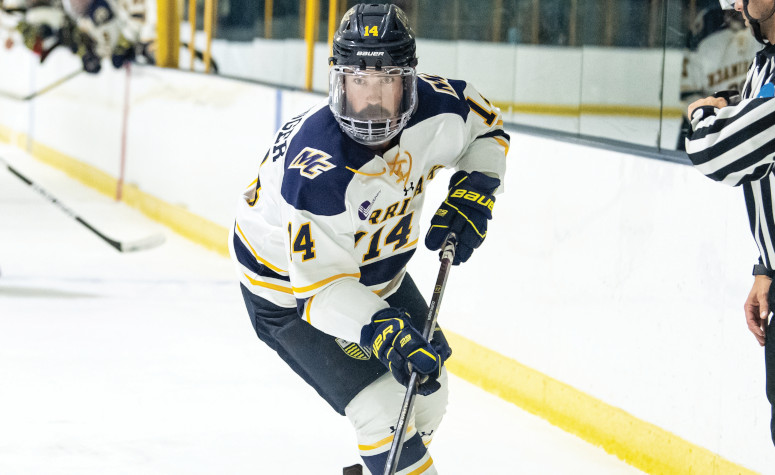

Following an unprecedented past year, the college hockey world has undergone a change.
Not only was every NCAA student-athlete granted an additional year of eligibility as a result of the COVID-19 pandemic, but April’s one-time transfer ruling — the reverse of previous legislation that required men’s hockey, men’s and women’s basketball, football and baseball student-athletes to sit out a year before being eligible to compete at a new school — has made an impact on nearly every Division 1 team in New England and beyond.
“It’s kind of a new age in college hockey with the transfers and everybody getting a fifth year,” said Quinnipiac coach Rand Pecknold, whose team got off to a 7-1-2 start with a class of five transfers that includes a reigning national champion in former UMass forward Oliver Chau. “With the transfer rule, you’re going to see a lot more fluctuation of rosters. Players are going to leave for different opportunities, and you’re going to have to plug holes here or there.”
The new rule essentially created a “free agency” period leading into the start of the school year and likely will continue to do so for seasons to come.
As Pecknold said, it allows teams to fill holes on their rosters quickly and access a wealth of experience in the form of fifth-year seniors looking to finish out their careers. Every New England program outside of the Ivy League took advantage and gained at least one transfer.
Bentley’s Collin Rutherford was one senior who entered the new world of the NCAA Transfer Portal this summer. The Dartmouth graduate from Tonawanda, N.Y., admits that there was some craziness early in the process.
“It was kind of wild,” Rutherford said. “Pretty much the day after the NCAA announced that everyone was going to get another year (of eligibility), there were hundreds of players in there. It was all new to everybody, so that made it a little different than the original recruiting process. I reached out to some schools, some head coaches, some assistant coaches, and I had my coach at Dartmouth do the same. … But, it’s been awesome here at Bentley.”
In the end, the Falcons and their Atlantic Hockey rivals from Sacred Heart used the portal to help retool their teams in a major way entering the season.
Eight of Sacred Heart’s 11 total newcomers are transfers who joined the program from four of the nation’s other five conferences and, in the case of junior goaltender Justin Robbins, from independent Arizona State. Bentley welcomed five transfers, four of whom are graduate students.
“You can’t teach experience,” said C.J. Marottolo (North Haven, Conn.), the 13th-year coach of a Sacred Heart program that brought in more transfers than any other New England team. “As we formulated a philosophy and a recruiting strategy before the rule got ratified, we felt we needed to adapt. Bringing in players with 80 or 100 games in college, and even the guys who aren’t grad transfers, they’re all coming from high-level programs and have really fit into our culture.”
American International is one program that has “been in the business long before the Transfer Portal” and the one-time transfer rule, head coach Eric Lang said, but the new rule is certainly a change from the norm of identifying, recruiting and developing freshman talent that comes from the scholastic and junior ranks.
But, it sure looks like it is here to stay.
Bentley coach Ryan Soderquist (Stoneham, Mass.) agrees. His hockey team dove deeper into the transfer market this summer than he expects in the future, but he knew of the benefits of bringing in a handful this season. Their experience helped the Falcons pick up an Oct. 15 home win over BC, which was his program’s 12th over a Hockey East program since 2008.
“I definitely went into this year saying, ‘Let’s give it a shot,’ so we could see how it worked,” Soderquist said. “I don’t see us (taking five transfers in one year) in the future. Four-year culture guys are our main focus in recruiting, but there’s going to be a bit of free agency in the spring … and we’ll definitely put ourselves in a position to be able to bring in a good player if someone comes available late. I think this was a good year to take a shot on a few guys.”
Similarly, Marottolo’s program saw “great value” in adding a number of veteran players to the roster, especially following a year during which in-person recruiting was impossible for so long due to the COVID-19 pandemic.
“It’s hard to really get a feel for how players are going to adjust to this level when you’re watching video, so we felt taking guys that have played college hockey was the way to go for us,” Marottolo said. “They’ve already gone through it. They were a proven commodity, so to speak. They’ve done the job so far.”
For Rutherford, the opportunity to join the Falcons had even greater meaning after his senior year in the Ivy League was canceled.
Though he didn’t have the opportunity to meet with Soderquist and his staff in person due to the pandemic, Rutherford found a great fit with them, the team’s style of play and the school’s master’s of science program. He also had played a game in Bentley’s four-year-old arena during his sophomore year at Dartmouth.
In reflecting back upon his career, which included 96 games at Dartmouth, Rutherford believes that the experience that his entire graduate class can share was a crucial piece to building the Falcons as they appear today.
“We have a pretty veteran team, and that has helped us build chemistry,” Rutherford said, pointing to former Miami (Ohio) captain Phil Knies as a player who has taken on a leadership role during his grad year at Bentley. “When I was younger, I would look up to the upperclassmen and use them as role models. What are they doing? What’s acceptable? It’s important to set that same example and provide some leadership based on the experiences that we all have.”
Soderquist has seen a mutual benefit in bringing in Rutherford. He believes the same holds true for other Ivy League graduates throughout the country who were unable to continue their careers for a fifth year at their original institution until a waiver for only the 2021-22 school year was enacted in February. For many, that was too late.
“I think those guys value quite a bit in getting this extra year,” Soderquist said. “So, I’m glad we were able to make things work with Collin. It was a good academic situation and he’s been a great fit in the locker room. He’s added a tremendous amount to our program, and I think we’ve added value to his life. The leadership that Collin and those veterans provide brings a lot to the table.”
Unlike the grad transfers, Robbins still has more college hockey to play after this season’s end. He’s more than happy to spend it with the Pioneers.
The Alpine, N.J., native had appeared in only four games over two seasons at Arizona State, so the program that Marottolo and his staff are continuing to build in Fairfield, Conn., was the perfect place to continue his career.
“It was just exciting to come into a place that is really on the rise and building something great with a ton of new guys,” Robbins said. “Obviously, last year was just a weird season and I missed some time with injuries, so Sacred Heart was a fresh start. I think that’s why you see a lot of guys looking for new opportunities. I think this team had a great core, a great coaching staff and a culture that myself and others wanted to be a part of.”
Jake Durflinger views his new home at Merrimack College in a similar way.
Playing for a Hockey East program appealed to the veteran of 131 games across four seasons at Denver. A California kid, Durflinger found a fit with a Warriors team that he originally was connected to by current assistant coach Dan Jewell, who coached him with the USHL’s Bloomington Thunder.
“It’s a school that’s been on the up and a team that is heavy on returners,” Durflinger said. “I really wanted to play in Hockey East, and it’s a team that kind of fits my personality. They kind of get overlooked, but you saw (against teams like Boston College and Boston University), we played with them all night. That was an opportunity that really stood out to me.”
Durflinger, forward Steven Jandric, and former Kimball Union and Bentley defenseman Christian Felton were Merrimack’s transfer additions. Jandric played with Durflinger last season at Denver after three years at Alaska, where current Warriors captain Max Newton played his first three years of college hockey before joining Merrimack in January.
All three newcomers, who had connections to the team’s coaching staff or players before the transfer process, have impressed fourth-year coach Scott Borek (Swampscott, Mass.) and played regularly of late.
“Everybody has transfers and it’s going to continue that way,” Borek said. “We got really fortunate with the three we have — they’re all team guys. I think the fact that they came to Merrimack in the first place and just buckled the helmet, it’s great for the team. I have a world of respect for the situation. They came into the team very easily, which speaks volumes for them and our locker room as well.”
Of course, playing time can be another key motivator for transfers.
At Sacred Heart, Robbins has seized the starting role in net following an early injury to senior Josh Benson and beat both Boston University and Maine during a season-opening stretch of seven straight road games against Hockey East teams.
Although Robbins didn’t get an extended chance to show what he could do before transferring, his performance out of the gate proved Marottolo’s point. Replacing a former All-Atlantic Hockey goalie who started right away as a freshman could have been daunting, but nothing rattles an experienced player like Robbins.
“Justin is a very competitive young man, so the guys love playing for him because they know how hard he works and how prepared he is,” Marottolo said. “He came from a great program, like all of these guys. When he was thrown into the fire at BU, the moment didn’t faze him. He’s been there, done that. He played in the USHL, which is a great league that really prepares you for this level. All of that made him ready for the opportunity.”
When second-year Vermont coach Todd Woodcroft jumped into the Transfer Portal, he knew that experience would help his young, growing Hockey East program as well. The Catamounts added four transfers: former UMass forward Philip Lagunov — a grad transfer who began this season with four goals in six games — and defensemen Cory Babichuk (RPI), Robbie Stucker (Minnesota) and Joe Leahy (Cornell).
Woodcroft believes that these newcomers are the greatest teachers for his young roster, which includes six freshmen from outside North America.
“Hockey is an emotional game, but these guys don’t let emotions get in the way,” Woodcroft said. “Emotions can be very disabling, so when the young players see how hard someone like Phil practices and the details of how they all prepare, it’s almost like having an extra assistant coach.
“I know problems are going to be solved before they even get to us, and that might just be giving a young person who just came into a new country and a new school some support … with all of those things that someone else taught them.”
The new rules could create expanded rosters and a recruiting crunch for some programs over the next few years, but coaches throughout New England have found many positives in bringing transfers into their programs this season.
Like many, Marottolo believes the changes will impact the game for years to come.
“College hockey is getting older. Now, it’s really getting older adding in these grad transfers, and you’ve got guys at 25 or 26 years old on a team,” Marottolo said. “I think you need to adapt right now with the new NCAA rules or you’re going to fall behind. I think over the next two or three years, we’re going to see the same kind of stuff.”
@JoshuaKummins
jkummins@hockeyjournal.com