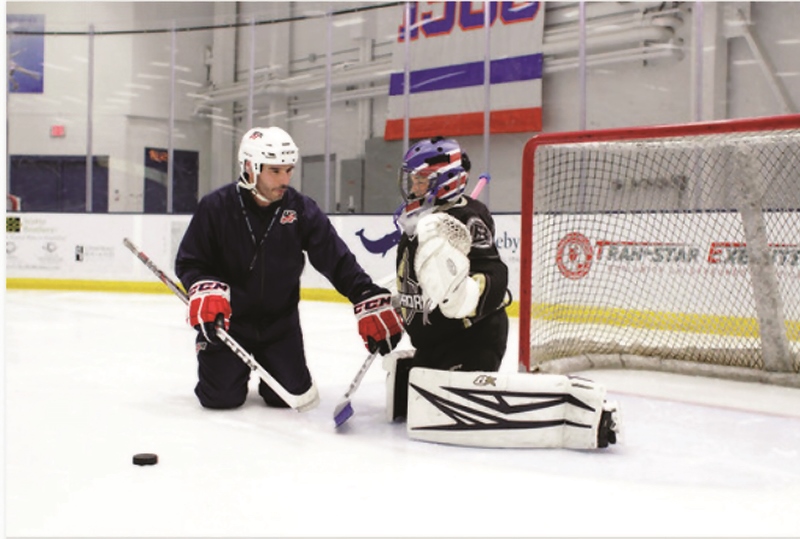
A native of the Big Apple, Dave Starman is a longtime coach and instructor at nearly every level of hockey.
Starman tended goal for the University of Hartford before turning to the other side of the game, becoming the youngest head coach in Central Hockey League history in 2000 when, at age 31, he took over the Memphis River Kings. Starman later guided the New York Junior Bobcats of the Atlantic Junior Hockey League and was associate coach of the New York Apple Core of the Eastern Junior Hockey League. Starman is now one of the nation’s most respected college hockey TV analysts and is part of the USA Hockey Coaching Education program.
Billy Jaffe: Without comparing it to years past too much, how would you describe the state of college hockey right now, Dave?
Dave Starman: Active. I think it’s not done doing what it’s doing right now in terms of the conference structure and the way that it looks. On the business side of things, you’ve got this WCHA thing percolating right now, where seven of the 10 teams are looking to move in a different direction. Alaska (Anchorage) was a little bit in flux. Where does (Alabama) Huntsville slot in conference wise? And then you’ve got Arizona State that is still looking for a home. I think Arizona State is going to wind up in Hockey East. Just a hunch but I think that’s where they’re going to wind up, for a million different reasons, starting with travel. Nobody’s finished yet. I think the Big 10 would love to add one more team for an even number. Do the two Minnesota teams in Bemidji and Mankato wind up at some kind of alliance with the NCHC just for travel reasons and economic. The big picture, how the conferences are now, probably won’t look like it does now, two or three years from now.
Jaffe: College hockey has many question marks right now. Is that a good thing?
Starman: For guys like you and I, I think it’s great. It gives us something to chat about and speculate about. For fan bases around the country, it could be a great thing because maybe a certain team can wind up in a conference that gives them a better chance to make the NCAA tournament on a yearly basis. So that’s certainly a factor. I think that expansion’s a great thing. Where do some new programs slot in? We’ve heard Illinois, but there are certainly other programs out there that are looking at a feasibility study and the NHL is going to pay for a lot of those feasibility studies. I think it’s a win-win for everybody. The negative part of it is — and we’ve talked about this a lot, and you being a Michigan alum can understand this — where do the traditional rivalries go? Because fans love traditional rivalries. You’ve seen that in the Big Ten — Minnesota and Wisconsin are still together. That rivalry has lost a little bit of its jam in recent years, but they’ve also lost all of those old WCHA rivalries, especially North Dakota and Denver, that were such a big part of the WCHA culture. Michigan, Michigan State, Ohio State still have each other. Notre Dame is back in there so you have the old CCHA thing, but I think schools like that miss Miami, and to an extent, schools like Ferris State and Lake (Superior) miss having some of their CCHA friends like Michigan come into town. So I think for the fan base, it’s a little unsettling, but the big picture of college hockey, if we get a few more teams in and geographically it works better, then everybody wins, especially if we can keep some of the teams’ expenses down.
Jaffe: You talk about rivalries and all the rivalries that you mention that could be in flux a little bit are in the West. The East seems to be more stable, and I would guess that it comes down to geography more than anything. What are your favorite East Coast rivalries when you look at games either to work or to watch?
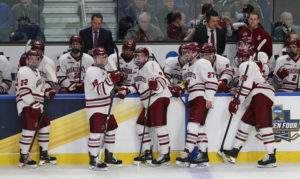
Starman: Going back years, I always loved Maine and New Hampshire, especially when they were at Maine. BU-BC is obvious. Yale-Quinnipiac has really become a great rivalry. I was at a game when both were at the height of how good they were few years back and I think it was I think was a rematch of the national title game the year after, and they were four, five rows deep at Yale for the game, fanwise. That was awesome, so I think they have really put something together. Cornell and Clarkson has always been a great rivalry and always a great one to watch. Cornell and Harvard has been great. Harvard and Yale is terrific. And right now, with the way UMass has started to put things together, I think anybody and UMass right now, could be a good one, especially with schools like Providence and Northeastern starting to maintain their level. You’re looking at Providence, UMass, Northeastern with a little three-way rivalry to see who is going to start to crack into that the BU-BC high ground that fan basse for so long have generally accepted as the two big faces of Hockey East.
Jaffe: We’re starting to see some significant coaching inquiries from the NHL, David, to the college ranks. Doesn’t always mean the guy’s going to take the job, but at least feels like they’re being taken more seriously now, perhaps, or more legitimately than in the past. How good is that for the game and, in your opinion, how difficult is it to go from coaching in college, to coaching in the National Hockey League?
Starman: That’s a good question. I mean what we could start by turning to the other side of a couple of pro guys coming to the college ranks. I look at two programs that have grown significantly in the last five years. I look at UMass under Greg Carvel. I look at Colorado College under Mike Haviland. What’s the common link? They both have a ton of NHL experience as assistant coaches. I think they brought a ton of experience with them, adapted to the college game and grew those programs. Then you look at the other side of it, with David Quinn and Dave Hakstol and Jim Montgomery going from the college ranks to the NHL. I think Monty was so suited for pro hockey, even when he was in the NCAA. I think he was biding his time, building a winning a résumé to get himself into the NHL and he did it very methodically and he ran a very much a pro style at Denver. I. I look at Dave Hakstol at North Dakota. North Dakota, we all used to joke, was almost like a pro team anyway. I think Dave Hakstol adopted very well. The Flyers might not have gotten the results they wanted, maybe they were short the personnel that they wanted, but I think Hack did a pretty good job there. And David Quinn, I think, in one year has done a really good job with the Rangers. What’s the common trait with those three guys? They’ve all got the demeanor to handle pro hockey because they’ve been around it. They’re all no nonsense, straight ahead, no baloney, they tell it like it is, they’re not afraid to take on their veterans, and bench guys that they have to, and they all have similar personalities in that they don’t say too much, but they say what’s needed to get said and they’re not afraid to put their rear ends on the line to make the right decisions for their organizations. I think you’re going to see a little more of it. There are a couple of college guys that are ready to go pro, in my opinion, but just love the college game too much and will never leave.
Jaffe: One of the things that makes you such a qualified and talented analyst is your background in scouting. You’ve been doing it for a long time. As a scout, can you see a difference between an East Coast and a West Coast player, or an Eastern and Western player?
Starman: I see it sometimes with teams. The matchup between AIC and St. Cloud was a great example of the difference between the East and the West a little bit. The West, especially the NCHC, if you’re gonna go to the net, you’d better be ready to give up some skin to do it. It’s skilled, it’s not dirty. But it’s a physical, hard, body-on-body league. The Eastern teams, most of them are so good with their sticks and so disciplined positionally that it’s a little bit of a different game in the East. I’m not going to say one is better than the other. They’re just different. But, in breaking down even some of the players, I look back at some of my reports, I can definitely see I write up some of the Western kids a little different than the Eastern kids, just based on, sometimes, the team mentality that they play for. The structure that you play within, and the region that you grew up in, has a lot to do with how you see the game and how you play it. But I think one of the minor differences, and the Big 10 plays into this a little, it’s a little more physical in those two leagues, where the Eastern leagues were probably a little bit better defensively, stick wise, and a little bit better positionally.
Jaffe: One team that perhaps was a little different than that in the last year, at least in my opinion, was UMass, with how aggressive they were. You mentioned Greg Carvel a while ago. Maybe it’s his pro mentality, but I thought the way that they attacked the net in the way that they attacked the game in general was definitely different. They obviously had some amazing players led by Cale Makar on the roster. Is he as good a defensive prospect that you’ve seen in, in how long, in the NCAA?
Starman: I remember sitting with a bunch of scouts watching a game last year, early in the season, and the Colorado scout wasn’t near us. There were three or four of us and we looked at each other and said, “You know what? He could quarterback the Avalanche power play now.” How often do you say that when you’re watching an underclassman playing college hockey? The one thing — and I think you’re bang on with UMass — one of the reasons that UMass played the way they did was because they could all skate. That was a team that was really good on their feet, and the wide rink, and with their puck control, it was a lot like St. Cloud. St. Cloud obviously didn’t have the national tournament they wanted, but I thought to myself, St. Cloud and UMass are two teams that if you gave them a best of seven, would produce some incredibly entertaining hockey last year because of how they were built. They were built on speed, skill, a little tenacity to them, their goaltending was real good, power play could work, they each had a quarterback that was a big-time player, but they also could play that physical, nasty game when they needed to. I just thought that their structure was so good. I didn’t think they were oversystemized, but structurally they played really well and I thought Carvel’s mentality of pucks up ice, pucks to the net, don’t fool around with it, don’t overhandle, and led by Makar, who reminded me a lot of Kevin Shattenkirk, kind of a one-man breakout player type of player. I thought he was such a big pow to their engine that allowed them to play a lot of different ways.
Jaffe: One of the factors that have allowed teams to get better quicker, and it’s a trend that we’ve seen now in the last decade, is older players coming in. Is it good for the game that many schools are taking 20- and, in some cases, 21-year-old freshman?
Starman: It’s interesting. I’ve worked for two NHL GMs who both had concerns about how old some of the college players were getting and whether or not you could make a good evaluation of some of the younger guys and some of the older guys, because of the fact that you could have an 18-year-old and a 24-year-old in the same game. I thought there was some merit to that argument maybe from a scouting perspective. But from an entertainment, program-building perspective, I don’t think it’s a bad thing that some of these kids are older kids, because I think they bring more sophistication, more savvy, probably more ability at times, and they play a man’s game. There’s probably a little bit more limited mistakes, more depth. There is a definite difference between the NCAA game and the major junior game, and one of the reasons is, the NCAA game has a little bit more structure to it, because the players are a little older, a little stronger, and a little smarter. I say smarter due to the fact that they’ve got two or three years experience on the oldest kid playing at the major junior level. Is it good for the entertainment product? I think so. Does it sometimes make it tougher to evaluate players from a scouting perspective? Probably, but if you’re asking me with my TV hat on, I think older players really help allow teams to build a core, build a culture, keep players together a long time, and that makes a better team, and better teams are the teams you want to watch because they’re more entertaining.
Jaffe: Does it hurt, though, the young player who really wants to go to college to use it as a place to play hockey and, as important, if not more important, get an education, and now it’s trickled all the way down to the Division 3 level, the club level. Would that be the negative aspect to all these older kids getting these opportunities?
Starman: You can make your argument for that, but if you’re a high-end 18-year-old kid, you really should have no problem establishing yourself in the lineup and jumping over on the depth chart the 22-year-old undrafted free agent. In theory you should be able to. I look at a kid like Oliver Wahlstrom. To me, Oliver Wahlstrom is a kid who, no matter what school he played at last year, with his skill level, you could make a case that he should have earned himself some big minutes. And I know he was up and down last year. But when I look at some of these high-end kid, I say to myself, I don’t think playing on a roster that has some older kids is an issue. If anything it should help them because they’re going to have some guys to rely on, and some of those older guys will probably gravitate toward the young stud who is headed toward the NHL, as somebody who they could take under their wing and show them the ropes and even if they’re only there for a year or two, can prepare them better based on their three- to four-year experience at the NCAA level, on what the next level potentially can look like. I think it’s a win-win, for the older kids to be there. I think it helps coaches keep their jobs, I think it makes programs better and really provides some of the younger players with a guy that they can look up and keep them in line when they just want to be them as opposed to be part of a team and a culture.
Jaffe: Keeping it on the East Coast here, is there an Eastern team, maybe two, that are not spoken about as much that you have a real affection for?
Starman: One team that doesn’t get talked about enough that’s been a really, really good the last two or three years has been Clarkson, under Casey Jones. They’ve made the national tournament the last couple years and I think they’ve gained some traction. They’ve put out a couple of pretty good players that have signed NHL deals the last couple, including Nico Sturm, who everybody was chasing around and is going to turn into a really good, strong centerman who can make plays. Clarkson certainly is one team. Quinnipiac does get a lot of attention and I think they deserve. I mean sometimes of the national stage they might get overlooked, but look at what Quinnipiac has done over the last few years — they get themselves to the national tournament, they win a lot of games, they can play up there with the big boys, they’ve been to two national title games, they’ve turned out NHL players. They’ve been fun to watch. In Atlantic, AIC didn’t lose a lot. They’re well-coached, under a kid who played for me in junior who was always a tenacious go-getter, in Eric Lang. AIC is a team, this year, because they didn’t lose a lot, much like UMass, they can pick up where they left off and really make another run through Atlantic and potentially get back into the NCAA tournament. All of the components that they need to be good this year, have returned to their lineup.
Jaffe: Joe Bertagna is finishing his run as Hockey East commissioner at the end of this year. How do you see Hockey East having developed under Joe? Has there been anything that stands out to you more than another?
Starman: I think that the run that a lot of Hockey East teams have had through the national tournament, through the Frozen Four and winning them, have been great. I think that the exposure the league has gotten, media wise, over the last 15, 16, 17 years now, has been great…. I never like to see anybody lose their job, and I really like Joe a ton. I could talk goaltending with him for hours. He’s a unique rare bird in terms of the fact that he can see the game for what it used to be and also understand what it is today. I do think his efforts to try to keep Hockey East up there with the Big Ten and the NCHC when it comes to exposure here without a national TV contract, he certainly is somebody who has wanted that to happen, but I guess that the decision was made that it was time to hand it over to the next generation to move it forward. I don’t think’s Joe Bertagna’s career in hockey is over by any means, and I was sad when I heard the news, because I have built a really nice relationship with him. The one thing Joe does not get enough credit for is the coaches convention in Naples and the AHCA and everything he has done to make that a really, really strong organization for the NCAA coaches, for coaches who wanted to learn more and can attend that convention and interact with the big boys. He doesn’t get enough credit for the contribution that he has made to hockey for the AHCA.
Jaffe: Who do you think will be the best team coming out of the East this year?
Starman: Despite losing Cale Makar, who was a big part of their team, I think right now the mantle in the East belongs to UMass. It’s theirs to lose. I think you’ve got to give them the benefit of the doubt. They return both of their goalies, who were really good. They lost two players who were real good — Makar, who certainly was a key guy — but they’re bringing back a chunk of it. I think they can start off right where they left off and, like St. Cloud, they can take their big-rink game to a small rink and almost be better at times. So I think until proven otherwise, the best team in the East is UMass.
Jaffe: How would you describe to a person the importance, the necessity, the love affair that is called “Bagels for Jerry.” How would you describe that to somebody?
Starman: Everybody has got their favorite tradition in hockey and mine is Jerry York and the Boston College staff’s affection for Long Island bagels. Here’s where it started: When he was recruiting Tim Filangieri, who had played for me with the New York Bobcats then went to Waterloo, when he was recruiting Filangieri, he had to come down and make a home visit, even though it was basically a sewn-up that Filangieri was going to wind up at BC. I remember sitting in the office one day with Mike Cavanaugh and Ron Rolston at the time and saying, “Hey if you don’t go take a look at this kid, you’re gonna lose a chance at a good player.” I’m glad they followed up on it. I remember he came down for the home visit and I said, “Did you really have to seal the deal?” and he goes, “No, I just wanted to come down and get bagels.” From that moment on, I started bringing him a dozen bagels every time I went up there, whole wheat. Then it just grew, and took on a life of its own, to a point where if I know I’m going to BC to scout a game, I know I’m stopping at the bagel store in Long Beach to make sure I bring the staff a couple dozen. It’s this neat little thing that has connected our two worlds, and it’s pretty cool.
Jaffe: There’s no bagel like the New York bagel. End of story.