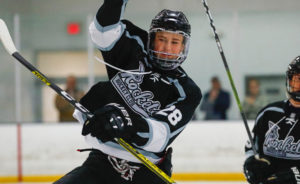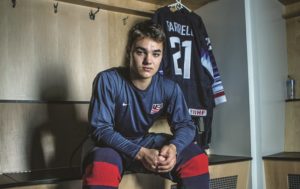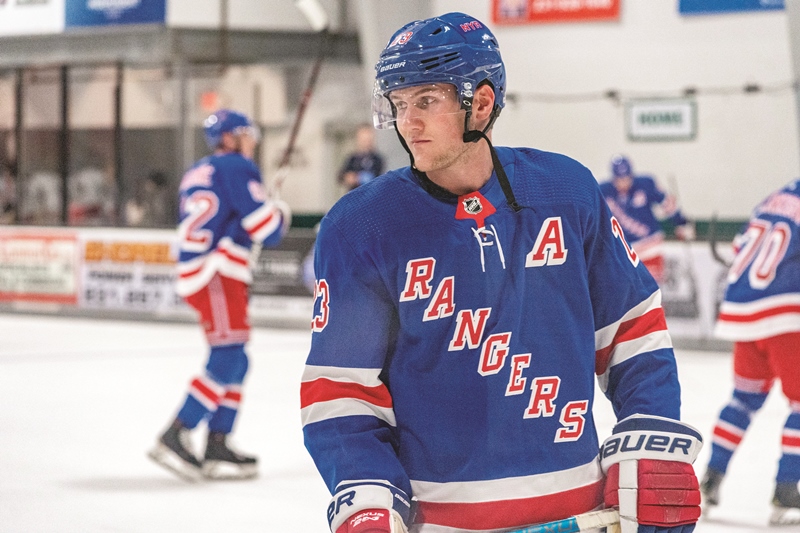
Former Harvard star Adam Fox was making hockey look easy, again.
In a game against the Dallas Stars’ top NHL prospects in Traverse City, Mich., in early September, the future quarterback of the New York Rangers power play toyed with the Stars, keeping the puck on a string for long touches throughout the contest, snapping off two goals and delivering three tasty helpers to complete his five-point night. ECAC Hockey fans will appreciate the fact that Fox was lighting up goaltender Colton Point, the former Colgate stopper who had been a Crimson nemesis.
“He shut us out a few times in college, so it was nice to finally get a few on him,” said Fox, who shared the moment with fellow Crimson skater Lewis Zerter-Gossage, who also was suiting up for the Rangers. But unlike Fox, Zerter-Gossage was scrambling helter-skelter to make an impression on the scouts, while his longtime Harvard teammate barely broke a sweat.
“Seeing him every day for three years, you get used to it,” said Zerter-Gossage about Fox. “It’s frustrating because I always watch him and think, ‘I wish I could do what he does.’”
Despite the exceedingly long list of Fox accolades — NCAA’s most prolific point producer last season (1.45 points per game), the U.S. National Team Development Program’s third-all-time leading scoring defenseman, and a first-team All-American in each of his three seasons at Harvard — the kid still plays with an edge from being slighted somewhere down the line.
“There’s definitely a chip on my shoulder,” Fox said at the Traverse City showcase. “From a young age I’ve always heard things, ‘too small,’ and things like that. Sometimes it’s nice to try and prove people wrong. It definitely pushes me.”
How could one of Harvard’s most decorated players feel slighted? The Crimson’s veteran coach, Teddy Donato (Dedham, Mass.), shared his insights. “Sometimes he gets the short end of the stick for what he’s accomplished,” said Donato. “Because he’s so good offensively, people try and find fault with other parts of his game: ‘I don’t know about his skating, I don’t know about his defensive skills.’ His hockey sense is not limited to the offensive end of the ice; when he needed to stop and defend, he was very good at it.”
An Internet search brings Donato’s complaints to life. The Athletic’s prospect guru Corey Pronman spells out what the Fox doubters are saying privately. “The question on Fox … it’s whether he can defend given his size and very average skating. His coach may need to be careful with him.” Pronman rates Fox as only the 39th-best NHL prospect.
Fox made a point in Traverse City to express his desire to defend, especially on the penalty kill. “I don’t want to be a one-dimensional player; I’m able to play in the D-zone and have a well-rounded game,” he affirmed. Fox did just that throughout the tournament, willing his way to rebounds and making vital clears on the PK, “Trying to show what I can bring to the team.”
Regarding Fox’s skating, one needs to observe his edge work, not just his ability to fly down the ice, to fully grasp his skating acumen. Watching him “walk the line,” moving toward the middle of the ice with the puck on the offensive blue line, reveals him to be an elite skater, flashing from inside to outside edges in confined spaces. Scott Wheeler, also of The Athletic, devoted an entire feature to Fox’s gifts, included several videos demonstrating Fox’s mastery of walking the line. Meanwhile in Traverse City, his edge work in the defensive zone kept Fox in ideal position to defend, never having his skates pointed in the wrong direction.
Upon further review, it turns out that the chip on Fox’s shoulder first was planted when he was only 5 years old, playing for Mike Bracco’s Long Island Gulls back in the day. “He always had to prove people wrong,” said former Dartmouth goalie Bracco, who played Fox a year ahead of his age group during his entire youth career. “Other kids, who were a little bit bigger and stronger, got the benefit of the doubt, where Adam used his brain, and figured the game out.”
Bracco plugged in the cerebral Fox with a core of 1997-born players like Charlie McAvoy, his son Jeremy, and Steve Ruggiero, a group that tore up international youth hockey competition for more than a decade. They dominated in the Lake Huron Silver Sticks, claimed major scalps in Toronto, and played a game for the ages in the Bantam nationals in Buffalo, falling in triple overtime to the St. Louis Blues juggernaut that featured Matt Tkachuk and Luke Kunin.
“Adam’s playing against kids that are a year older, real Triple-A kids that are doing big things,” said Bracco, shaking his head at the memory. “I can’t remember him ever turning the puck over, ever making a mistake. He’s one of the smartest kids I ever coached.”
Those words have also been said about Brian Leetch (Cheshire, Conn.) during his mind-blowing one-season career at Boston College in 1986-87. Fox’s scoring line his junior year at Harvard (9-39-48) bested Leetch’s season by a single assist. In terms of percentage of team offense, Fox had a hand in an astonishing 47 percent of Harvard’s goals last season, while Leetch figured in 22 percent for BC’s offense in 1986-87.
“His hockey sense is as good as anybody I’ve ever played with,” said Donato, a massive compliment coming from a veteran of 14 NHL seasons. “The only one that compared, that I played with as a teammate, was Adam Oates. They have this sixth sense; they make things look so easy that aren’t easy at all. You almost take it for granted.”
Fox’s formative years on Long Island created a permanent foundation, both personally and as a player. “Obviously some great players have come out of that Long Island crew; we had a special team growing up,” said Fox with a smile. “We’re all still in contact, and rooting for my friends to do well.”
Fox burns to succeed on the same level as his former teammates, from both the Gulls and the NTDP. He paid close attention to his old L.I. pal McAvoy coming within a game of having his name etched on the Stanley Cup with the Bruins, and tracked national teammate Clayton Keller as he became a finalist for the 2018 NHL Rookie of the Year. Fox expects to breathe the same rarified air of these men, NHL stalwarts with whom he performed shoulder-to-shoulder on the way up.
“Seeing how well they do, knowing that you were with them, makes you want to get there, to show what you can do,” said Fox. “They’ve obviously done some really good things at high levels, so I hope to follow them.”
Fox’s former mates now in the NHL sense that he will be a force upon his arrival. “I think Adam Fox is probably the most skilled defenseman I’ve ever played with,” Keller told the Sporting News, before quickly including his Coyotes teammate Oliver Ekman-Larson. “The way he (Fox) sees the ice, he was the most fun to play with, always looking for me; we’re best friends.”
Fox’s NHL value has climbed steadily since he was Calgary’s third-round pick in 2016. Rewriting the NHL draft in hindsight, The Athletic’s Wheeler had Fox jump 57 spots to ninth overall in that class of 2016. In the three years following that 2016 draft, Fox became a Harvard legend, significantly outscoring 2017 Hobey Baker Award winner Will Butcher, and replacing Chad Krys (Ridgefield, Conn.) as Team USA’s power-play quarterback, collecting world juniors gold and bronze in that role. One could make an argument that Fox could have bolted Harvard for the NHL after his sterling freshman campaign. Not surprisingly, Fox demonstrated his signature vision by sticking around Cambridge.
“Anyone that goes to Harvard has the intention of getting that degree,” said Fox. “I saw it as a possibility that I might not come back (for his senior year), so I tried to get a little ahead of it. I’ll probably be back there some summers taking classes, so hopefully I’ll finish that up shortly.”
New York Rangers GM Jeff Gorton (Melrose, Mass.) has earned a reputation for reading the NCAA market as well as anyone, and this spring he gave up a second-round pick and a conditional third-rounder for the rights to Fox, whose value had clearly spiked since 2016. “Adam is a guy that obviously has a lot of talent, a lot of skill,” said Gorton. “It was time to push himself, go to another level after what he’s done in college.”
After seeing his NHL rights shuttled to three different organizations as an undergraduate at Harvard, Fox is convinced that he has found the right home to begin his professional career. “It’s a little different this year,” said Fox. “I’m at the development camp knowing I’ll be around these familiar faces for a while. It’s nice to be settled in with one organization now.”
Fox has had no missteps to date: tangible gains at both USA Hockey and Harvard while closing in on the most prestigious diploma in America. At the NHL Prospects Tournament, his finely honed skills were on display for all to see. One highly placed NHL scout insisted Fox was “the best player at Traverse City.” Now he moves on to New York, ready to quash the few remaining doubters. New York Rangers president John Davidson is ready to be converted.
“He’s done everything we’ve asked to this point,” said Davidson. “He wants to play, he wants to make a difference. All those things have added up, but it’s still a big step when you think about the National Hockey League.”