


Undoubtedly, the most misperceived notion among high school parents is the value they place on sport specialization. Contrary to mainstream thoughts about creating and maintaining durability, it is not the overexposure to multiple sports that yields injury, rather the absence of sport diversification across multiple seasons that creates vulnerability for them.
Regardless of the level of talent possessed in any given sport, it is the athlete’s ability to perform and succeed in other sports that draws more respect and admirable attention to collegiate coaches.
Many FBS football coaches, for example, will forgo multiple opportunities to watch a high school football player continuously dominate their competition and, instead, wait one more season to watch them play basketball — a sport that requires footwork, fitness and hand-eye coordination to be the forefront of their skill-set.
It is the diversification of an athlete’s skills and their ability to remain healthy throughout the consistent demands of multiple sports that bares the most attention from prospective collegiate programs.
Although collegiate scholarships, academic merit and preferred walk-on offers are the goal for many high school athletes, it is imperative that the interpretation of the journey required to receive the former is not compromised by the fear of a multisport approach.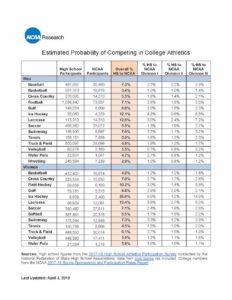
For perspective, we can examine comprehensive data offered by the NCAA Research Committee that examines the probability of high school athletes continuing to play at the Division 1, 2 and 3 levels, across a spectrum of college sports.
The shift in the sports landscape over the past 20 years that has led to the rise of women’s sports, the funding of secondary athletic programs, and the rapid influx of competitive lacrosse and hockey programs means more opportunities for a greater number of high school athletes.
With a simple understanding that an increase in visibility yields an increase in opportunity, it is difficult to dispute the multisport approach to promote attention, access and offers at the next level.
Regardless of gender, there is a glaring combination of high school sports that concisely and continuously yields the greatest exposure to collegiate coaches and, ultimately, provides the most reliable opportunities to progress to the next level.
In 2018, 12.1 percent of men and 25 percent of women continued to play collegiate ice hockey. In parallel, nearly 13 percent of men and more than 12 percent of women advanced their athletic careers in lacrosse.
It does not require a mathematician to see the statistical relationship between ice hockey and lacrosse as they relate to collegiate opportunities. For both men and women, adding lacrosse to hockey or hockey to lacrosse will essentially double their rate of exposure to collegiate athletic programs that are eager, able and willing to make an offer.
The interpretation of this data is less important than the origin of it. The correlation between ice hockey and lacrosse could be as simple as the similar skills required to play each or as complex as the demographic diversity that exists within each.
Nonetheless, the validity of this relationship far supersedes any argument that supports single-sport athletes as the most talented, durable and heavily recruited collegiate athletes. The existence of multisport athletes provides increased exposure, attention and opportunity to high schools, clubs and other organizations that rightfully garners attention toward them.
As in life, two is company and three is a crowd, but one always will be alone.
Joe Caligiuri (MS, ATC) is the owner of Stadium Performance in Dedham, Mass., and has served as athletic trainer for the NHL’s Los Angeles Kings and NFL’s New England Patriots. SP offers Boston’s No. 1 injury-prevention, ACL rehab and speed programming. Check out spstrengthcoach.com.