For the third season in a row, Hockey East has fallen behind the NCHC and Big Ten when it comes to inter-conference records.
The 2013-14 season was the last time Hockey East had the best inter-conference record in college hockey. While league teams such as Providence, UMass Lowell, Northeastern and UMass have enjoyed unprecedented success during parts or all of that stretch, the league as a whole has suffered.
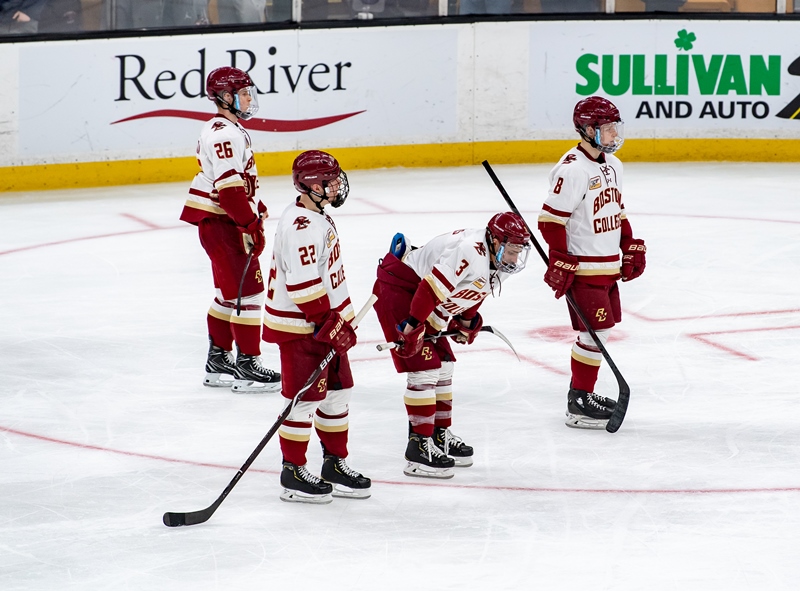
It doesn’t help that the four original powers in the league, Boston College, Boston University, Maine and New Hampshire, have slipped. But the league falling on hard times, both on and off the ice, extends far beyond the four schools that dominated Hockey East for much of the league’s first two decades.
If a Hockey East school fails to win the national championship in April, it will be the longest drought for the league since going from 2001 to 2008.
Maine was the first Hockey East school, in the league era, to win a title when it did so in 1993. Boston University followed it up two years later in 1995 and the Black Bears won again in 1999. Boston College won in 2001, 2008, 2010 and 2012 with the Terriers winning in the middle of all that in 2009. Providence, in 2015, was the last league team to win all the marbles.
The NCHC has clearly become the best conference in the country. While Hockey East has fallen behind the Big Ten in pure statistics, some of that can be chalked up to the large number of home non-conference games played by Big Ten schools.
A lack of resources at some institutions, trouble recruiting, and problems getting exposure on television and in arenas all have been reasons for the league’s overall decline in success.
Institutional Resources and Support
It’s easy to see the benefits of a school and its athletic department prioritizing success on the ice. Providence’s Nate Leaman and UMass Lowell’s Norm Bazin are great coaches, and both have benefited from their respective schools putting money into the programs.
Each program has enjoyed renovations to their rinks and the surrounding infrastructure. UMass Lowell has made great improvements to the fan experience at Tsongas Center and the marketing department at the school has done a terrific job of getting people to fill the seats. Providence renovated its facility, which now includes a shooting room and other amenities that make recruits want to come play for the Friars.
Part of it is the financial support each school has given Leaman and Bazin to keep them on campus instead of possibly leaving for other opportunities. Each coach has deservedly been courted by other schools and rumors of potential jobs in pro hockey have also loomed.
Northeastern associate coach Jerry Keefe has been in the running for other jobs as well, but the school has rewarded him with a contract extension and increased salary.
The financial backing and overall support from each administration is a major reason why the Friars, River Hawks and Huskies are enjoying success that they never experienced previously in the history of any of the three programs.
At the same time, schools such as Maine, New Hampshire and Vermont that have enjoyed more success in the past are struggling as their administrations seemingly do not support the programs the way they used to.
When the Whittemore Center opened in 1995, the new home of UNH hockey was one of the nicest facilities in all of college hockey. The school enjoyed an unprecedented run of success over the next few years that included trips to the Frozen Four in 1998, 1999, 2002 and 2003 along with 15 NCAA Tournament appearances over the course of the next 17 seasons.
While Maine’s Alfond Arena was once the most intimidating road atmosphere in all of college hockey, the school has done little to fix the infrastructure behind the scenes that will help lure in top recruits. Red Gendron has done an admirable job trying to help fundraise, but the administration has not given him nor his staff the same support it once did. Part of that stems from budget troubles at the state level, but it’s another example that financial support is a big key to a winning program.
Recruiting in your backyard
With Notre Dame out of the conference, the league is once again made up of institutions entirely within the six New England states. Recruiting in this region has been made difficult for a myriad of reasons.
The over-saturation of junior and midget hockey in the region has come at the expense of the second-tier players. While New England has still pumped out top 10 NHL picks in recent years such as Jack Eichel and Noah Hanifin, the region’s development model has negatively impacted potential depth players at the collegiate level.
Minnesota has long surpassed Massachusetts as the top state producing college hockey talent. While in Minnesota, players can play for their town teams growing up and throughout high school, players here have to choose between select teams, midget teams, public or Catholic high schools, prep schools, and a low level of junior hockey.
Many of the region’s colleges are not putting as good of a product on the ice because the second- and third-tier players in the region aren’t good enough to provide depth that can compete against the upper echelon of teams in the NCHC.
Look at the recent success of UMass Lowell and UMass as examples. The River Hawks had a great run that included five trips to the NCAA Tournament, a Frozen Four berth, and three Hockey East Tournament titles, all with very little local influence.
This year’s UMass team, the top seed in the upcoming Hockey East Tournament, has only three New Englanders on the roster, the least of any league team. One is a backup goaltender and one is a sixth or seventh defenseman. Only John Leonard (Amherst, Mass.) plays a significant role.
This isn’t the fault of the region’s youth hockey players. The blame lies with the culture that has been created by money-hungry entrepreneurs looking to make huge profits off of youth hockey.
There are a few youth organizations that have done a good job overall, including the Boston Junior Bruins and Boston Advantage. However, there are many organizations in the region that are charging kids and their families up to $10,000 to play with very little chance of playing Division I college hockey.
Division I college hockey isn’t the end all. There are many good schools in Division III and club hockey where a player can earn a good education while playing the game they love. However, playing high school hockey with your friends you grew up with shouldn’t be sacrificed to do so.
Look around Hockey East rosters and you’ll find very few players who played 18-U hockey. It’s not that kids who compete in 18-U are bad hockey players, but doing so serves little purpose when they could instead be playing for their local high school team or being part of a campus community at one of the many terrific prep schools in the region. However, it’s the culture that permeates around New England in which people sniff their noses at playing high school hockey.
Another issue with recruiting in this region is that many of the top players don’t play against each other like in Minnesota. For many reasons, including selfish adults who refuse to come together, many of the top players and teams don’t play against each other during the fall split season. With so many options during the winter, the same is true.
Whereas, in Minnesota, almost every kid plays in the Upper Midwest HS Elite League during the fall before playing for their respective high school teams in the winter.
The downfall of junior hockey in the region has hurt college teams out here in more ways than one. There’s the obvious reason that colleges don’t have as many good players in junior hockey in their backyard. One only has to go back about a decade to find a time when three or four teams in the old EJHL were producing up to a dozen Division I players a year. Now, the entire USPHL NCDC has less than two dozen Division I commits.
A more subtle issue is that as junior hockey here has suffered, the USHL has flourished into the unquestioned best developmental league in the world for college hockey. NCHC and Big Ten coaches can easily drive or take a quick plane ride to watch USHL games while Hockey East assistants have to choose between staying with their teams or missing an entire weekend of games to go out and check in on recruits or potential recruits in the USHL.
Exposure
While Hockey East teams still have regular season home games televised, it’s on the school’s dime. The NCHC and Big Ten have terrific television deals with partners, CBS Sports Network and Big Ten Network. League teams such as Minnesota and North Dakota have virtually every single game broadcast on one channel or another.
In this day and age when kids have access to Twitter, Instagram, and television packages, being seen is a crucial part of getting top recruits into school. In 1999, a kid in Western Canada would only know what he’s being told by coaches recruiting him. Now, the same type of player can rely on social media, the internet and television to find out information.
Unlike the Big Ten and NCHC, no Hockey East quarterfinal game will be on television, as of now.
Hockey East is still a league with many great programs and exceptional coaching staffs all working hard to win games and championships. It’s the outside forces that need to step up to ensure the future is as bright as the past.