
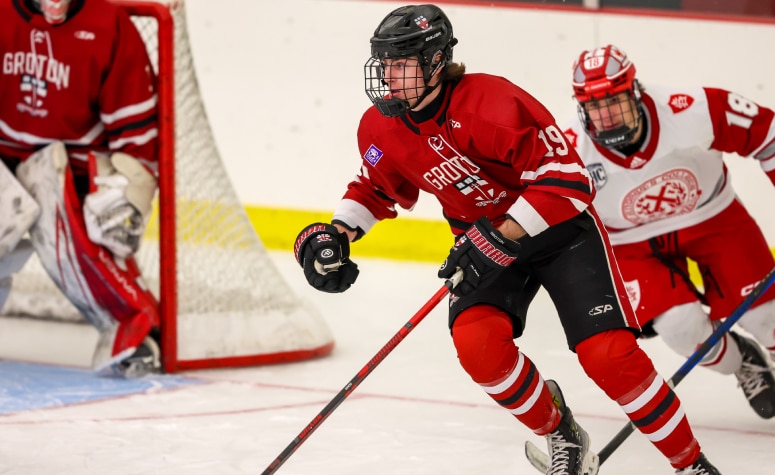

Myles Brosnan scored nine goals and tallied 36 points in 28 games last season. He was by far one of the top defensemen in prep as a sophomore. When the lights were brightest in the Elite 8 Tournament, he notched a goal and five assists in the three games and was consistently one of the best players on the ice. He was a hot topic among NHL scouts.
The thing is, he’s a late 2007 birthday, which means he wasn’t eligible to be drafted until this year.
Brosnan more than proved himself ready to make the jump to juniors. In the 2025 USHL Phase 2 Draft, the Sioux City Muskeeters picked him in the fourth round. He could fit.
He accelerated over the summer to become a senior for the 2025-26 school year. He had a decision to make: To stay in prep school or go to juniors for his draft year.
Brosnan was fortunate: He’s at Dexter. The Harvard commit wanted to finish his education.
“When you have a coach like Danny Donato and a program like Dexter, it’s easy to go back to Dexter,” Bobby Gauthier, Brosnan’s adviser, said. “I think it has made a ton of sense for Myles.”
Dexter has a good recent history with draft prospects. Defenseman Sean Keohane (Milton, Mass.) was drafted by the Buffalo Sabres in 2023, and forward John Farinacci was drafted by the Arizona Coyotes in 2019. Since 2019, Dexter has had seven players make NHL Central Scouting’s final list.
But it’s also no secret that players are increasingly not playing their draft year in prep.
In 2022, there were 12 prep prospects on NHL Central Scouting’s final list. Half were drafted. The number of prep prospects on Central’s list in 2023 plummeted to six. There were seven in 2024, but only one got drafted. And last June, only four were on the list, and two were picked.
There hasn’t been a player selected before the fifth round since 2022.
It begs the question: What is the future of prospects playing their draft year in prep?
To tell this story, we talked with three NHL scouts who were granted anonymity so they could talk freely. We will refer to them as Scout A, Scout B and Scout C when quoting them.
How we got here
The holiday tournaments have always been the main showcase on the New England prep hockey calendar. But it was especially true in 2017.
Thayer had Jay O’Brien, who was a high-ranking NHL Draft prospect. The 5-foot-11, 185-pound center from Hingham, Mass., tore it up at Thayer the year before and was rated high by NHL Central Scouting.
NHL executives wanted to see him. And they did — in droves.
READ MORE: Which New England District players made USA Hockey Select Camps?
One NHL scout, granted anonymity, attended the Watkins Tournament with a senior executive from their organization. O’Brien posted seven goals and two assists in Thayer’s four games at the tournament, leading to the executive declaring he was a first-round pick.
“If you saw him all year, he was a third or fourth rounder,” Scout A said. “He was a good prospect anyway, but he was probably a third-round guy. It just takes one decision-maker to see a kid be really, really good for him to then want to have that kind of bias and want to take him, no matter how good or bad the kid has been. I guess it goes the other way, too.”
O’Brien finished the prep season with an incredible 43 goals and 80 points in 30 games. The Philadelphia Flyers picked him 19th overall in June of 2018.
He played the next year with Providence College and struggled with five points in 25 games. He went to the BCHL with the Penticton Vees and tallied 66 points in 46 games before going to Boston University. In 79 games over three seasons with the Terriers, he had 70 points.
Hip issues forced him into an early retirement.
“If Jay O’Brien hadn’t had injuries, he’d be in the NHL right now,” Matt Keator, his agent, said.
For the 2019 NHL Draft, there were 14 prep players on NHL Central Scouting’s list, which was the most since 2012.
“Short term, I think that people were like, oh, a first-rounder? Prep school still has some kids,” Scout B said, referring to the increase in players on Central Scouting’s list that next year.
As O’Brien was proving to have been taken too high, prep was undergoing another evolution: High-end players were opting to leave for junior hockey before graduation.
That trend kicked into gear in the late 2010s and has only grown this decade.
“It’s going to make prep school younger,” Scout B said. “I think it’s going to make prep school a lot less deep.”
The CHL ruling opened up more options for local players, too. As of November 2024, prospects who play CHL games became eligible to play NCAA Division 1 hockey. Dexter’s Rian Chudzinski (Needham, Mass.) and Cushing’s Tommy Bleyl were two players who jumped from prep after their junior years to the QMJHL. Both would’ve been high-end draft prospects to watch in prep this season.
“Now with all these options, the level of competition isn’t great,” Scout A said. “It can still be a good development path, but you’re seeing now more of it being the younger kids, and then they’re leaving for their draft year.”
With the way things are, scouts want to see draft-eligible players dominate — especially if the high-end players they’re competing against are younger than them.
“If you stay in prep and you’re not dominant or you don’t have a tremendous, translatable skill, it doesn’t matter where you’re playing,” Scout B said.
A common sentiment among scouts is that this has all made prep harder to scout. One NHL scout disagreed.
“I’m not going to say that,” Scout C said. “Sometimes you go to a college or a junior game and not a lot happens, which is difficult to judge. Then you go watch a prep game, and the player that you’re watching has the puck, and you can see him make some plays, and you can judge his hockey sense. Usually has the puck a bit more, so you can judge his skill even better.
“There are things you can judge better, but there are also things like when he goes up a level, playing against stronger, faster players, how’s he going to do? Those are things that you might not be able to see at the prep level, but other things you can see. It’s a little bit of a trade-off.”
And prep players have gone up a level. St. Mark’s forward Will Manchuso (Concord, Mass.), Groton defenseman Kaiden Donia (Townsend, Mass.) and Brosnan — all current draft prospects — have all spent a few games in the USHL during the fall or winter. Manchuso and Brosnan even got some games in with the U.S. National Team Development Program. That gives scouts a glimpse at what they’ll be at higher levels.
Is there a difference in what scouts look for between levels?
“You look for the same things,” Scout C said. “Who can make a play in a tight area? Who wins the puck battle? And you watch for skating, size, puck skills and hockey sense.
“When you’re drafting a player who’s having success at the highest level that he can be at before going into pro, it cuts your risk. When you’re drafting a player who’s playing at a lower level, it increases the risk.”
But maybe, just maybe, it isn’t all about the draft.
BOYS BEST OF NEW ENGLAND: Top 50 ’07s | Top 50 ’08s | Top 50 ’09s | ’10s to watch
A different focus
Everett Baldwin’s stock was rising quickly. It was the summer of 2024, and the Providence College commit had just established himself as one of the top ‘07s at USA Hockey’s Select 17 Camp. The defenseman opened eyes with his incredible speed and skating abilities. He had two goals and three points, and made the Hlinka-Gretzky Cup Camp.
This was right before the CHL ruling, but the USHL’s Cedar Rapids RoughRiders had his rights. Going to Cedar Rapids was an option.
Baldwin instead opted to return to St. George’s for his senior year. He wanted to graduate.
“There are reasons why kids stay,” Pete Donatelli, Baldwin’s adviser, said. “A kid who is 17 and a half and doing really well with a lot of puck touches, do you say that because people want to see him play junior, you automatically put him there for the benefits of viewings? Or do you stay on the path and let the kid develop? I would err on the side of letting the kid develop.”
Last year, Baldwin had 20 points in 22 prep games, but also played in the All-American Prospects Game, spent some time with the NTDP’s U18 squad and played two USHL games with Cedar Rapids.
The Tampa Bay Lightning ended up picking him in the fifth round. He was the highest selection out of prep since 2022.
“My role is to make sure that they’re developing to get to the NHL, not to make viewings easier,” Donatelli said. “And I don’t say that lightly. We try to project out on our end how many seasons does this kid need to play before he becomes a pro? Where they play within those seasons isn’t relevant to me. It’s that they’re developing within that timeframe to become a pro.”
Because many of the high-end players have left prep by their senior year, the draft prospects in prep are often late bloomers and raw projects. It’s why for the last few years, the players taken out of prep have been in the fifth, sixth and seventh rounds.
“They’re much more incomplete,” Scout B said of NHL Draft prospects in prep. “And they are projects. I think that’s why they’re going to trend more towards the later rounds.”
Agents, however, don’t view that as a bad thing.
“You’d rather stay and play your draft year in prep and highlight yourself,” Keator said. “And if you get picked later because you’re a prep school kid, who cares? If you don’t get picked because you’re a prep school kid, who cares? It’s not what you do your draft year; it’s what you do four or five years down the road to earn a contract.”
In 2017, Michael Kesselring opted to stay at New Hampton for his senior year. He tallied 11 goals and 34 points in 38 games, which got him picked in the sixth round by the Edmonton Oilers that June.
He spent the 2018-19 season in the USHL before two seasons at Northeastern. He left Northeastern for the AHL’s Bakersfield Condors in 2021 and didn’t get his first NHL game until 2022-23 with the Arizona Coyotes. Now, he’s an everyday NHLer.
“There’s a progression that can happen,” Keator said. “And he’s a sixth-rounder. It didn’t matter. If he had gone in the third round or the sixth round, it didn’t matter.”
Prep can also help hide flaws during a draft year, as well as allow players to work on those weaknesses in an environment where they can dominate.
“I’ve seen kids make mistakes by leaving too early,” Keator said. “It’s better to be overcooked than undercooked in terms of going to junior hockey or college directly.”
READ MORE: 15 takeaways from NHL Central Scouting’s 2026 final rankings
The future
Seven current prep players made NHL Central Scouting’s preliminary watch list for the draft.
Five of the seven are skaters: Thayer defenseman Brian McFadden, Winchendon forward Charlie Puglisi, Donia, Manchuso and Brosnan.
All five are intriguing for different reasons. McFadden and Donia are both 6-foot-5, right-shot defensemen. Manchuso can fly. Brosnan has proven himself as an elite, offensive defenseman in prep. Puglisi led prep in points (76). They all have their flaws, too.
While Donia was at the NTDP Evaluation Camp for his birth year, McFadden, Manchuso, Brosnan and Puglisi have all begun to bloom a bit later.
“There’s always going to be kids that are later developers, with everything that’s going on, that are going to get drafted,” Donatelli said. “Not everyone is a hotshot at 15 or 16. Somebody is going to develop a little later.”
Ask any scout, and they’ll like one more than the other. That answer will continue to change.
Some scouts feel that because players may have question marks in prep, they’d rather wait to scoop them up later. This impacted Caeden Herrington. The 6-foot-2, 205-pound defenseman was an offensive force with Holderness in 2023-24, finishing with 49 points in 29 games. He went undrafted and responded by potting 16 goals and posting 34 points in 56 games with the USHL’s Lincoln Stars.
The result: the Los Angeles Kings picked him in the fourth round of last June’s draft. It was his second year of draft eligibility.
“I don’t know if teams are going to be super inclined to reach on prep kids anymore in the third or fourth round,” Scout A said. “They’re going to be okay with missing on him like the Caeden Herrington situation. You’re okay not drafting him out of prep. You identify him as a good hockey player, and you’re going to have to spend on him the next year if and when he pops.
“Prep is now going to be an underage start your book on these kids a year before you need to, kind of a thing.”
It’s also no guarantee that players make it to the NHL. That’s where degrees from elite prep schools and colleges matter.
“The biggest thing that a lot of people forget about, too, is there is life after hockey,” Gauthier said. “And the race to the NHL should not always be a race.”
Players and families are also more tuned in to what peers are doing because of social media. It’s never been easier to be jealous of what others are accomplishing. But that goes the other way, too — it’s never been easier to see what didn’t work for someone else.
READ MORE: Ranking the best 2026 NHL Draft prospects in prep
There will always be players who would rather be overcooked.
“Too many players and parents are looking for the external gratification of being a junior player, and they rush it,” Keator said. “They want to just get out there. And the grass isn’t always greener on the other side. That’s important.”