When Warrior Ice Arena opened in September 2016, much of the attention was given to the Boston Bruins and the fact that the Brighton, Mass., facility would be the team’s new state-of-the-art practice home.
One of the main hopes of having the local NHL team based minutes away from the city would be the impact it had on youth/amateur hockey in the area. In order to make that hope a reality, Warrior had to hire the right person to develop and nurture a program that would benefit all levels of amateur hockey.
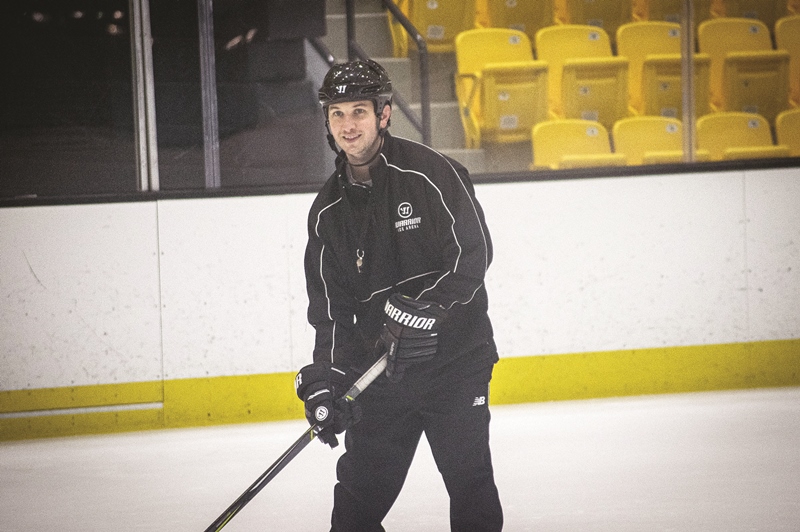
Peter Joyal was tabbed to be Warrior Ice Arena’s hockey director from its inception, and recently I caught up with him to discuss his tenure and the successes and challenges of the job.
Billy Jaffe: How did you get into playing hockey and the business of hockey?
Peter Joyal: I’m from Southboro, Massachusetts. I started playing hockey, like most guys in the area, when I was 4 years old. Grew up locally, playing for town teams in the GBL and the Minuteman Flames, went on to Algonquin Regional High School then Westfield State. As soon as I had graduated from high school, my head coach asked me to coach my summer team for our high school program. So I went back when I was 19 and coached the varsity summer program for our local high school. While I was in college I helped out with the Minuteman Flames in Marlboro (Mass.), I coached the North Stars Selects U-18 Tier 1 team shortly after graduation, and I also coached Wachusett Regional High School’s varsity program.
Jaffe: Which coaches had the biggest influence in your desire to coach and be around the hockey development business?
Joyal: The two for me were John Butler and Mike Roy. John was my youth coach growing up. He’s big in the area. He coached at Marlboro High for probably 20 years or so, now still does some stuff. I try to keep in contact with him every once in a while. Mike was my high school coach — great guy, put trust in me as a player and part of the team. He was a huge part of my development as both a hockey player and young adult.
Jaffe: Where have you seen the greatest growth at Warrior Ice Arena in youth hockey development?
Joyal: When we started, we really focused on the grassroots. We were a new building, so we wanted to develop lifelong Warrior Ice Arena skaters. To do so we focused heavily on the learn-to-skate and Mite programs. As participants moved up levels, we added more and more programs to participate in. For us, we’ve seen growth in the Squirt, PeeWee, Bantam programs because kids are aging out, or they’re having their older brothers and sisters come. I’ve had multiple adults say, “It looks like so much fun what these kids are doing out there. Can you do an adult program for us?” So we’ve started adult learn-to-play programs and skills clinics, adult leagues. For us, we feel that the sky’s the limit. We’ve got a great team in place and there are also a lot of passionate hockey fans in this area. We’re only scratching the surface with what we’ve done. This year, we’ve expanded to specialty camps, with Transitions to Full-Ice camps, for Mites going to Squirt hockey, Intro to Body Contact clinic, an adult shooting clinic and more. We really have something for everyone. Within the game there’s obviously certain skills that people want to develop and focus on. We want them to have an opportunity to work on those things.
Jaffe: What has been the biggest challenge for you here at Warrior Ice Arena as the hockey director?
Joyal: The biggest thing is, there’s only one sheet here. There are a lot of great organizations that we want to work with. Strategically managing our time, in terms of how the ice is used, is something that we focus on. We want to be able to provide an opportunity for all the local kids and families to come out and use the rink, but we’re also trying to have events that bring new people into the building and let them experience Warrior Ice Arena and Boston Landing as a whole, the whole campus and many of the other retailers and companies that are on the street. We hope everybody can come here and enjoy.
Jaffe: What have you taken the most out of working around the Boston Bruins organization?
Joyal: It’s exactly what you expect. As a kid, you go to the rink and you try to get the high-fives, try to get the autographs, and these guys are your idols. Now I’m seeing that with young kids coming here and their jaws are dropping, excitement that can’t be explained, so thrilled to see the guys that they see on TV and look up to and want to be someday. In that aspect it’s awesome to see the impact they have on the community. In terms of getting to work with them and getting to know some of their staff and players a little bit, they just do it right. They care about the right things and they want to win and make the city proud. They’re a pleasure to work with. They’re all great people. It’s been a blast.
Jaffe: What type of participation numbers do you get?
Joyal: Our Saturday program consistently sells out. We split the ice: Half is learn to play, half is learn to skate. Every Saturday we have 70 participants on the ice. That’s the most we feel comfortable with, 35 in each program. On Tuesdays during the meat of the season, we have 70 kids for learn to skate, and on Fridays during our learn-to-play program, we typically average about 35 to 40 players.
Jaffe: Given your location, do you find you’re getting more minorities or different players, perhaps, than you might see at other rinks, trying hockey out for the first time?
Joyal: Yeah. I think part of that is just the growth of the game, too. Everybody’s just getting into it and they want to try it. We have people all over the country, all over the world really, trying it. With the schools that are here, we have a lot of parents who are studying, or teaching, at these schools, and they’re coming from Japan, China, really all over the world. Those are the two countries that we see the majority of our players who are not from the U.S. come from. We’ve had camps this summer where we’ve had people come from Australia, all over the U.S., Canada, Europe. People are hearing about the rink and what we have going on and they’re traveling long distances to be a part of it.
Jaffe: What has been the best part of being the director of hockey and hockey development here at Warrior?
Joyal: The light bulbs clicking. I’ve had some kids, maybe they come to me and they’re 12 years old, never skated before, never been able to play hockey, then they go on to make the ‘A’ team after a year working with me. It takes the right type of player to make that jump, because it’s not necessarily easy to do. But when you work with somebody who is committed and dedicated to what you’re trying to teach them, and they work hard at it, then they accomplish a goal, I think that’s the most rewarding thing.