
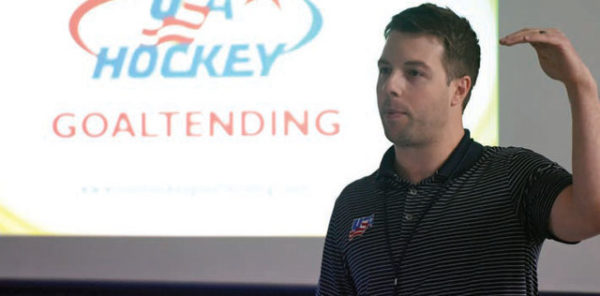

As goaltending manager for USA Hockey’s American Development Model, Phil Osaer is tasked with nurturing this country’s next generation of netminders. It’s a daunting job, but the 37-year-old Osaer, a former collegiate star at Ferris State University and seventh-round draft choice of the St. Louis Blues in 1999, is relishing the challenge.
New England Hockey Journal: In your opinion, what are the biggest challenges today facing youth hockey programs in terms of goaltending, and barriers to entry for the position?
Phil Osaer: I feel the biggest barrier is perception of the position, and all that it involves, including the equipment, financials, coaching and what I consider an "old-school" approach to coaching goalies in practices and games.
NEHJ: How to you define "old-school" coaching, and how does that impact goalie development?
Osaer: I’d define "old-school" goalie coaching as two things: One, coaches not talking with their goalies or engaging in their development, simply because the coach didn’t play the position and hasn’t put in the time to learn to coach it; two, the concept that a high quantity of shots in practice will produce good goalies in games. Both of these will be detrimental to the goalies’ development and the team’s success.
NEHJ: How is USA Hockey addressing each of the above issues? Do those approaches change based on age level and on talent level (town programs vs. elite and development programs)?
Osaer: One way we at USA Hockey addressed a barrier of entry is the development of the Quick Change Pad Concept. Working with Pure Hockey, we developed goalie pads that can fit over a player’s shin pads and can be put on in less than a minute. We feel this will allow more kids to try the position without having to just play goalie in any one practice or game. We also feel, through direct coach education, we will help coaches put their guard down when it comes to coaching their goalies. We launched a nationwide network of goaltending development coordinators who are in charge of getting to every club and association in an effort to educate coaches and demonstrate best practices in goaltender development.
NEHJ: What do you mean by the statement: "Through direct coach education, we will help coaches put their guard down when it comes to coaching their goalies."
Osaer: There’s apprehension among coaches who didn’t play the position to coach goalies at all. Through direct, or thorough, coach education, we can empower all hockey coaches to coach all hockey players. And goalies are hockey players as well.
NEHJ: Apart from the above, can you detail some of the initiatives that USA Hockey is implementing to make the position more attractive, and to make American goalies more successful at every level?
Osaer: We have also updated our materials that are part of the coaches’ education online modules, while expanding our reach by appointing associate coaches-in-chief in charge of goaltending who will be overseeing and presenting a consistent goaltending coach education program within each (USA Hockey) district. We’re also running two goaltending development camps this summer that are targeted for 2002 boys and 2003 girls, where the goalies get to invite their coach, in order to create season-long consistency. These camps are designed to address holistic goaltending development. We also run monthly webinars aimed at improving goaltending development. All of these new initiatives are in addition to the Warren Strelow National Goaltending Development Camp, which has just completed its 10th year with numerous NHL, college, and U.S. national team goalies among the alumni list.
NEHJ: In a sentence or two, how would you define "holistic" goaltending development?
Osaer: Holistic goaltending development features all the fundamentals, plus player recognition, off-ice athletic development, and the mental, or cognitive, development of goaltending. We also include a parent education portion to make sure they can do their part to help develop their goaltenders. Hockey’s an all-encompassing sport, and we’re trying to give goalies and their parents all the tools they need.
NEHJ: Goalie coaches are always borrowing ideas from different coaches from around the world. What has USA Hockey "borrowed" from other countries and implemented into its goaltending curriculum?
Osaer: We are continuously studying what other federations are doing to develop their goaltenders, and we try to immediately implement aspects that we believe will help our cause. With everything we do, we strive to be world leading, so as we borrow, we always try to improve. And once we think something is good, we try to make it great.
NEHJ: Last year, you spoke about the goals of USA Hockey in terms of goaltending. Can you give us an update of those goals, in terms of youth hockey, juniors, college and the professional ranks?
Osaer: We have a goal that 51 percent of the minutes played in the NHL will be played by Americans by 2030, as well as 76 percent of women’s NCAA Division 1 minutes played, to be played by Americans. We have implemented rules in the junior ranks to make it more appealing for teams to have American goalies on their rosters as well as serve as advocates for our goaltenders to be given every opportunity possible to prove themselves.
NEHJ: Given the emphasis on size these days, what do you recommend to coaches and parents who have "undersized" goalies?
Osaer: Skating and positioning are two of the most crucial aspects of a goaltender’s game. This is heightened by goalies who are perceived as undersized. I recommend goalies and their parents focus on what they can control, and let the non-controllable factors take care of themselves. Watching Karl Goehring of North Dakota (5-foot-7; 2000) and Jeff Lerg of Michigan State (5-6; 2008) win NCAA championships and countless others defy odds should give all goaltenders the belief that with hard work, they can achieve anything.