
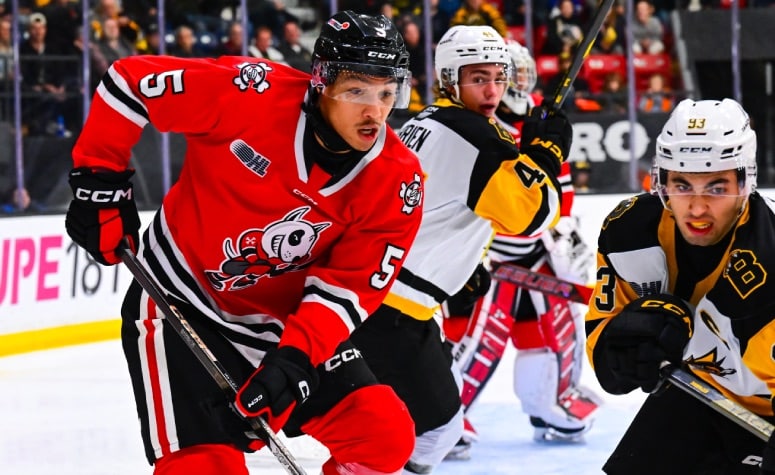

The college hockey landscape is constantly evolving on a week-to-week, season-to-season basis. That’s never been truer than it is right now.
“If you don’t like a rule, just wait a little bit. There will be a new one a couple of days later,” Sacred Heart associate head coach Scott McDougall (Mansfield, Mass.) said.
For McDougall and other college coaches around the nation, the changes seem to be rolling on a day-to-day basis lately.
In the wake of impacts from the transfer portal in recent years and the rise of NIL, last November’s CHL ruling has flipped college hockey on its head.
Take Bemidji State, for example, as the Beavers recently added two players with professional experience in either the AHL or ECHL to their roster after clearing them through the NCAA Eligibility Center.
“It’s hard to have a strategy when the goalposts keep moving on you,” McDougall said.
The recruiting arms race has only intensified, whether it’s Penn State landing top 2026 NHL Draft prospect Gavin McKenna out of the OHL, Boston University committing WHL standout and Minnesota Wild prospect Ryder Ritchie, Michigan State nabbing Porter Martone — the sixth overall pick to the Philadelphia Flyers this past June — or Providence landing WHL standout Roger McQueen — the 10th overall pick to the Anaheim.
“I think the initial shock freaked out a lot of people, but at the end of the day, I still think the blue bloods are going to get their pick of the litter, as they always do,” one Atlantic Hockey assistant coach, who wished to speak anonymously, said. “Then, there’s that second tier of teams, and then there’s always everybody else that’s just battling it out, just trying to sell their programs. I think the talent that we’re going to be able to get is better than it used to be, just because more players are playing in high-level leagues, and I think that’s a good thing for us.”
So far, more than 240 CHL players have committed to play Division 1 college hockey. As the pool of talent to recruit from has increased, so have the challenges that college coaches face, especially at smaller programs like those in AHA.
READ MORE: Did the CHL ruling have an impact on Aug. 1 commitments?
“Now, we’re trying to tackle the CHL, and it’s (61) teams and (61) different relationships, and that’s hard,” McDougall said. “You’re trying to build these relationships, and sometimes there’s some language barriers and certainly some misunderstandings on their end of who’s what.
“At Sacred Heart, we want to work with them and recruit their 20-year-olds, but there are some big-time schools that are walking away with the potential No. 1 picks in the draft (McKenna).”
The Pioneers already have dipped their toes into the CHL waters, bringing in three skaters with major-junior experience for the 2025-26 season between Noah Van Vliet (Niagara Ice Dogs, OHL), Gavin Bryant (Peterborough Petes, OHL) and Stephane Huard, who played in the QMJHL before playing USports at McGill University in Montreal.
They’re part of a crop of more than 20 CHL players who’ve committed to AHA programs for 2025-26 and beyond.
The new rules mean more teams and players to see and longer trips, especially since the CHL leagues don’t hold showcases with every team in one place, like the USHL, BCHL or NAHL currently do.
With more ground to cover, college coaches need to be more intentional than ever with their time on the road. One of the biggest changes is where they’re going to look at players now, in addition to the pre-existing circuit.
“We’re not the kind of school that can avoid any lead, right?” the anonymous assistant said. “We have to find good players everywhere. If that means we’re going to watch a random NCDC game because we got a hint on a guy, we’re still going to go. We’re not too good for anyone. But I think looking at who a third- or fourth-liner on a WHL team is playing against, they might be more equipped for college. It’s just a way deeper pool. We basically tripled the number of players who are Division 1 caliber and can come in and be good players for us. That’s certainly a good thing.”
'THE REAL WORK STARTS': What comes next after committing to play college hockey?
The talent level might rise with the deeper pool, but as one coach already said, the blue bloods will still come away with the top prospects. McDougall said, “Listen, do I think it makes teams better? Yes. Do I think it’s closed the gap between the haves and the have-nots? I don’t. I think the haves have gotten even better in this scenario. Our teams will be better, but the very top teams are very, very good.”
Of the 10 AHA programs, four — Holy Cross, Mercyhurst, Army and Air Force — opted out of the House v. NCAA revenue-sharing settlement. Programs that opted in, like Sacred Heart, face challenges of smaller roster sizes, dropping from 30 spots to 26.
“Everyone’s been making recruiting plans for 30-person rosters under the old way, and now that teams are opting in, you have smaller roster sizes with a much bigger pool, which goes against the plans you were using before,” McDougall said. “So it makes for fewer spots for some really good players.”
It’s a difficult paradox to solve as programs must continue to grow their recruiting into major-junior hockey while planning for fewer roster spots than initially anticipated if they’ve opted into the House settlement.
Aside from the CHL, two areas Atlantic programs can continue to expand, in particular, are with potential transfers and decommitments. As important as it is to establish themselves with CHL prospects, it’s also key to keep the long game in mind with all recruits.
“For us more so than others, if a kid chooses another school over us, it can never be a closed-off relationship,” the anonymous assistant said. “We always end it on a positive note and leave it open. At the end of the day, it does come around more times than not because it’s getting harder and harder now.”
McDougall said, “Just because someone’s committing somewhere, especially in this day and age, doesn’t mean they’re going to necessarily get to that place. It’s about continuing to evaluate those players and doing a good job in the initial recruiting process, so if they do not get to where they want, we’re at the top of their list the second time around.”
FULL MAGAZINE: Check out the September/October edition of the New England Hockey Journal magazine
Sacred Heart has had success in the portal with players like defenseman Mikey Adamson (Quincy, Mass.) and forward Felix Trudeau. Both players broke out with SHU after struggling to find a footing at their previous schools.
The Pioneers plan to continue to be aggressive in the transfer portal.
“It’s an area we’re strong in because we have a great facility here, and we believe we can be toward the top of our league each season, compete to win and get to the tournament through our league,” McDougall said. “We think we’re a destination for a player who went to a ‘bigger school’ the first time through and didn’t get that opportunity they may have been looking for, but know they’re a really good player, can break out here and put themselves in a position for a better pro career.”
Other Atlantic programs are hoping for similar success as the Pioneers have had with recent transfers.
“If people feel good about how you make them feel, they’re going to want to be around you,” the anonymous assistant said. “That’s what we try to do.” Locally, there’s an opportunity for Atlantic programs to tap into a market of high-end prep players that bigger programs might prefer to wait-and-see on. Sacred Heart, for example, has a chance to be aggressive with good young players around New England.
“We’ve always been about recruiting the best players from our neck of the woods,” McDougall said. “Having good, local New England, Long Island and New Jersey kids as part of our program will always be at the forefront of our recruiting.”
Small programs know they can’t cut corners, especially in the current landscape. Whether they’re recruiting high-end NHL Draft prospects in the CHL, players in the BCHL or top local talent, the pitch remains the same.
READ MORE: How NIL and revenue sharing are shaping the future of college hockey recruiting
It hasn’t changed in Atlantic Hockey, where coaches want recruits to feel wanted. Players want to go where they’re comfortable and feel they have a chance to get better.
“We don't have an NHL-caliber arena like some of these other schools, but the thing we offer is you’re going to be somewhere where you’re valued,” the anonymous assistant said. “We’re going to work to develop you to get to the NHL. Just because you’re not playing with the flashy lights doesn’t mean you can’t get to that next level. If you play well and you do well, someone’s going to watch you. … I think once kids start to realize, too, that not everyone goes to a blue blood, I think it’ll open even more for us.”