
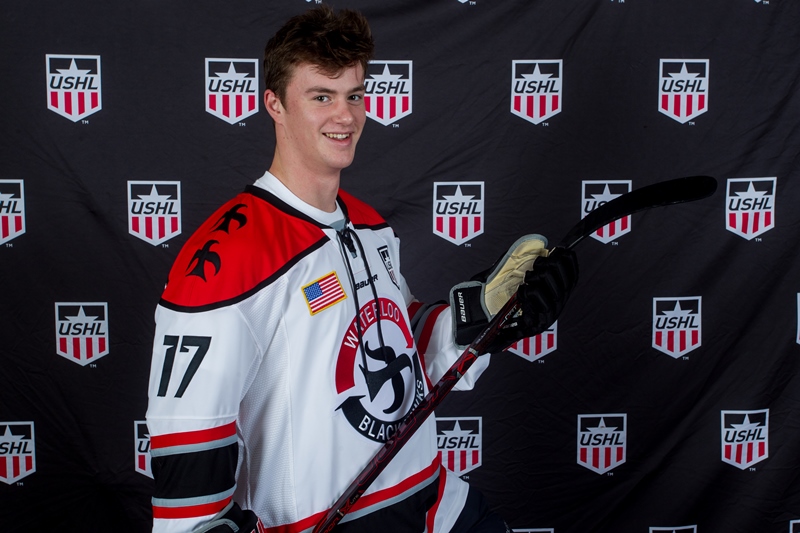

Kyle Haskins knew the United States Hockey League featured fast-paced games. What the forward didn’t know was that they were going to be “this fast,” with the emphasis on “this.”
“It was a totally different game from 18U,” said the Huntington, Vt., native, who after three seasons at Selects Academy totaled 25 points (12-13—25) in 58 regular-season games and three points (2-1—3) in four Clark Cup playoff contests this past season with the Waterloo Black Hawks. “You can go from dominating 18U to not doing as well in the USHL. It clearly showed.”
It took Haskins some time to adjust – about half a season -- but by campaign’s end the 5-11, 192-pounder had finally adapted to the up-tempo style of play.
“You just have to stay with it,” he stated. “Nothing comes easy.”
Especially in Haskins’ case.
When the prior season in 2017-18 started, he was among the prospects named to National Hockey League Central Scouting’s Preliminary Players to Watch list for the 2018 NHL draft. However, it was as high as he would be slotted. He missed the cut when the department released its midterm and final rankings for the event, and then he went undrafted.
“It affects me a little bit because you want to be on the list and you want to be drafted,” Haskins, 19, lamented. “I felt I had a great year at Selects and had a good chance of making it happen. But I knew it was going to be hard for me to get drafted right out of prep school without playing in the USHL. It didn’t hurt me too bad, but motivationally wise, I definitely trained harder in the summer and tried to get better. I feel that I still have a good mindset, and I know that I have to be better. It can still happen. Nothing is over yet. It’s not the end of the world.”
Although Haskins yearned to take his game to a higher tier with Waterloo, he was aware of the fact that he was going to be suiting up in the USHL for the first time. And because of his inexperience, he was going to begin at the bottom of the lineup and have to climb his way to the top.
“I knew I wasn’t going to be a top guy, but I wanted to show the coaches that I can do more than they think and contribute,” the left-handed shooter remembered. “By the end of the year, I wanted to get some power play and penalty kill time, and I was going to do whatever I could because nothing comes easy. You really have to work for it.”
So, off to the rink he went to toil, with his initial task being to find a way to get up to USHL speed so he could be a boon for his club.
“My toughest challenge was feeling comfortable on the ice to the point where I could play as well as I knew I could and score goals and be a contributor,” Haskins said.
He overcame this obstacle by “sticking with it.” What also helped was listening to the words of wisdom spoken to him by Black Hawks head coach and general manager PK O’Handley.
“He was always telling me to get my feet going and be fast,” Haskins said. “Once I started moving my feet and getting to places faster, it definitely helped me improve my game and score some goals.”
In fact, Haskins feels his speed was one of the two components of his game which improved the most from the start of the season to the end, with the other being his defensive zone play.
“My first weekend was not great,” he recalled. “It was definitely a challenge for me. But once I figured that out, I started being a plus instead of a minus, and everything else took care of itself.”
Haskins credits his teammates, roommates and coaches for helping him get through that early rough patch, and he began to feel like himself at the rink around Christmas.
“You’re going to go through struggles, but if you’re positive and have the right mindset you can overcome anything,” Haskins said. “You can’t let struggles get the best of you. If you’re determined and demand more of yourself, it’ll come. You just have to be patient. My coaches kept telling me to stick with it and not give up on myself. My roommates – (forward) Connor Caponi, (defenseman) James Marooney and, for a little while, (forward) Solag Bakich – were great and good people to talk to. They were successful and I played with (Caponi at the 2017 Ivan Hlinka Memorial Cup) so he knew what I could do and that if I just stuck with it everything was going to be all right. And they were right.”
While Haskins had to battle to attain a level of comfort on the ice, one aspect of life he didn’t struggle with was being far from home.
“It wasn’t completely different because I went to prep school the last three years,” he explained. “It wasn’t hard adjusting to living here because there were guys here who had been through the process before. And my billet mom was great; she took care of us and when we were feeling homesick, she knew how to make us feel better.”
Unfortunately for Haskins and his fellow Black Hawks, the good times didn’t last long once the playoffs commenced, as they were eliminated in the Western Conference semifinals by the Sioux Falls Stampede.
“We had a really good team,” he said. “We had some really offensive and high-skilled guys, and we all were very tight in the locker room. We definitely wanted a better ending. We had a team that could win it. It’s unfortunate how it ended.”
The early exit, combined with a desire to keep developing his own game, means Haskins will be super motivated again this summer to make sure next season starts better for him and ends with a different result for Waterloo.
To accomplish these goals, Haskins will be working with a skills coach, Brett Leonard, who was a forward at the University of Vermont and runs the Vermont Hockey Training Center. They worked together for the first time last summer.
“We are going to be working on my skating and improving on the ice,” Haskins said. “He knows that skating and being good on your edges is crucial at the next level. We work on that for 45 minutes a day.”
Haskins, who’s committed to playing for Michigan State University starting with the 2020-21 campaign, also wants to “get more involved in the gym.”
Concluded Haskins: “I want to come back stronger than ever.”