
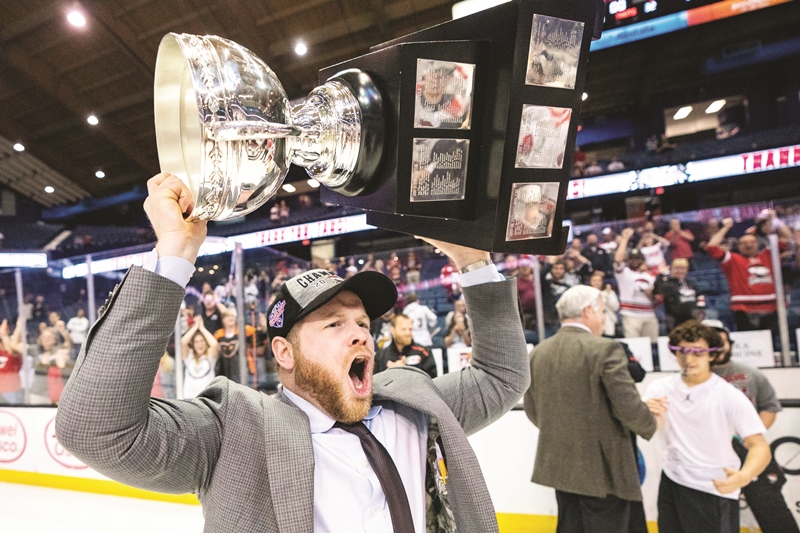

Ryan Warsofsky’s ascent up the hockey coaching ranks continued this offseason when, after helping guide the Charlotte Checkers to the 2019 Calder Cup championship in his first season as their assistant coach, he was named the club’s head coach.
Warsofsky, 31 years old and a native of North Marshfield, Mass., is the youngest coach hired in the American Hockey League since 2000.
And none of this would’ve happened had he listened to a two-time Stanley Cup-winning bench boss when he was younger.
“A good family friend of ours is Mike Sullivan,” Warsofsky said of the Pittsburgh Penguins head coach, who led them to back-to-back championships in 2016 and 2017 after serving as a player development coach for the 2015 Stanley Cup-winning Chicago Blackhawks. “His parents (George and Myrna) are my godparents. When he was coaching the AHL Providence Bruins and when he was the head coach of the Boston Bruins, I went to games. That’s when I realized I wanted to be a coach. I knew I wanted to do it. But Mike tried talking me out of it.”
Sullivan, a native of Marshfield, Mass., spoke to Warsofsky about the stresses of the gig, especially how losses and the day-to-day worries wear on a coach.
“When Mike was let go in Boston, you could tell it took a toll on him,” Warsofsky remembered.
But Sullivan stuck with it and is now someone whom Warsofsky considers “the best coach in the National Hockey League.”
“I try to learn from him every time I talk to him,” Warsofsky said. “I’ve looked up to him since I was 2 years old when he was at Boston University playing in the Beanpot in 1990. He knows what it means to be a coach, and he shows a lot of passion. He’s a really good communicator. When he speaks, he brightens up and controls the room. He’s got good conviction with his words. He gets his point across to this new generation. And he cares about his players. When he was in Boston with Joe Thornton and Sergei Samsonov and those young guys, he never spoke a bad thing about them to the media. Everything was behind closed doors. He kept it as a team, a tight team. He didn’t want negative attitudes or negative words creeping into the locker room through a different channel of information. That was one thing he really taught me — what happens in that room stays in that room.”
Warsofsky also watches coaches from other sports, such as Bill Belichick (New England Patriots), Sean McVay (Los Angeles Rams), Doc Rivers (Los Angeles Clippers, formerly with the Boston Celtics) and Dabo Swinney (Clemson University football), in an effort to keep gaining knowledge about his craft.
“You can always get better as a coach,” he stated.
A self-described “student of the game” when he skated as a defenseman, Warsofsky learned many lessons from his coaches, starting from when he played at Marshfield High School for Dan Connolly. “I was the captain for two years, and he let me lead, let me make mistakes, and also helped guide me,” Warsofsky said. “He didn’t micromanage me as a leader and as a player; he let me learn and grow. That was a huge part of my growing process as a teenager.”
After his time at Marshfield, Warsofsky played two seasons at Cushing Academy, where he learned from head coach Steve Jacobs, assistant coach William Troy and assistant coach and Hockey Hall of Fame blueliner Ray Bourque.
“They were instrumental in my career, not just playing but also coaching,” he asserted. “I still have a relationship with all three of them.”
Warsofsky added that Bourque remains a major influence on him to this day.
“Ray has been a huge part of my career,” he said. “I’m close friends with his sons, Chris and Ryan. It’s helped a lot when Ray and I talk about what makes certain players be great, and how you have to bring it every single day.”
Warsofsky continued his playing career at Sacred Heart and Curry College, where he was coached by Shaun Hannah and C.J. Marottolo (North Haven, Conn.) at the former, and Rob Davies at the latter.
“Shaun and C.J. were very different guys,” Warsofsky recalled. “I definitely learned things from Shaun; some things I liked and some things I didn’t like. He was hard on his players but wanted to see us succeed on the ice. I liked the energy C.J. brought every day. It’s important to have energy every time you come to the rink, and he taught me that. And Rob was a very smart coach who really cared about his players, and you could sense it. Hockey was his life. He gave me a chance to come in there and be a leader, be a go-to guy. He tried to help me along, and there were times when I didn’t agree with him — he’ll be the first to say that. There was some tough love at times. But I learned from that and learned how to approach my players when I eventually started coaching.”
After college, Warsofsky played professionally for one season before trading in his jersey for a suit and a spot behind the bench at Curry, where he was an assistant under T.J. Manastersky during the 2012-13 campaign.
“I’m very thankful for T.J.,” Warsofsky said. “He gave me a chance to get my foot in the door with coaching at Curry. He’s a smart coach, very well-prepared.”
Following that season, Warsofsky returned to the pro game, joining Spencer Carbery’s staff as the assistant coach of the ECHL South Carolina Stingrays. He held that post for three seasons before becoming the team’s head coach and director of hockey operations for two years.
“ ‘Carbs’ has a bright future and is going to be an NHL coach, for sure,” said Warsofsky, who helped lead the Stingrays to the Kelly Cup finals in his second season as assistant coach and first season as bench boss. “He brought a lot of energy and was very passionate and very smart. He gets his point across very well. He’s very detailed. He doesn’t leave any stone unturned and is going to look at every way he can make adjustments. He’s really good at getting guys motivated to play the right way with great structure and conviction. I’m super-grateful for him and (president/alternate governor) Rob Concannon; they gave me a chance to go down there and start my pro coaching career.”
Warsofsky took the next step as a coach before this past season when he joined Charlotte, where he was quickly taken under coach Mike Vellucci’s wing to learn the AHL way.
“As you go up, the players are a little bit different,” Warsofsky noted. “You’re dealing with first-round picks and guys who might be making a lot of money after being sent down and clearing waivers. Mike taught me how to handle those types of players. He cares about his players and is a motivator. We are very similar in that we have great detail in our habits and what we want to teach. We like to get the most out of our players, but we try not to overcomplicate the game and overcoach. That happens quite a bit when you look around. Everyone is doing similar things as far as structure — there’s no secret — but I learned from Mike how you get your guys to challenge themselves and bring them up another level and how to handle players and different personalities at the AHL level.”
Some of the more special experiences Warsofsky has had since he started coaching have been the wins and the long playoff runs, including last season’s championship. Other memorable moments include the smaller triumphs, such as making in-game adjustments that lead to victories.
Most rewarding, though, is seeing guys advance to the next level, for good.
“When you’re in the ECHL or the AHL and you see a guy get called up and not come back is what this is all about — developing these players for the next level, challenging them, and having them believe in themselves so they can play at that next level,” Warsofsky said. “Also rewarding is when you see a guy who’s struggling and you guide him and teach him about what it takes to play at that next level and stay at that next level, and then it happens.”
As Sullivan expressed when he unsuccessfully tried to deter Warsofsky from running a bench, there are challenging moments that come along with the job.
“There are times when you have to trade a player or release a guy,” Warsofsky explained. “Those are hard conversations because I really care about my guys. I’ll do anything for them, and I know that’s not the norm sometimes. But you feel for a guy when you have to let him go, no matter what the situation is, or when you have to make a decision that’s best for the team, such as having to trade someone or bench a player who’s struggling. You have to really break it down because, yeah, you want to win, but there are guys who need to do well and need to have good numbers so they can get their next job or their next opportunity. You have to break things down to some guys and have them understand. Maybe it’s a 20-year-old kid who doesn’t understand certain aspects of his game to make it to the next level and you have to break it down to get him to believe in those situations.”
What stands out most about Warsofsky is his affection for his players and his desire to make the rink an enjoyable place to work. Those traits will remain at the forefront when he begins his quest to capture another Calder Cup this fall.
Concluded Warsofsky: “I care about them, their families and what’s going on at home, because what goes on at home usually comes back to the rink. You have to make sure everyone is in a good spot mentally, so they can come to the rink and do their jobs. I also want to challenge them to be better than what they might be. If you had seasons where you had 30 points, why can’t we stretch that to 40 points? I want to push them, and it’s going to get uncomfortable at times, but getting uncomfortable and going through some adversity along the way usually leads to success. At the end of the day, whether you go on and play in the NHL or you go back and become a financial broker, you can relate to the things that you went through to make you a better person.
“You also have to enjoy coming to the rink. That’s one thing Bourque taught me when I was at Cushing. If you have a day that you are coming to the rink and you don’t want to go, it’s time to hang the skates up and find something else to do. We are going to make sure these guys care about coming to the rink, play together and stay positive.”