
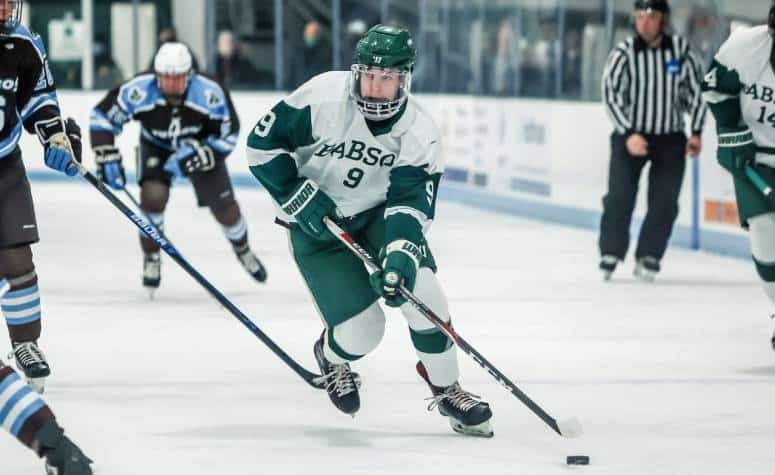

It is not often that you see a college player make the jump from Division 3 to Division 1, but Ryan Black is ready to do just that from Babson to the University of New Hampshire.
Black, coming off of his fourth and best season with the Beavers, will swap the green for blue as he heads to Durham for one final collegiate campaign. The 23-year-old earned a share of the 21st annual Joe Concannon Award as the top American-born Division 2/3 college player. Black, who tallied 19 goals and 39 points, was named co-winner of the honor with Endicott goaltender Conor O’Brien.
However, that recognition really was just the beginning for the Pomfret, Conn., native, who announced April 11 that he was taking advantage of the extra year of NCAA eligibility caused by the COVID-19 pandemic, and will compete at a higher level.
“It was in the back of my mind that I would try to exercise the option and just see after the season if there was any opportunity to play Division 1,” Black told New England Hockey Journal. “I know (UNH) coach (Mike) Souza (Wakefield, Mass.) and (Babson) coach (Jamie) Rice (Newton, Mass.) have a good relationship, and I know that they had talked a bit about me before (COVID) even happened.”
Black’s path from the Nutmeg State to the Granite State is a winding one, but an important lesson for other aspiring players who might feel overlooked or underappreciated.
“When I was in high school, I was a late bloomer,” he said. “Freshman year I was younger, smaller, didn’t really grow until later, so I went to Woodstock Academy, which is Division 3 public high school hockey. I just played with my friends, played in town, so for me, playing college hockey seemed like a long shot.”
The 6-foot-1, 180-pound, 23-year-old left wing’s rise while toiling in relative obscurity at the Division 3 high school level in his home state might be an improbable one, but Black was not a completely unknown commodity when he started on a path to Babson.
Black was the first in his family to take to the sport. He was followed by younger brother Jake, who just scored 41 goals for the NAHL’s Johnstown Tomahawks and committed to UConn. Black credited parents Paul and Sue for the kind of essential support that allowed both boys to grow and develop in the sport, with Paul Black installing backyard rinks despite not having a hockey background.
“We never actually played together on the same team and I never played against him either,” Black said of the three-year age gap between the brothers. “I’m his biggest fan, and it will definitely be fun just to get the chance to play him.”
However, Black’s path from family hockey pioneer to college captain and MVP was anything but assured.
More than a decade earlier, he played for the Worcester Crusaders minor program under head coach John Herlihy, a New York Islanders 10th-round selection in 1987 out of Babson. Herlihy didn’t go on to have a pro career, but in his native Worcester he remained connected to the game, and maintained connections with his old Beavers linemate and good friend, Rice.
“I said, ‘We’ll go check him out,’ ” Rice said when Herlihy mentioned Black to him years later. “That was a huge lead and the start of getting him to Babson. Coming in, I didn’t know that he’d be the player of the year in our league, but it became evident right away that we had someone special once Ryan got here.”
Black also played minor hockey for the Providence Capitals with future NHLers Mike Hardman (Hanover, Mass.) and Marc McLaughlin (North Billerica, Mass.) before dominating high school play at Woodstock Academy. His 88 points in 23 senior games earned him the chance to play a postgraduate season at Winchendon in 2017-18.
Even with his 63 points in 28 games, Black said he didn’t have a lot of interest from Division 1 schools. Rice, however, saw the potential even before Winchendon, and committed Black to Babson in the middle of his postgraduate year.
“I always wanted to go to just as good an academic school as a hockey school,” Black said. “Even in my year at Winchendon when I was putting up big numbers, I didn’t get much interest from college coaches. As the year went on, I had spoken with coach Rice and coach (Jon) Coleman at Babson, and that was always something that stuck out that fit academically. So, when coach Rice offered, it was pretty much a no-brainer. It was at the top of my list.”
After taking his game to the next level in the second half of his prep season, Black could have pursued an opportunity in the USHL with the Tri-City Storm after his standout prep season and then another strong showing at the 2018 USA Hockey Nationals in Philadelphia with the Eastern Mass. Senators. Instead, he stayed true to Babson and went in at age 19, feeling he was ready to contribute right away.
He did exactly that, scoring 25 points in 27 games, then leading the team in scoring in each of the rest of his years at Babson. With his size, skating and natural scoring instincts, Black is the kind of player whose consistent production at every level looks like a solid bet to translate with the Wildcats.
“Coming in as a freshman, you want to do anything you can to get into the lineup and play,” he said. “Over the years, I think I learned more about how to be a complete hockey player defensively. Being harder, being smarter and playing in the smarter areas by putting myself in better situations, which coach Rice focused on a lot at practice.”
The attributes go well beyond the natural playmaking, though. Named a captain this past season, Black is humble off the ice but a fierce competitor on it. His drive translates beyond hockey and to everything he does. The physical package, smarts and effort should add up to one of the Hockey East’s inspirational stories to watch next season.
“I give all the credit in the world to Ryan for what he’s done, and how he’s gone about it,” Rice said. “You put those pieces together, and you wind up with a great opportunity. Now, go make the most of it.”
After making such a positive impact at Babson, including earning NEHC tournament MVP honors in leading the Beavers over Skidmore this spring, Black finished as one of the most impactful forwards in program history. Rice compared his senior’s career to that of Tom Sasso (Malden, Mass.), the school’s all-time leading scorer and All-American from 1984-88.
Playing hockey at UNH would not have been possible without the NCAA granting Black and so many others like him another year of college hockey. Without that dispensation, he would have graduated from Babson with a business administration degree (concentration in finance) and faced an uncertain future in pro hockey. Now, he gets one more chance to prove he can play at the next levels.
Based on what he’s done his entire life, don’t count him out.
“Everyone has a different journey and not many people would expect a Division 3 high school hockey player to make it to Division 1 in college,” Black said. “But I think that just trying to be the best and work my hardest is my number one characteristic and it’s what has gotten me to this point.”