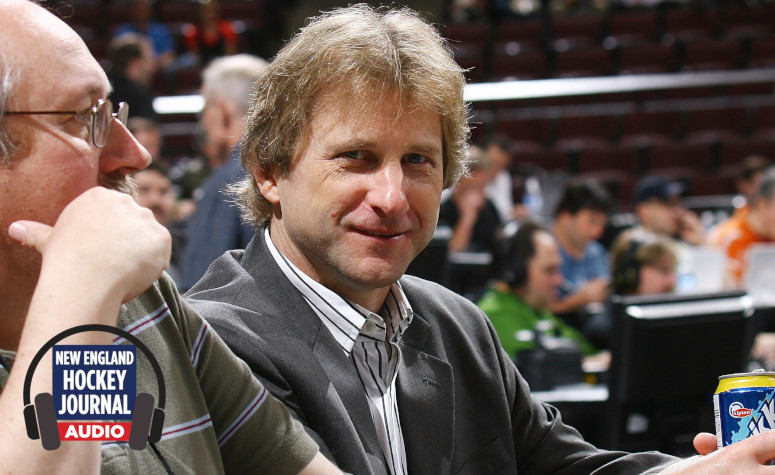
When it comes to scouting, Kyle Woodlief is one of the most knowledgeable individuals in the space.
As the publisher and chief scout of Red Line Report, an independent scouting service that has become an industry standard for NHL teams to help their own scouting process, Woodlief has been evaluating talent and covering the draft for over 20 years.
Prior to starting the publication in 1999, Woodlief, a Plattsburgh State alum who is based in Lake Placid, N.Y., was a scout in the Nashville Predators organization.
With his expert knowledge on the topic, Woodlief joins Kirk Luedeke on the latest episode of New England Hockey Journal’s “RinkWise” podcast to share insights into the scouting world, how the landscape has changed over the years, attributes that he and other scouts look for in players, and more.
Woodlief shares his thoughts on the World Junior Championship cancellation, as well as opinions on the top draft-eligible players -- both globally and here in New England, including Northeastern true freshman Jack Hughes (Westwood, Mass.) -- for the NHL drafts in 2022 and 2023.
Scouting (and the idea of what makes an enticing pro) has changed quite a bit over the years, Woodlief said.
In his time in Nashville, a period that he referred to as “kind of an unfortunate era of hockey,” the general consensus was that size was the most important factor in evaluating a players’ worth.
However, that wasn’t exactly the case.
“I think we (the scouting community) were making mistakes then," Woodlief said. "Teams were just looking for bigger guys that could physically dominate, but they didn’t really understand the game and how to play away from the puck."
Those tendencies that top draft picks were lacking quickly became the focus of his -- and eventually Red Line Report's -- scouting tactics.
“If you’re a forward and you’re playing 19-20 minutes a game, unless you’re a Gretzky or a Lemieux, you don’t have the puck on your stick for more than 60-80 seconds in the course of a game, so most of your playing is done without the puck on your stick," he said.
“You’ve got to understand the game well enough to know what areas to get to; when to get there, how to anticipate what plays are going to be developing."
Going off the beaten path and away from the scouting status quo ruffled some feathers at the start, Woodlief said, but that didn’t deter him and his crew from sticking to their guns.
"We took a lot of heat early on from NHL teams because we would rank smaller players in the first round that we knew weren’t going to be drafted in the first round, but we felt they were going to have good long NHL careers,” Woodlief said. "Danny Briere is an early example of that; there’s so many of them.”
Eventually, front offices began to come around on the idea that size wasn't the end-all-be-all in determining a players' potential path.
Now, 20 years later, it’s the norm.
“It's now a skating and skills game," Woodlief said. "If you have the size to go along with it, great. But there’s an awful lot of 5-10/180 defensemen out there now. When I first got into the sport in the scouting aspect of it, if you were a defenseman (of that size), teams weren’t even looking at you. That’s one of the biggest things that’s changed over the years.”
For more from Kyle Woodlief on scouting, players to focus on in the drafts ahead, and more, listen to the full episode of NEHJ’s “RinkWise” podcast today.
The podcast, which typically drops Friday mornings, can be streamed on all major platforms, including Apple Podcasts and Spotify, or online at hockeyjournal.com/podcast.
"RinkWise" is brought to you by Paul Vincent Hockey, Laura Stamm Power Skating, Sacred Heart University and University of Nebraska High School.