
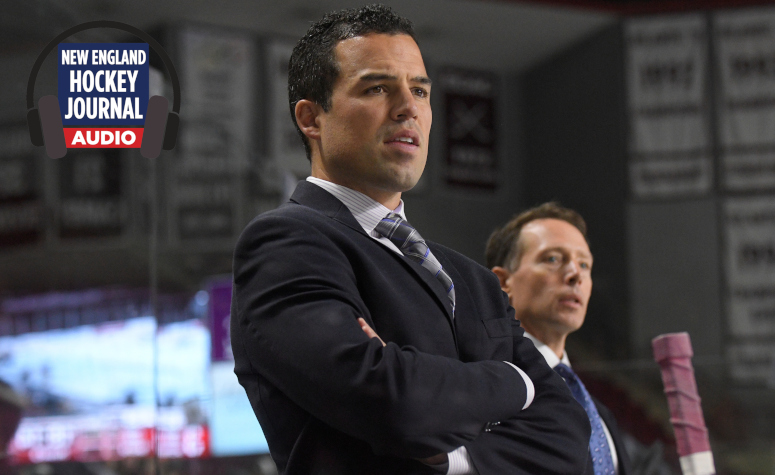

On the latest episode of New England Hockey Journal’s RinkWise podcast, Kirk Luedeke is joined by Ben Barr, first-year head coach of the University of Maine Black Bears.
A former Division 1 player at RPI, Barr arrives in Orono after 15 years of assistant coaching experience with a long history of success. His fingerprints are all over NCAA titles at Union, Providence and UMass.
Most recently, he spent five years serving as associate head coach/recruiting coordinator of the Minutemen, guiding the Amherst, Mass., program to its first-ever national championship in April.
With years of experience as a D-1 player, assistant coach, and now in the early going of his first season as head coach, Barr joined the podcast to talk about his coaching career, lessons he has learned along the way and strategies for returning Maine to NCAA prominence.
A native of Faribault, Minn., Barr grew up in a hockey hotbed, playing non-stop on the local outdoor rinks. When high school came around, he continued the family tradition and enrolled at Shattuck-St. Mary’s. From Shattuck, he attended RPI and played four years in college.
Upon graduating, he returned to Troy, N.Y., and filled a volunteer assistant coaching role, before he secured the assistant job at Union under Nate Leaman in 2008.
After building the foundation of a team that turned into a national contender -- the Dutchmen won the NCAA championship in 2014 -- Barr moved to Providence College, where he spent three more years under Leaman and once again helped the program reach new heights, culminating in an NCAA championship in 2015.
A young, seasoned recruiter, Barr realized he needed more hands-on coaching experience, prompting him to take the associate head coaching role at Western Michigan in 2014. Two years later, he arrived at UMass alongside first-year head coach Greg Carvel.
Things didn't go as planned in year one for the new staff, as the team won five games and continued its run in the basement of Hockey East.
In year two, everything changed when the team brought in future pros, Mario Ferraro and Cale Makar.
"Getting two NHL defensemen in one year, they were just game-changers from day one," Barr said. "And they were culture changers even more so. Two of the best people you'll ever meet and when you get players like that that are also phenomenal teammates and just unbelievable people, that was a game-changer for us."
The Minutemen reached the national championship in 2019 but fell short of winning the title at the hands of Minnesota-Duluth. Shortly after, the Makar-Ferraro duo made its way to the NHL.
"A lot of people thought that when they left -- because they were such high-profile players -- (that the program was going to fall off)," Barr said. "But we knew they were culture-drivers and things weren't going to be any different."
He was right. UMass continued its newfound dominance during the 2019-20 campaign and looked poised to make another trip to the Frozen Four. Then, the pandemic hit.
A year later, the Minutemen made it back to the NCAA Tournament and finished the job, toppling St. Cloud in the 2021 title game.
"Our team was really starting to play well when COVID hit, and then last year was different but it was just a continuation from that experience we had in 2019. I have no doubt they will continue that process over there this year and in the future," Barr said.
Now head coach at Maine, Barr is using some of the lessons he learned at UMass to right the ship in Orono and bring the Black Bears back to prominence.
"It sounds cliche, but we just have to establish a culture and identity here. And I'm not saying that that hasn't been here in the past, we have really, really good kids in our locker room, it's fun to be around them, they all want to learn," the first-year head coach said.
"But changing the infrastructure of how our program is set up, how we operate, how efficient we are as a staff and as a program, that's always the biggest challenge."
"On the outside, you think, 'Oh, you have to go recruit and get a bunch of really good players," Barr continued. "And yes, recruiting is a huge part of what we do, but we have to fix what we see as our issues administratively, efficiency-wise within our program because if we don't take care of those things, the environment for our players to develop is not going to be what it needs to be."
It takes a village, and he knows it.
"That's really what I learned the last five years at UMass, and it took a few years, but to find the right people -- to find the right volunteer coach that does skills with your team, find the right hockey ops director -- we have to create that environment where our players know that they can come in here every day and improve whatever they want," Barr said.
"We have to bring our program to the present. Those are some of the things that, on top of making sure that we're recruiting well and (bringing in) top-notch student-athletes -- hungry, driven, character players -- we have to look within ourselves to make sure that we're doing the best we can do to help our program get better every day."
For more from Ben Barr on his coaching career, taking over the program at Maine and more, listen to the full podcast today.
The podcast, which is typically dropped every Friday morning, can be streamed on major podcast platforms, including Apple Podcasts and Spotify, or online at hockeyjournal.com/podcast.
RinkWise is brought to you by Sacred Heart University, University of Nebraska High School and Bruce Haas’ “Great Game!: D-1 College Hockey: People, Places, Perspectives.”
(Previously on NEHJ’s RinkWise: Mark Divver, Paul Cannata, Jeff Cox, Jordan Harris, Bobby Farnham, Steve Jacobs/Paul Pearl, Kent Hughes, Mark Dennehy)