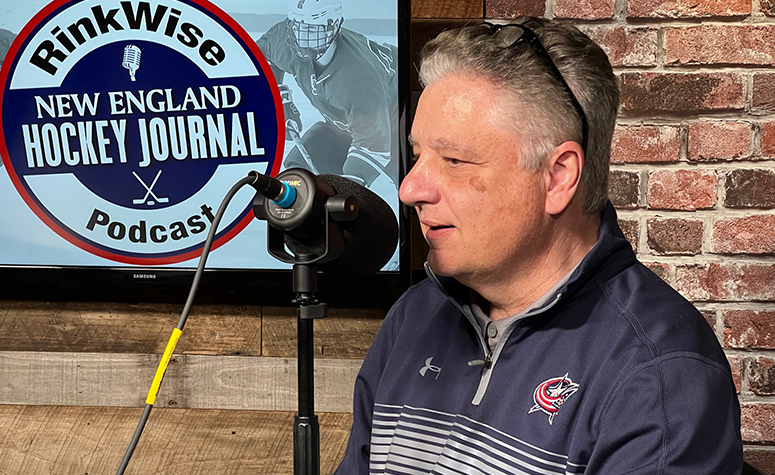
Dave Peters is a scout for the Columbus Blue Jackets and longtime coach, with a wealth of knowledge across multiple aspects of hockey.
Born and raised in Quincy, Mass., he played at Archbishop Williams and with the Boston College junior varsity team. After graduating and working in the textile industry, Peters gravitated to the sport he loved. He started out coaching high school hockey in Weymouth and Quincy before heading to Ohio to form the Kent State Golden Flash Division 1 program under former Boston College star Billy Switaj.
His time at Kent State eventually led him to Providence College (under Mike McShane and Paul Pooley), then to New Hampshire and Dartmouth College, where he was Saugus, Mass., resident Bob Gaudet's longtime assistant and associate head coach. While at both programs, Peters had a hand in the development of NHLers like forward Fernando Pisani, former Boston Bruins Hal Gill (Bolton, Mass.) and Lee Stempniak, plus defenseman Ben Lovejoy (Concord, N.H.) among others.
He also served as head coach for the NAHL's Danville Wings, and at South Kent Selects Academy from 2014-17.
Based in Connecticut, Peters joined the Blue Jackets for the 2017-18 season as an amateur scout, and continues to be a strong presence in rinks throughout the Northeast.
He joins Kirk Luedeke to talk about his personal story and often winding path on both the hockey operations and media sides.
Listen:
From the podcast:
On his first college coaching experience at Kent State:
It was a really great learning experience for me because we were building a Division 1 program. I had a little Geo Prism that I drove everywhere. I was in Ontario, I drove out to Saskatchewan, I was in the USHL and North American League... And the reason I felt like I learned so much is that you're at Kent State University looking for a Division 1 hockey player and you're not going to get the best players. So you see who the best players are out there and then you try to find players that might be close. Maybe they can pass some of the players that are the top profile recruits. So it was a tremendous learning experience because you weren't going to win any recruiting battles and you had to find players that may end up being better than the players who are already committed. And so it taught you how to evaluate and project, and I think those three years really helped me as far as the recruiting and evaluation.
On the challenges of recruiting players to Dartmouth from what he experienced at Providence:
It's different in that you don't have scholarships and there are admissions standards. But I still went with the same philosophy. I want to like a player, project a player, and then ... can you get them? You have to know who you can get. So a lot of people are interested in an Ivy League school. And for me to sit with (someone, I) had a simple formula. I really like them and I think we can get them. And there were players obviously that want to go Ivy that you don't feel like are good enough and there are players that you really want, but they have no interest in the Ivy. The finances have to work, the admissions has to work. And there's also a few schools called Harvard, Yale and Princeton that if they want to go Ivy, they can go there, too. So most of the players that we recruited and this is where the Kent State, I think, training ground came in, they weren't being recruited by a lot of other people.
On what he most appreciated about Dartmouth coach Bob Gaudet:
The biggest thing he did is he put people in the right positions to be successful. He trusted me and Brendan (Whittet) to to find players. He he empowered us. So he basically put the recruiting in our hands and he trusted us. And I think that that's the sense of a true leader who is building a program. And he was there to close deals. He was there to be a presence whenever we needed him there, but he let us do it. There are so many head coaches who think they can do everything and they micromanage and they don't trust the people that they have. You hire good people and you build a program and you try to support them. And that's something that I think not a lot of people recognize as far as what a head coach is supposed to do.
Advice he has for any player who aspires to play hockey for as long as they can:
I think you need to be ready to play. And whatever your routine is on game day, whatever your routine is, the week of the game, whatever your routine is in the summer, you've got to be prepared to play and and do the right things on and off the ice. Obviously, the if you're going to college, the better student you are, the more opportunity that you're going to have. And you also have to know that everybody that you interact with, the scouts and college coaches are going to ask. So if you have a coach that that you don't necessarily get along with, you better find a way to get along with that coach. And and I think that's important because you play for that coach. And what you want to do, I think, is is put your best foot forward in every way possible.
The podcast can be streamed at hockeyjournal.com/podcast and on major platforms, such as Apple Podcasts and Spotify.
“RinkWise” is brought to you by Paul Vincent Hockey, Laura Stamm Power Skating, Team ONE Hockey, Sacred Heart University and University of Nebraska High School, Lovell Hockey and Pro Ambitions.