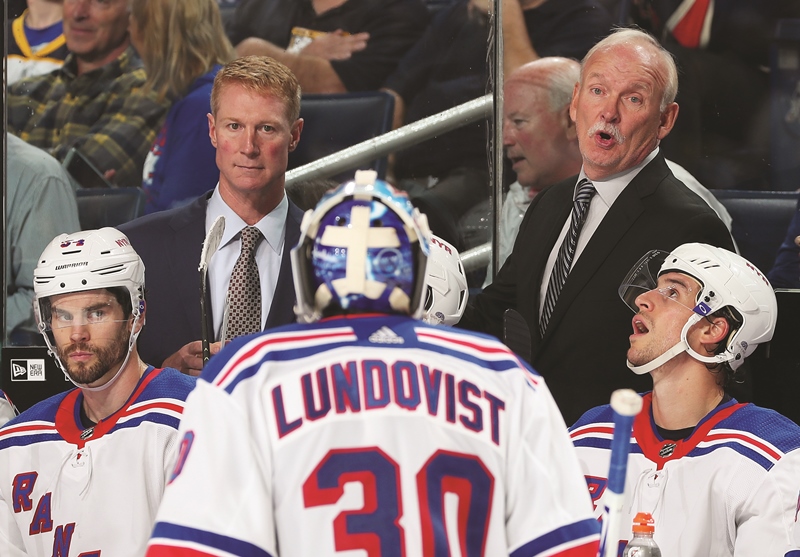
A fixture on the Boston College bench beside legendary Jerry York (Watertown, Mass.) for 14 seasons, Greg Brown has taken his coaching game to a new level — the highest level.
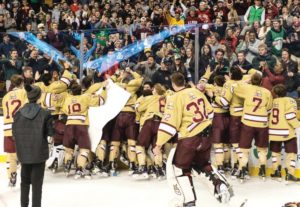
Southboro, Mass., native Brown is in his first season as an assistant coach with the New York Rangers under coach David Quinn (Cranston, R.I.). Brown helped BC win three national titles, spearheading the development of players such as Chris Kreider (Boxford, Mass.) and Kevin Hayes (Dorchester, Mass.), who now skate for the Broadway Blueshirts.
Brown also has served as an assistant coach with Team USA in several international tournaments. As a player, he starred at BC from 1986-90 and was a finalist for the Hobey Baker Award as the top player in collegiate hockey. Brown played 13 seasons of professional hockey, including parts of four seasons in the NHL. He caught up with New England Hockey Journal recently.
Billy Jaffe: How happy are you that you made the decision to become an assistant coach in the National Hockey League?
Greg Brown: It’s been a lot of fun here, so I’m very happy I made the decision. Obviously I miss BC. I was there for 14 years, and it was a great experience also. But this is new and exciting.
Jaffe: What has been the most exciting part of being a part of the New York Rangers coaching staff?
Brown: Two things stand out for me. First, the opportunity to work with this coaching staff has been fantastic. And second, getting to see this level of hockey every day, in practice, in games, has been a treat. Some of the things these guys can do out there are very special.
Jaffe: Isn’t it amazing, considering that you played for a long time, you coached very high-end players for a long time. But then when you see them all together from a different perspective, isn’t it amazing how impressive that is?
Brown: That is the difference. It’s amazing. When you put special players together on the ice — certainly we had a few at BC that were very good — more than a few — but when they’re all out there together, it takes the game to a higher level, and it’s enjoyable to watch.
Jaffe: How has it forced you to look at the game differently?
Brown: Everything happens fast out there. Things you see, or you might comment, like, “Put it there.” And they’re like, “No, don’t put it there.” Because it happens so quickly. The speed … certain things that you’d like to do in college, here, you just don’t have the time for, so you have to coach a little bit differently that way, knowing the time and space is getting closed down so quickly. Even though the skill level is so high, puck possession is a hard thing, because there’s not a lot of room out there.
Jaffe: How much have you learned in half a season as an NHL assistant now?
Brown: I’ve learned a ton. I can’t even count all the different things. Because of the level, the game is just different. You have to focus on different things, you have to choose a few things, especially because the games come so quickly here. Every week there’s much less practice time, so your teaching comes on the board or in the video session, more than on the ice all week preparing for your next opponent. So there’s a lot of teaching on the fly, and because of the different things with the speed and the gaps and everything, you just have to look at it different, especially offensive plays that you’d love to coach and make. They just can’t pull it off wth so little time. You have to make sure that whatever you’re going to do, it has to happen quickly, or you won’t be able to pull it off.
Jaffe: It’s different than a player. A player, you just go out and play. From a coaching perspective, has there been a lesson you’ve learned?
Brown: Many of the players have been at the game a long time, so their knowledge is pretty advanced, as far as what they know and what works and what doesn’t work. You work with them on how to get things done, more than just say, “This the way it’s go to be.” It’s more of a cooperation. Certainly it has to be the vision that we have as coaches, but they have some input and some ideas as well on how that works when you are on the ice and things are moving that fast.
Jaffe: How has it been living in New York, especially after living in the suburban Boston area for so long?
Brown: A lot different. We’re up north of the city, so I’m not right downtown, but not many people go to New York and have a shorter commute, but I do, and that’s been enjoyable.
Jaffe: How has time management been for you? You mention how the games come on average two and a half, three games per week. How has time management been, because the college routine, for the most part, is very structured — two games a week, usually on the weekend.
Brown: It is definitely less structured. You’re pretty much constantly doing video, whether trying to pick out things that you want your team to do better or also getting ready for the next opponent, because they’re coming either tomorrow or the next day, so you’re going to have a new opponent, and the next one after that. So it’s pretty constant, especially wth the video, as far as getting ready and preparing and then teaching whenever you can.
Jaffe: How has it been working with David Quinn, a guy you went against more often than not? I know you had a relationship with him from coaching seminars and USA Hockey and other things, but working here, what’s that been like?
Brown: “Quinny” is a great guy so it’s been outstanding. Really fun. I was excited when he asked me to join his staff and it’s been great to work with him these first five months. Hopefully he feels the same way.