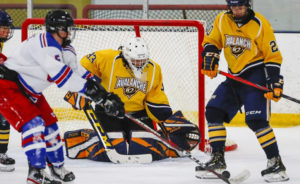
I was a hockey coach before I became a parent. I was a coach while I raised my two daughters, both athletes (including one hockey player). And I continue to coach, even though my kids have completed their varsity careers.
So I understand the pressures and frustrations that come with being the parent of an athlete. It’s a really tricky position, rife with emotions. After all, it’s your child. I get it.
I was introduced to this phenomenon early, during my own high school career. My family moved to New Hampshire before my junior year, so I was the “new kid” coming into an established but sharply divided team. My chief competition in net was a sophomore named Gilles Ouimette, who had won the starting spot the year before as a freshman. Gilles was a great kid, and a great goalie. We got along famously.
His dad, however, was a different story. I didn’t know Mr. Ouimette, for reasons that will become painfully obvious. As Gilles and I fought for playing time — a friendly, respectful competition if there ever was one — Mr. Ouimette would bellow his opinion (basically, his son should be playing) from the stands. Often. It was awkward for me, and embarrassing for Gilles. Mr. Ouimette was ahead of his time, apparently.
Today, that behavior has reached an entirely new level. The “bulldozer parent” is now a thing. Not a “helicopter” parent, who hovers over proceedings to the point of being obnoxious. The bulldozer parent is not content with such a subtle approach. In a great article by Hannan Adely in the North Jersey Record, bulldozer parents — also known as “snowplow” or “lawnmower” parents — are described as “the grown-ups who try to mow down obstacles in their children’s way to make their lives easier and help them succeed. Their actions are well-intended but not harmless, say counselors and parenting experts, who stress that young people need to learn to handle obstacles on their own even if they sometimes stumble or fail.”
Lauren Muriello, founder and director of the Well Being Therapy Center in New Jersey, told the Record that “it’s a byproduct of the current state of our society and our culture. Parents have a lot of resources and a lot of education and are trying to protect their kids from experiencing hardship or stress.”
Hmmm, sound at all like Lori Loughlin, Felicity Huffman and the other well-to-do parents caught up in the Operation Varsity Blues scandal, buying their kids way into elite-level schools (though Loughlin pleaded “not guilty”)? One of Loughlin’s daughters even had the audacity to pose for a photograph on a rowing machine to bolster the false claim on her application to University of Southern California that she was the crew coxswain for the L.A. Marine Club team.
“But of course what we see then are adolescents and adults who are not capable of dealing with stress, because they didn’t have to face all those little challenges when they were in middle school and high school, because well-intended parents trying to make it easier indirectly caused them to miss those life lessons,” Muriello told the Record.
In other words, falling down is not the problem. The problem is failing to learn how to get back up, and to understand how avoid falling the next time. If you’re not teaching your child those basic skills (and later the more complicated variations), you’re failing them. Because that’s a parent’s job.
But we see that failing in hockey all the time. Maybe it grows out of the idea that “everyone should play” at the earliest stages of sports. I’m completely on board with that concept. When kids are in elementary school (or younger), sports is about participating. Now, mind you, that doesn’t mean trophies. It means taking part, exercising, belonging to a team, learning to work together. These are all essential traits of sports.
Things do change later. I generally target middle school, or junior high, when kids start hitting puberty, as a good time to introduce the concept of “meritocracy” in sports. Yet even at this level, it’s not strictly about the wins and losses. Believe it or not, for a good coach, it’s about developing young men and young women, helping them to maximize their potential, individually and collectively.
To do that, children need to be challenged. They need to struggle at times in order to grow (much like a weight workout actually tears muscle down, initially). But when they get back up, without outside assistance, the result is powerful, and empowering. And it lasts much longer than the glow of any victory.
According to the Record article, a University of Minnesota study found that over-controlling parents made it harder for young people to navigate school environments.
“Children who cannot regulate their emotions and behavior effectively are more likely to act out in the classroom, to have a harder time making friends and to struggle in school,” said lead study author Nicole B. Perry.
Not a pretty picture. Bulldozer parents might be making lives easier for their kids in the short term, but their approach is short-sighted. Those same kids miss out when they don’t learn problem-solving, conflict resolution and coping skills they need for life.
Here’s a perfect example. Steve Kerr is coach of the Golden State Warriors and an eight-time NBA champion (five as a player with the Chicago Bulls and San Antonio Spurs, three as a coach). But he started only 30 games in his career. He was a consummate team player, willing to accept his role. And, eventually, that role included hitting clutch, game-winning shots.
“The thing that I took from Michael Jordan was that you go for it, every time, every play,” Kerr told Roger Bennett of the “Men in Blazers” show. “You never, ever worry about failure. And I had worried about failure my whole life. I didn’t want to be the guy at the end who missed the shot. So up until my time with the Bulls, I was afraid of being that guy.
“And then I realized, Michael took all these big shots, and he missed half of them,” he said. “I would see him go for it, and miss, and he’d go into the locker room and it was no big deal. He wasn’t fazed. And the next game, two nights later, he’d take the same shot. That made an impact on me. I realized I had to get over my fear of failure, and just go for it.”
This is the lesson. The only way you, as a parent, are going to help your child develop that mindset is to get out of the way. Let your children learn it for themselves. That way, it will be their achievement, not yours. That’s how it should be.
Brion O’Connor is a Boston-based writer and owner of Inspired Ink Communications. He is also a longtime hockey coach and player, specializing in goaltending instruction. Learn more at TheGoalieGuru.com.