


When Cam Ellsworth was introduced last month as the new coach at Norwich University, he inherited the reins of a program that has set the bar sky-high for achievement in Division 3.
Under Mike McShane (Wakefield, Mass.), Norwich is the national standard for prolonged success. His teams won their conference in 19 of the last 20 seasons, including 17 times in a row. The Cadets have captured four national championships, the last coming in 2017, and McShane, who stepped down from the position in June, was honored five times as the Division 2/3 National Coach of the Year.
One of his first players, Keith Aucoin (Chelmsford, Mass.), spent parts of seven seasons in the NHL, with the Carolina Hurricanes and Washington Capitals, and is still playing professionally in Europe.
As a player at UNH, McShane was a teammate of Dick Umile (Melrose, Mass.), the future longtime coach of that program. His 741 wins, compiled in 23 seasons at Norwich, and before that at Division 1 programs St. Lawrence (five seasons) and Providence (nine seasons), rank seventh all-time in college hockey.
Retirement means more time at his home on Cape Cod, and more time during the winter with family members in Florida. He’ll still have a presence on the Norwich campus, teaching a course in the school’s leadership program and running his hockey school, if not behind the bench.
McShane, 70, talked to New England Hockey Journal writer Mike Zhe about his legacy, the closest he came to leaving for another job and what he’ll miss about a special community that made Kreitzberg Arena in central Vermont one of the brightest stages in college hockey on game nights.
NEHJ: Take me through your thought process. Why was this the right time for you to step away?
Mike McShane: My daughter and son live down in Florida. My daughter is married and they have a baby. I don’t get to see them the way I’d like to. After last year when we won the national championship, I thought maybe this would be a great time, going out like this. But we had 10 seniors and I thought, I don’t want to lose any recruits if I announce I’m leaving, so I decided to stay one more year. And I’m glad I did. We had a very good year.
NEHJ: What are the biggest things you’re going to miss about head coaching, and maybe not going to miss?
McShane: The biggest thing I’m going to miss is the camaraderie — dealing with young guys who are good students and real good athletes who want to get better and improve. You really have an effect on their lives. I love the competitive part of hockey; I’ve loved it since I was a little boy. I love to prepare and then accomplish something as a whole group. There aren’t too many things I didn’t like. Recruiting — I didn’t go on the road a lot this year but I have in the past. The travel sometimes in the wintertime. It’s a long winter. You’re working basically seven days a week. You’ve got your games on Friday and Saturday, and Sunday you’re preparing and doing all your film work so Monday, when the kids come in, they know what they’re doing. Even though our season’s a little bit shorter than Division 1, it’s long. But I’ll certainly miss the good things more than not look forward to the bad things.
NEHJ: Who were the biggest influences for you as a coach?
McShane: I was very fortunate to have Charlie Holt as a coach (at UNH). Charlie was very instrumental in my thought process of coaching systems and style of play. He had a great mind for the game and wasn’t afraid to try different things. I enjoyed that; I enjoyed playing for him. I had a good high school coach in Charlie Kirk, then I had a good coach in Lucien Lavoie at Tabor Academy. ... And when I was coaching at (Phillips) Exeter Academy, certainly George Crowe had a big impact. He went on to Dartmouth and hired me at Dartmouth as an assistant; I’ve run hockey schools with him for a number of years. Other coaches I used to watch their style — Jack Kelley, Ned Harkness was an all-time favorite of mine. I got to know Ned very well and loved to pick his brain.
NEHJ: Twenty-three successful years as Norwich. How tempting was the lure of trying something else?
McShane: I thought about it. I had a chance to coach in the American Hockey League (in the mid-2000s) and I called Ned Harkness about it. He said, ‘Do you enjoy what you’re doing now?’ I said, ‘Yeah, I really do enjoy it.’ He said, ‘You know Mike, it’s not all it’s cracked up to be. Unless they’re going to offer you a five-year guaranteed contract or give you a million bucks or something like that, I think you’re better off staying where you are.’ I was kind of surprised. I expected him to say, ‘Yeah, go for it, maybe get a Stanley Cup someday.’ But I listened to that and thought maybe he’s right. I’ve moved around quite a bit. I’ve built up other programs and we’re having a lot of success here right now; let’s just enjoy it. I mean, this is my program. It’s going to be somebody’s else’s pretty soon but at least I can look back and say that 23 years is significant, keeping this thing at the level we’ve kept it at. Looking back, I have no regrets.
NEHJ: What were the early obstacles that were thrown in your path at Norwich when you began in 1995-96? Two of your first three seasons were 12-12 and 13-12-2.
McShane: My understanding was after my first year we were going to start building a new rink. But fundraising was slow and the economy bogged down for a little while. We kind of wondered where we were going with that but we worked our tails off. I give Charlie Holden a tremendous amount of credit on that. He’s an alum and one of the all-time great Division 1 referees. He pushed and pushed and pushed and we got the rink done. My first year here I was .500 but I really liked the team. Really liked the kids. The next year we went to the final four, the first time Norwich had gone to the final four, and we almost won it. After that the program just kept getting stronger, then we got into (Kreitzberg Arena). Now we’ve got 300 people on the waiting list for season tickets here.
NEHJ: Game nights at Kreitzberg after 20 years. Are they still special?
McShane: Oh, yeah. We look forward to the weekends. Everybody in the community looks forward to coming to the games.
I was eating at the Corner Cafe here in town the other day and a couple guys came up to me. I didn’t know them, personally, but they were fans. One of them said he hadn’t missed a home game since we built the new rink. He was appreciative. He said, ‘My whole winter is based around your team.’ Things like that are nice to hear.
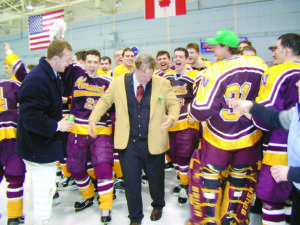
NEHJ: And the rivals over the years, both in the NEHC and outside it. Is there one program you’d put at the top of that list?
McShane: I’d say Middlebury. Recently, not so much, because the program has slipped, unfortunately. Billy (Beaney) had a rough couple of years his last couple of years. Now Neil (Sinclair) is trying to get it going again. I hope he does, because the fan base over there was so strong at one time. Plattsburgh is always strong. The teams that Jamie (Rice) has at Babson. The teams that Peter (Belisle) has had at UMass-Boston have been strong recently. It’s fun to go down to Boston. We’ve had some great battles.
NEHJ: Two years ago you won your 700th game and fourth Division 3 championship. What do you remember the most about that season?
McShane: At the beginning of the year we weren’t playing great. We went down to Skidmore and got beat, the only game we lost. Then we went up to Castleton the next day and the first period, aside from our goalie, we didn’t play well. Then Paul Russell (Andover, Mass.) got a breakaway, scored a goal and we went on to win 4-0. That was my 700th win and it was kind of emotional. On the way home I remember thinking, ‘This is a real good group of kids. We’ve just to put some things together and we’ll be OK.’ That team wasn’t one of my strongest as far as talent goes. But as far as character, and the willingness to work with each other, and our leaders — (Tyler) Piacentini (South Weymouth, Mass.) and (Austin) Surowiec — were just two magnificent captains.
NEHJ: How has Norwich been able to remain a perennial national title contender over all these years?
McShane: I’ve been fortunate that I’ve had a lot of support where I’ve gone. It’s so important for young coaches that when they get going, they have support, that they work hard and earn the support from the school, the players. Maintaining a program — that’s very hard. I’ve built programs back up, St. Lawrence and Providence. The harder thing is to maintain it. How can you keep it going as long as you can? Longevity is key. I’ve had the same president here at Norwich since I’ve been here (Richard Schneider). I’ve had the same athletic director (Tony Mariano). I’ve had excellent assistant coaches. Steve Mattson have been with me for more than 15 years. I’ve had consistent support. You do not do it by yourself. The day you think it’s you, you’re done. There might have been a time in my coaching career I might have been a little like that. I’m certainly not like that now.