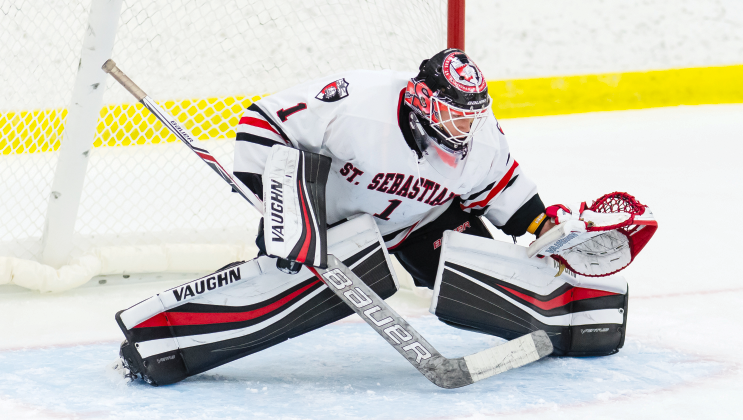
For the second consecutive season, a New England native will be the starting goaltender for USA Hockey’s National Team Development Program U-17 squad.
Drew Commesso of Norwell, Mass., was named to the roster after being the clear-cut top goaltender at the NTDP Evaluation Camp in Plymouth, Mich.
Committed to play college hockey at Boston University, the two-year starting goaltender at St. Sebastian’s has been widely regarded as the top player in his age group at this position for a few years.
“I’m looking forward to becoming brothers with the rest of my team and creating memories that I will never forget,” said Commesso. “With the amazing coaching staff and an environment of working hard and while putting the team first, I think that we will have an incredible amount of success. I’m beyond excited to go out and become a better hockey player, and a better man in general.”
The 6-foot-1 Commesso has good size, moves extremely well in the crease and is poised between the pipes.
“Drew is so calm and confident in everything he does. He’s big, long and lanky,” said his goaltending coach, Brian Eklund of Massachusetts Crease Goaltending School. “He has great control over his body. He has very good hand control. He can reach up, catch pucks and kill plays. He has great control over his movement. You don’t see him out of position or scrambling to try to get back into the play because he did too much.”
Commesso has been able to develop into an elite goaltender in large part due to his vast experience of going up against some of the best players in his age group. Furthermore, he’s a student of the game who does everything he can to educate himself on how to become a better goaltender.
“Drew is still learning a lot about goaltending. What really separates Drew is his ability to adapt to change. During the year he had a little bit of a spat. He was having a little bit of trouble, but he was overthinking the position. He just wants to learn,” explained Eklund, who is the volunteer goaltending coach at Boston University.
What comes with experience, maturity and knowledge is the ability to stay up longer and not go down so quickly. That’s a key part of the game that comes with having conviction.
“He has an advanced understanding of what he needs to do. He has the patience and confidence to stay on his feet longer than most goaltenders. He’s a modern-day goaltender. He’s done an amazing job at adapting to the way the game has changed,” Eklund said.
“He’s not a cocky kid. He’s very humble, but he exudes that he’s the man when he’s in net. The team feeds off that and they want to play in front of him,” Eklund added.
In the U-17 crease, he will be following Darien, Conn., native Spencer Knight, a prospect who could be a first-round pick at the 2019 NHL Entry Draft. While Commesso is the de facto starter, he’ll be pushed for ice time by Wisconsin commit Noah Grannan.
“Spencer Knight, the goalie they have out there right now, could be a transcendent type of player. When you come in after a guy like that, expectations are elevated. He has to focus on himself and his development and not try to live up to other people’s expectations,” said Eklund, who was a standout goaltender at Brown in his playing days.
Even without the challenge of living up to the hype and trying to be as good as the last guy, there are plenty of obstacles Commesso will face as goaltender of the U-17 team. He’ll be playing against elite players night in and night out while playing in back of a team full of 17-year-olds who might be going up against peers two to three years older.
“Every time you climb that next rung of the ladder, there are challenges that are there that weren’t there before. The speed of the players and the size of the players pick up. That part of the game gets bigger, faster and stronger,” Eklund said.
“Drew has played against older kids in prep, but when you go to the USHL you’re playing against the elite kids in all of the country. It’s just different. Those kids are hungry and looking for college scholarships. He’s going to need to evolve to the speed and think, see and move faster,” continued Eklund.
How Commesso handles that difficulty could ultimately define him as a goaltender and could determine just how far he goes in the sport.
“He’s not always going to have immense success. Everyone is adjusting. These are all 17-year-olds. This is the first time kids are going to go through adversity. He’ll go through that,” said Eklund.
Gavin Fitzpatrick
Another one of Eklund’s pupils is Thayer Academy’s Gavin Fitzpatrick. The Norwood, Mass., native just finished his first season playing for Tony Amonte’s Tigers after playing as an eighth-grader at BB&N.
“Gavin is a different style of goaltender. He’s a smaller goalie, but he has very good feet. He plays more on his knees than Drew does. We’re trying to evolve his game so he plays more on his feet. He has very good hand skills and poise in the net,” Eklund said.
“They’re both very high-end goaltenders. They’re both kids who separate themselves in a lot of ways. They’re great kids to be around and they have a drive to be the best,” said Eklund.
Connor Bradford
Over the past five or so years, life hasn’t always thrown Connor Bradford fastballs down the middle of the plate. He’s had to battle adversity and hasn’t always been afforded the opportunities that some of the other top prospects in the region have grown accustomed to on a daily basis.
His mom, Bonnie, has worked two to three jobs to support Connor and give him every opportunity she could when it comes to playing hockey.
“They don’t have a ton of money. The mother makes a huge commitment. Bonnie has done everything herself. She has two or three jobs. She does everything for him. He’s a great story,” said Boston Advantage coach Tim Lovell, a former standout player at Maine and UMass Amherst.
Hailing from Kingston, Mass., Bradford has grown up playing in the Boston Advantage system. Staying at the U-15 level this past year and not switching over to high school or prep hockey has cost him some exposure, but he’s forcing college and junior coaches to take notice.
“Connor could be at any prep school and play, but he doesn’t get as much notoriety playing Midget,” said Lovell. “He’s a stud. His compete level is off the charts. His second and third effort is off the charts.”
Bradford, who is being courted by the Saint John Sea Dogs in the QMJHL as well as several Division 1 colleges, isn’t a typical modern-era goaltender. He has the size, but he doesn’t have the sound techniques or typical butterfly approach.
“He doesn’t look like the other goalies. His skating ability might not be as good as them, but he stops pucks more than them. He’s an old-school goalie. He’s really, really good,” Lovell commented.
As Bradford continues to refine his game and mature physically, he should continue to make people take notice.
“He’s going to end up being really, really good. He just started working out. He just got a goalie coach, Steve Mastalerz of GDS, a month ago,” said Lovell.
Bradford has the intangibles and already has overcome steep obstacles just to get to this point. The sky could be the limit for him.
“His size and his compete level, it’s crazy. He’s pretty cerebral. He points out where back-door guys are for defensemen to pick up,” said Lovell, adding that his goaltender’s overall communication skills in the net are superb.
Talent runs deep
Commesso, Fitzpatrick and Bradford usually grab most of the headlines, but there are two other goaltenders in this age group who have bright futures ahead of them.
Winchester, Mass., native Tommy Aitken has gained attention, drawing an invite to the Omaha Lancers main camp after a stellar season at Selects Academy at South Kent.
In addition, Boston Junior Bruins U-16 goaltender Mason Kucenski has potential to blossom. He has good size, moves well and has strong fundamentals. As a youngster, he was considered the best of the bunch.
What’s best for development?
Today, more than ever, young hockey players are being pulled in a million different directions. There’s the faction of the sport that is pushing specification, while others are promoting multi-sport athletes. Some youth teams are playing upward of 100 games a season.
Eklund believes that if a young goaltender truly wants to get better, he or she needs to follow a few simple instructions.
“You have to understand that you don’t need to play 95 games a season to be a better hockey player. There’s this thought process that more equals better. Quality over quantity,” said Eklund.
Instead of playing so many games, a young goaltender needs to focus on specific areas of his game that need improvement.
“Some kids need to work on their technique or foot speed. Some kids need to do stuff off the ice to get faster or stronger. Some other kids need to start thinking the game more and watch hockey on TV to understand the game,” Eklund stated.
Video games and other forms of entertainment are drawing kids away from hockey as well. Prioritize what matters most, said Eklund.
“Beyond most of those things, today’s 12- and 13-year-olds need to put away the video game controller. Put away Fortnite and watch hockey,” Eklund said. “You need to watch and love the game if you want to be that level of player. It doesn’t just happen because it falls into your lap. You need to embrace it and love every moment of it.”