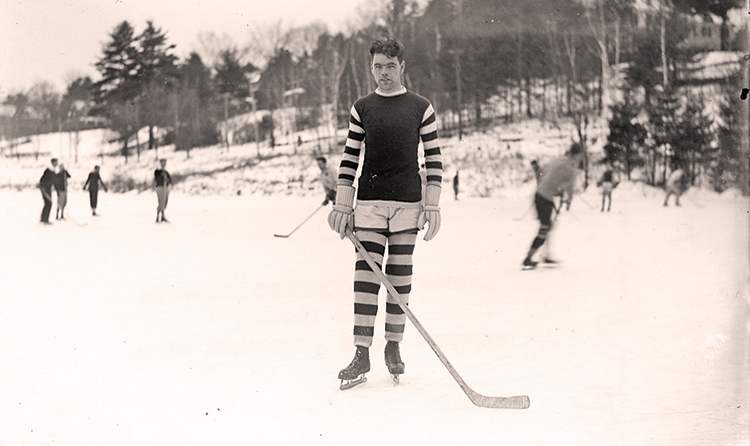
Ninety years ago, Myles Lane was such a New England hockey hero that the New York Rangers hoped the Boston Bruins would be so dazzled by Lane’s fame and popularity that they would trade their best player for him.
A Melrose, Mass., native and a Dartmouth legend, Lane had signed with the Rangers on Oct. 1, 1928, becoming the first American collegiate player in the NHL.
A week after Lane’s death in 1987 at the age of 83, The New York Times shared a story that Stan Saplin, the Rangers’ former public relations man, liked to tell time and again.
Rangers president Col. John Hammond believed the Bruins would be so eager to acquire the local legend Lane that they’d give up just about anything for him. So he instructed Lester Patrick — the Rangers’ coach and GM — to offer the Bruins Lane and $5,000 for Eddie Shore, the Bruins’ emerging star defenseman who would go on to win the Hart Trophy as the league’s MVP four times.
Patrick knew the Bruins wouldn’t part with Shore for anything, but he followed orders, sending a telegram to Bruins president Charles F. Adams. According to the Times, as the tale goes from Saplin — who later got the story from Patrick himself — Adams replied with a telegram of his own that read: “GET A LIFE PRESERVER — YOU ARE MYLES FROM SHORE.”
Adams’ pun-filled retort nixed the Rangers’ attempted heist, but it did lead to further trade talks. The Bruins did acquire Lane on Jan. 21, 1929, for $7,500.
That season, Shore — along with Harry Oliver, Dit Clapper, Lionel Hitchman and, yes, Myles Lane — led the Bruins to their first Stanley Cup, fittingly sweeping those same Rangers in two games in the finals.
Ninety years later, Lane remains the only New England-born player to win the Stanley Cup with the Boston Bruins.
Lane was born Oct. 2, 1903, in Melrose, Mass., and quickly made his mark as a standout multi-sport athlete. Lane attended Dartmouth College, where he excelled at football and hockey (and also lettered in baseball) and remains one of Dartmouth’s most accomplished athletes of all-time.
On the football field, Lane was a record-setting, All-American halfback, leading Dartmouth to acclaim as the national champion in 1925 as a sophomore, and leading the nation in scoring in 1927 as a senior. He was inducted to the College Football Hall of Fame in 1970.
On the ice, Lane was a two-time All-American, establishing school records that still stand for most goals by a defenseman in a game (five in 1928 vs. MIT), in a season (20 in 1926 and ’28) and in a career (50).
Lane’s multi-sport success in the 1920s was so prominent that he drew comparisons to Jim Thorpe and Hobey Baker as the nation’s best all-around athlete.
The day before his 25th birthday in 1929, Lane chose the NHL over the fledgling NFL, signing with the Rangers. He scored one goal in 24 games with New York, and then scored one goal in 19 games with the Bruins.
While beginning a nascent pro hockey career, Lane also coached college football, serving as an assistant at Dartmouth in 1929. He played just three games for the Bruins in 1929-30, then focused on coaching football. He was the head coach at Boston University for one season (2-3-2 in 1932), then served as the backfield coach at Harvard in 1933.
After a four-year hiatus from pro hockey, Lane returned to the Bruins in 1933-34, recording two goals and one assist in 25 games. In total, he played 71 career games in the NHL.
Still, as a pioneer among American players, Lane was a member of the inaugural class inducted to the U.S. Hockey Hall of Fame in 1973, along with the likes of Hobey Baker, George and Walter Brown, and goaltender Frank Brimsek, the only other American-born player to win the Stanley Cup with the Bruins until Tim Thomas in 2011.
Lane then embarked on a promising law career after graduating from Boston College Law School in 1934. He served as a Naval Commander during World War II, then returned to the office of the U.S. Attorney for the Southern District of New York. He was named U.S. Attorney in September 1951 and served until April 1953, when he returned to private law practice. In 1968, Lane was elected to the New York Supreme Court, then was appointed to one of the court’s Appellate Divisions in 1974. He retired from the bench in 1979.
Lane died Aug. 6, 1987, in Manhattan at the age of 83 — the last surviving member of the 1929 Stanley Cup champion Bruins.