
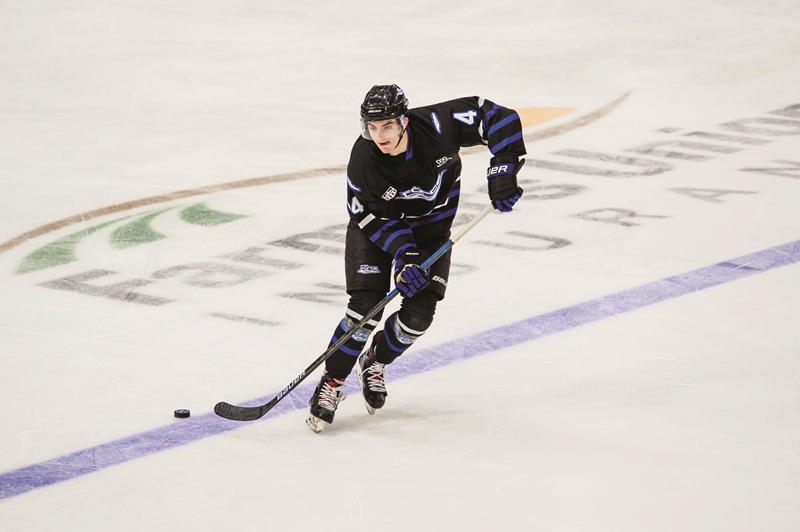

Michael Kesselring was at his lake house in Barnstead, N.H., last June watching the second day of the 2018 National Hockey League draft on television when he saw a familiar name appear on the screen.
It was his own; the Edmonton Oilers had just selected him in the sixth round, 164th overall.
“I looked at my parents (Casey and Shawndra) and hugged them,” the 19-year-old defenseman remembered. “It was an unbelievable feeling. Then getting the call from Edmonton was unbelievable. I sat there a little longer than I was hoping, but to hear my name called was an unbelievable experience. I flew out to development camp the next day, so it was a quick turn of events.”
It was a rapid change in more ways than one.
Nearly four months earlier, Kesselring concluded his fourth and final prep school season at New Hampton before going to the United States Hockey League’s Des Moines Buccaneers, with whom he recorded two assists in a dozen games to close out the 2017-18 campaign.
Now, he was westbound again, eager to learn the big-league way of doing things. “The Oilers brought in a (nutritionist) one day to talk to all of us about how we can get better that way,” Kesselring said. “(Skills development coach and Hockey Hall of Fame defenseman) Paul Coffey showed me how to improve my skating — to keep my upper body still so my legs can move smoother.
“You learn how to compete at a higher level after seeing how good all the players are at the next level. Each guy at the camp is a very good player in college or a very good player in junior. It was good to see all of those things and take it back with me and know you have to work a little bit harder.”
The original plan for Kesselring was to take those lessons to Merrimack College for the 2018-19 season. However, after speaking to his dad, who was his coach at New Hampton, and several scouts whom he knows well, he decided it was best to return to the USHL to mature for another year.
“The single biggest thing was to take that extra year to let my body develop,” Kesselring stated. “I also wanted to improve the defensive side of my game and play more aggressive down low in my own zone, and I wanted to get used to the speed. Making the jump from prep school to college is hard. The USHL is a big jump, and then college is a little jump after that.”
Kesselring figured out how much of a leap the USHL game is from prep school hockey during his first stint with Des Moines. Those contests also provided him with valuable knowledge that he was able to utilize in his first full campaign in the junior circuit.
“Those games were huge for me to see what it was like out there because I was really going into the unknown,” he said. “I didn’t know how the USHL worked. I never lived away from home. I didn’t really know the schedule. It was good to get familiar with the league and get some experience being away from home. It was good to see the speed, too. This way when I went into the next season I wasn’t thinking, ‘Wow! This is fast!’ I would already know what it’s like and would just have to adjust my game.”
It proved to be easier thought than done. When Kesselring returned to the USHL for the 2018-19 season, he initially struggled, notching just 12 points (2-10-12) in 33 games with the Buccaneers. But after a trade to the Fargo Force in January, the right-handed shooter excelled, totaling 22 points (7-15-22) in 33 contests with his new club. He finished the campaign with two scoreless appearances in the Clark Cup playoffs.
As it turned out, he just needed time to adapt.
“I feel like I grew up a lot. It was tough at times, but it will help me in the long run at school next season with being used to being away from home and being more mature,” asserted Kesselring, who’s now committed to playing for Northeastern University. “I’m now more ready to handle the speed and physicality of the college game. And going there, I want to take an even bigger step and play consistently. A lot of times this year I went through stretches where I played well, and then at times I stepped away from it a little bit. Hopefully I can step in and make a big impact right away.”
Kesselring already considered himself a hardworking kid before the season began. What the 6-foot-4, 195-pounder didn’t realize was how much of a homebody he is, which was one cause for his slow start.
“It was a big adjustment,” he said. “I was OK the first two months, but by the third month, before Christmas, it was getting tough. Honestly, I was getting homesick. But after I came home for Christmas and then went back, I felt better about being away from home. That’s part of the reason why I improved in the second half of the year. I was thinking less and playing more.”
What also helped was being dealt to the Force, even though the trade was unexpected.
“I was surprised because I had just talked to the coaches a few days before about how much better I was doing in Des Moines,” Kesselring recalled. “I was disappointed because I was close with my teammates, but I was very excited for the new opportunity, too, because I knew Fargo needed a power-play defenseman and I knew I was going to step into that role. It worked out really well there and I got to play a lot. I developed a lot in my time there defensively, which was a big goal of mine, and offensively, too. (Associate head coach) Pierre-Paul Lamoureux had a lot of trust in me right when I got there.”
If Kesselring was to sum up his character and play this past season in one word, “resilient would be a good one.”
“The second half of my year really showed my resiliency,” he said. “I was in a tough spot with my confidence going into Fargo. I had struggled at the start of the season with everything — being away from home and not doing as well as I wanted to on the ice. I showed up in Fargo, worked hard, and it really worked out. I got an opportunity and took advantage of it.”
With the 2018-19 season in his rearview mirror, Kesselring now has his sights set on taking advantage of this offseason and entering Northeastern a stronger player and even more mature person.
“A big thing for me on the ice this summer will be power skating and to keep working on my skating,” Kesselring concluded. “If my skating improves, I can move around the ice better, which is going to open it up for me to make plays with my vision. As a person, I need to keep working hard and continue to grow.
“There are still a lot of things I can learn and get better with around the house with my family, and I want to keep being a role model for my younger siblings. If I do all of those little things in the gym, on the ice and at home, they will add up to being a good overall person, and that’ll lead into being a good player.”