

The hockey world was captivated by the great holiday tradition that is the IIHF World Junior Championship. Earlier this month, players from Hockey East and ECAC programs returned from playing on the world’s stage during the 2020 edition held in Ostrava and Trinec, Czech Republic.
This year’s United States roster included six Hockey East (five current, one former) and two current ECAC players. In addition, two Boston Bruins prospects (John Beecher, Michigan, and Curtis Hall, Yale) and two local assistants were on Minnesota Duluth boss Scott Sandelin’s Team USA coaching staff: Northeastern’s Jerry Keefe and Dartmouth’s David Lassonde.
Now that the local collegians have played in games since the World Juniors tournament ended, here is a look at what some of them learned from the experience and how the tournament’s aftermath impacts hockey and life upon their return to campus:
Speed is good
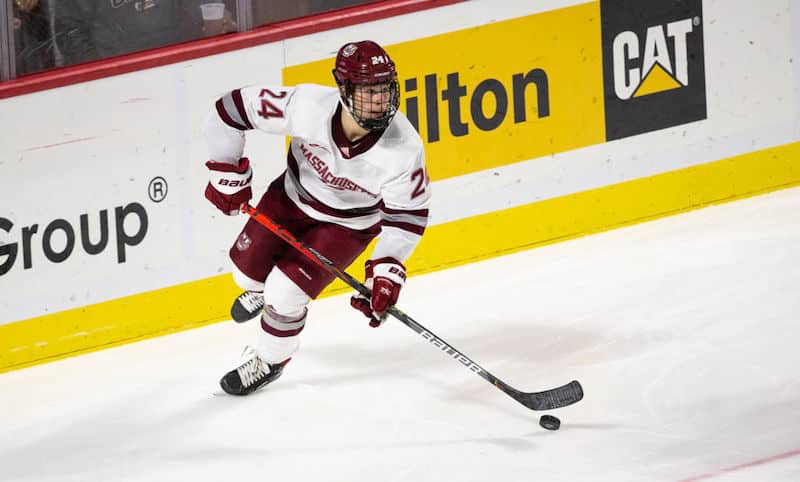
UMass freshman defenseman and New York Rangers prospect Zac Jones -- the first Virginian to play for the U.S. World Junior squad -- noticed a difference between the styles of play after playing in three games since his return.
The offensively gifted blueliner saw the international tournament as more of a skilled game, whereas the college level is a physical test. Jones has been an effective player at both ends of the ice at both levels, scoring a goal and adding an assist at World Juniors and has two assists since returning to the Minutemen lineup.
“The best players in the world at that age group are at World Juniors, but college hockey is the best players at an older age group,” Jones said. “I’d say this level is definitely a lot harder. There were a lot of skilled players over there, so here is harder and there was just a faster game.”
Feel good about your game
One word players and coaches often use to describe the impact of the World Juniors is simple: confidence. Though the U.S. had a four-year medal streak snapped with a quarterfinal loss to Finland after a strong preliminary round, that was no different this year.
The experience of playing at the World Juniors and thriving while playing a different style of game often leads to increased confidence and success on the ice.
Boston University freshman Trevor Zegras showed his passing wizardry to the world over the course of five games in the red, white and blue. The Bedford, N.Y., native recorded nine assists during the tournament, all of which were of primary.
“I’m pretty confident in my game and the way I can make plays,” he said. “It’s nice that some of them worked over there, but it wasn’t really anything new or something I was wowed about. I try to make plays all the time, so I guess it was kind of glorified at World Juniors.”
Plays are easier to read
For Jones, jumping into the play from the blue line has become easier in his few games since returning from the World Juniors, and a two-point game immediately followed. Though Greg Carvel and the rest of the UMass staff have seen Jones grow his game over the course of the season, especially in terms of 200-foot play, the speed of the international game did help his return to college.
“I wouldn’t say it’s slower after getting to play with all of those skilled guys, at that level, at that fast of a pace, but it has definitely been easier to read the play coming back,” Jones said. “It definitely helped my confidence playing over there and I learned a lot, especially playing in the D-zone.”
Providence coach Nate Leaman saw the same for Wakefield, R.I., native freshman Parker Ford, who scored a goal against Cornell at the Ice Vegas Invitational and had three points over his first two games back on U.S. soil.
“He’s always had pretty good confidence with the puck, but I think he just came back and maybe the game is a little bit slower for him,” Leaman said. “He’s definitely been confident and I think he’s been more assertive in the game as well.”
Momentum is key
One of the best recent examples of how competing in World Juniors can impact a player’s performance in college came last year in the form of New York Islanders prospect Oliver Wahlstrom (Quincy, Mass.).
Though his lone season at Boston College was disappointing as a whole as compared to lofty expectations, Wahlstrom’s best college hockey came after helping the U.S. earn a silver medal in 2019. He recorded 14 of his 19 points (4-10-14) in BC’s first 22 games after posting just a 4-1-5 line through the first 15.
The next few weeks will tell whose impact will be as strong this season, but Harvard sophomore Jack Drury is certainly off to a good start in that department with six points in his two January games, including a hat trick and an assist during Saturday’s “Rivalry On Ice” win over Yale at Madison Square Garden.
“He doesn’t really take any chances to get his offense,” Harvard coach Ted Donato said of Drury. “He’s just a really sound, fundamental player and a tremendous teammate and leader. In a game like this, it was nice to see him rewarded with a big night. From the day he walked on campus, he’s been asked to do a lot of things, play against the team’s top line every night. He’s one of the most impressive and mature players I’ve ever worked with.”
Manage those minutes
The days and weeks after the tournament can challenge a coaching staff. Keeping an eye on workloads is critical as coaches want their players in the best shape possible for important conference games down the stretch.
Zegras made his return to the BU lineup last Wednesday against Brown, but some of his U.S. teammates were in the lineup for their college teams just days after the run at the World Juniors ended.
“Trev was really good early in the game and really good on the power play, but I think he got a little bit more tired as the game went on,” BU head coach Albie O’Connell said after Zegras returned. “It’s going to be important to manage his energy and giving him a little time off. We gave him a few days, so we’re going to have to monitor that. We don’t want him tired because that’s a long tournament with a lot of travel.”
Ford was one player in the latter category as he played for the Friars on the Saturday (Jan. 4) after the U.S. was eliminated on Thursday. Leaman has also managed Ford’s time on the ice since, but feels his two years of experience in the grind of the USHL makes the adjustment from the World Juniors easier.
“He’s got a great motor and you never question his work ethic, but I gave him off of practice (Monday) and I sent him home for some time after we got back from Vegas,” Leaman said. “As a coach, it’s more about putting the brakes on him a little bit and making sure he’s fresh for the second half. … I don’t think he’s had a big break for three years or so now because he’s been used to the USHL for the last two, so I think that was an advantage.”