
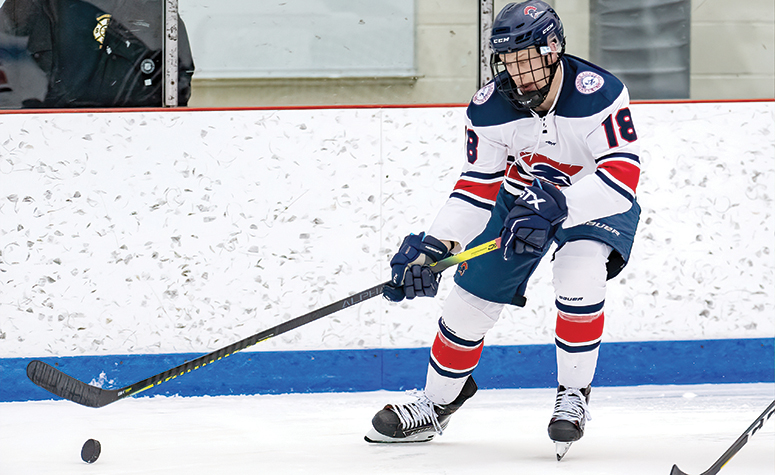

As far back as David Sacco can remember, hockey has been a part of his life. Based on what he’s accomplished so far in the ice game, it will play a major role in the 18-year-old forward’s future, too.
Sacco, a 6-foot, 187-pounder from Middleton, Mass., recently completed his senior season at Lawrence Academy, where he totaled 40 points (17-23-40) in 24 games. He also left his mark on National Hockey League Central Scouting, which lists him 175th overall among North American skaters in its midterm rankings for the 2020 NHL draft.
“You look at the kids who are on the list with me, and there’s crazy talent all across the board,” Sacco said. “It’s an honor to be placed on a list like that, and it gave me confidence.”
But just because Sacco is on the list doesn’t mean his job in hockey is done. Far from it.
“I still have to prove myself. Even with whatever happens in the summer, it’s just another part of my career,” Sacco said, talking about the prospect of being drafted. “It’s not going to change anything. I still have to be working at all times.”
When Sacco is performing at the top of his game, his style of play resembles that of another feisty forward, his idol, Tom Wilson of the Washington Capitals.
“I don’t have the size that Wilson does (6-4, 220), but I love how every shift he goes out, flies around and doesn’t take anything from anybody,” Sacco stated. “He’s very physical, but he doesn’t just hit players when he’s out there, he also generates offense. And that’s what I try to do. I’m not a giant size-wise, but I like to think of myself as a power forward who creates offense, drives the net and brings a lot of energy, as well.”
Despite being a teenager, Sacco already has faced and overcome a rare obstacle in the hockey-playing world. When the right-handed shooter was 9 years old, he was diagnosed with type 1 diabetes. But instead of letting that derail his ambitions of climbing the hockey ranks, he pressed on.
“As a kid, I had no idea what diabetes was, so being told I had it was very scary in the moment,” Sacco said. “When your blood sugar is a little bit off, it can really affect you, and I had to learn how to regulate it so that I’m always in a good position when it’s my turn for a shift. When I’m on the ice, if my blood sugar is high, I’m going to get tired really easily, which would put me at a giant disadvantage.”
After being diagnosed, Sacco started following Montreal Canadiens center Max Domi, who also has type 1 diabetes. “Domi has had interviews where he talks about it and what he did, so I’ve used that to help me, along with what my doctors have told me,” Sacco explained. “When I looked up to him, he was still playing junior hockey, but knowing that someone was playing at such a high level with the same thing I had was a good thing to see because even though he had it he showed me that you can still compete at a high level.”
Playing at a high level is precisely what Sacco has done ever since he started ice skating as a kid in Medford, Mass. And although many years have passed since he first donned a pair of skates, Sacco recalls that experience as if it happened yesterday.
“I remember ever since before I could hold a stick, when I was in learn-to-skate,” Sacco said. “My first memories have to do with hockey, and even when I was older, I remember being on the pond with all my cousins.”
Sacco didn’t only skate and score on a pond. He did so indoors, too. After skating for several years with Masco Hockey, Sacco joined the half-season Valley Junior Warriors, with whom he played for the bulk of his life. While a member of the Junior Warriors, he was coached by John Burke for all but one season. He also received guidance from his father, David, who starred at Boston University and played 35 games in the NHL as a left wing.
“Coach Burke taught me not only what to do on the ice, but also how to act off the ice. I have to give him a lot of credit,” Sacco said. “I also have to credit my dad, who helped out with our teams. He’s my biggest role model and knows what it takes to make it to the big leagues.”
Sacco’s next half-season team was the Islanders Hockey Club, which he suited up for during the 2017-18 season. He then played for the Cape Cod Whalers, where he was coached by Bob Beniers in his U-16 season, 2018-19, and Andrew Orpik this past campaign, his U-18 year.
“Coach Beniers knows a lot about the game and helped me,” Sacco said. “And this year, Coach Orpik helped me understand the game from a different perspective as far as what it takes to get to the next level.”
That “different perspective” stems from the knowledge Orpik gained by talking with his brother, Brooks, a former defenseman who retired last year after playing in more than 1,000 NHL games and winning two Stanley Cups, with the Pittsburgh Penguins in 2009 and Capitals in 2018.
“Coach Orpik was coaching when Brooks was still playing,” Sacco explained. “Brooks reached out to him and Coach Orpik relayed messages to me about good habits. Even during half-season, you don’t want to get into bad habits. You want to play every game like it’s going to be your last, like you’re playing for a championship.”
In addition to playing for his half-season squads during the 2016-17 and 2017-18 campaigns, Sacco skated for St. John’s Prep, where he totaled nine points (8-1-9) in 22 matches as a freshman and 26 points (12-14-26) in 23 contests as a sophomore.
“Playing for St. John’s opened my eyes to how competitive high school hockey is and prep school hockey even more so than that,” Sacco said. “Going in there, I had expectations to play. First, my goal was to make the team, and then it was to contribute. St. John’s also opened my eyes to how much you have to work in the offseason to play well during the season. You can’t just show up and play. It takes a lot of preparation. And that’s been my goal during offseasons. I’m in the gym a lot and I skate when I can.”
Following his two-year tenure at St. John’s, Sacco headed to Lawrence, where he developed under the tutelage of Robbie Barker (Concord, N.H.).
“I love him as a coach because he knows when to be hard on you and when to reward you,” Sacco explained. “He taught me how to follow systems better, especially as a center. I used to run around the zone a lot and worry about offense. Now I feel like I’m a little more defensive than offensive when I’m playing center. He taught me how to play in my own zone and really helped round out my game.”
In 2018-19, Sacco enjoyed his favorite hockey moment thus far when Lawrence captured the Independent School League championship.
“Winning that title is something you can’t take away,” said Sacco, who registered 29 points (14-15-29) in 25 games in 2018-19. “That’s on a banner for the rest of the time the school is around. It feels unbelievable to know that all of our hard work paid off.”
Sacco isn’t sure where he’ll be playing next season, but his plan starting with the 2021-22 campaign is to suit up for the University of New Hampshire Wildcats.
“(Head coach) Mike Souza (Wakefield, Mass.) believed in me from the start. He was the first person to send me an offer, and he reaches out to me all the time,” Sacco said. “The other coaches, (associate head coach) Glenn Stewart and (assistant coach) Jeff Giuliano, also are people you want to play for. I didn’t want to go somewhere where I wasn’t wanted, and they make me feel special when I talk to them. They are genuine and make me want to play hockey for them.”
In addition to his adoration for the coaching staff, another reason Sacco made New Hampshire his destination of choice is because of his cousin Joe Sacco, who just completed his junior season with the Wildcats. Joe’s dad, also named Joe, played 13 seasons in “The Show” as a left wing and is now an assistant coach for the Boston Bruins.
“I’ve been to a bunch of my cousin’s games, and I feel like every time I’ve been to New Hampshire it’s always packed,” Sacco concluded. “Seeing that helped a lot, too. When you’re playing hockey, you want to play in front of people. I’m looking forward to it.”