
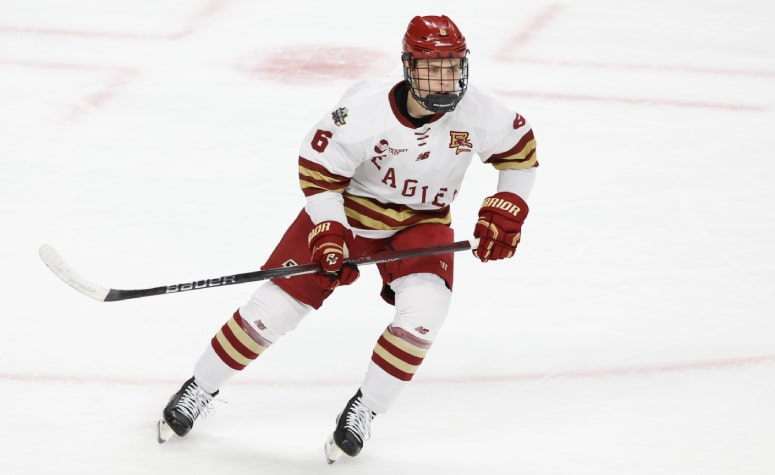

It's a question I ask myself when countless players commit to someday play at different Division 1 programs.
What are the chances this player makes it to that school?
It's easy to think that percentage is low given the decommitments and transfers we see in today's men's college hockey landscape.
I held that hypothesis as I researched past commitments from every New England Division 1 college hockey program.
For starters, I only tracked commitments from New England Division 1 college hockey schools since May 1, 2019. That was when the NCAA instituted two ground-breaking rules on recruiting:
- College coaches can't have recruiting conversations prior to Jan. 1 of a player's sophomore year
- NCAA coaches can't verbally offer players until Aug. 1 entering that player's junior year
It's been just over five years since the rule changes. Since then, 965 players had committed to New England Division 1 colleges prior to July of this year. Players who committed to a Division 1 school after July 1 weren't included in my research.
Of those 965 players, 538 have made it to college hockey. The rest have yet to begin their careers and weren't included in most data (unless specified). Players who start as freshmen this fall weren't included.
This is part 1. Part 2 will include numbers surrounding August commitments, goalies and Division 3.
Let's dive into some of the big findings.
83.64 percent of players went to the college they committed to
Of the 538 players who made it to college hockey or aged out of junior, 450 ended up at the college they committed to.
"To me, that's a healthy number," Yale men's assistant coach Joe Howe said. "You wish it would be higher, but there's a lot of context and a lot of unique situations. It's not always the school and it's not always the kid. It could be some different things. I don't think it would ever be 100 percent just because so much has changed."
Personally, the number was surprising. I thought it would be lower. That comes from seeing players decommit. Ultimately, those are the ones that get talked about and not so much the droves of players who commit to a school and then arrive on campus as freshmen later in their careers.
TRANSFER PORTAL: How the transfer portal is affecting junior hockey
There are many unique situations that contribute to why some don't end up at the college they committed to.
"Some things are controlled by the player," Harvard men's associate head coach James Marcou said. "Some things aren't controlled. I think maybe whether it was a young, committed player, things have changed or the school piece has changed — some of those variables change over time. I don't think it's surprising. Some kids go major junior and change their minds. Schools have coaching changes. That allows for change and kids switch their commitments."
Other major numbers help us understand the overall recruiting landscape even more.
28.66 percent of those players eventually transferred or left
One of the biggest college hockey stories since May of 2019 has been the evolution of the transfer portal.
Due to the COVID-19 pandemic interrupting college hockey (and everything else), the NCAA granted an extra year of eligibility to players who participated in the 2020-21 season. The NCAA went the extra mile in 2021 as well, allowing players to transfer and not have to sit out for one full season.
This is undoubtedly the biggest reason why almost one third of those 450 players who made it to their college they committed to eventually transferred or left.
"I would have thought it would be closer to 10 percent," Providence men's associate coach Joel Beal said. "The only reason I say that is because I think the goal of the committee that implement this transfer portal rule was that they wanted to allow the student-athletes to have the same opportunity that the general student population does. I think if you look in general, it's probably closer to about eight to 10 percent of normal students that go to college and end up transferring to a new school because they don't like the dorms, they don't like the food, they don't like the class, they want to be closer to home.
"I kind of expected it to be a little closer to the normal student. Obviously, there are more factors when it comes to athletics."
That there is.
According to National Student Clearinghouse, transfer enrollment represented 13.2 percent of all continuing and returning undergraduates in the fall of 2023. That's the entire slate of colleges, while our number is just college hockey players who committed after May of 2019 to New England Division 1 programs.
GETTING READY: What should recruiting prospects be doing in the lead-up to their Aug. 1?
Still, it's a big jump and, as Beal said, there are more factors when it comes to transferring. Playing time is a big one. Some leave to play in a higher-ranking conference; others do the opposite.
"[The transfer number] concerns me more because I think in a lot of ways it shows me the player didn't make the decision for the right reasons," Howe said. "I think kids realize that once they get to school that it's more than just the hockey program that you're making a decision on. The fit in the environment, the fit in the school, your life outside the rink — that kind of thing. Where the school is located, what kind of school it is, what you can study. There's so much that kids find out there. And then, if hockey isn't going great, that pushes them to transfer.
"I don't mind that they have the ability to [transfer] at all."
15.23 percent of all commits had previous commitments
There are two prominent names that come to mind here.
The first is Will Smith (Lexington, Mass.). Before embarking on a memorable, one year at Boston College, he committed to Northeastern. Ironically enough, that commitment came on April 30, 2019. The other is Cole Eiserman (Newburyport, Mass.), who was committed to Minnesota but will instead begin as a freshman at Boston University this fall.
Ultimately, out of the 965 commits since May 1, 2019, they are two of the 147 players who had previous commitments.
"The percentage doesn't seem huge," Howe said. "But it's still over one of every 10 kids changes their commitment."
Lots of factors impact why players decommit from schools (or have the school decommit them). A big one is a coaching change. Another is how NIL (Name, Image and Likeness) has permeated college sports.
"The NCAA world changed in terms of what some schools can offer players today that maybe they couldn't four or five years ago," Beal said. "A player might commit to a school and think it's a right fit for them at the time, but maybe before they signed the NLI (national letter of intent), other opportunities have become available — financial opportunities. I do think that plays an impact on some of these decisions.
"I'm assuming some of these kids are going from a full scholarship at School A to a full scholarship, plus Alston money, plus cost of attendance, plus NIL opportunities at School B. And you have scholarships. You're committed to one school on a 50 percent scholarship and there's another school that is going to give you a full scholarship. I think those financial decisions absolutely come into play when a kid decides."
BEAST FALL CLASSIC: 12 uncommitted 18U standout forwards | 6 uncommitted 18U standout defenders
Another massive shift over the last five years has been junior hockey. Once looked at as optional prior to playing in college, it's become a must. It's also provided a place for players to eventually switch commitments.
"Things are just constantly changing with junior hockey and kids playing junior hockey longer," Marcou said. "There's more of a likelihood of guys changing their mind or they don't want to play junior hockey as long as their school wants them to. I think the longer somebody plays junior hockey, the gap years might have a higher rate of wanting to switch schools."