
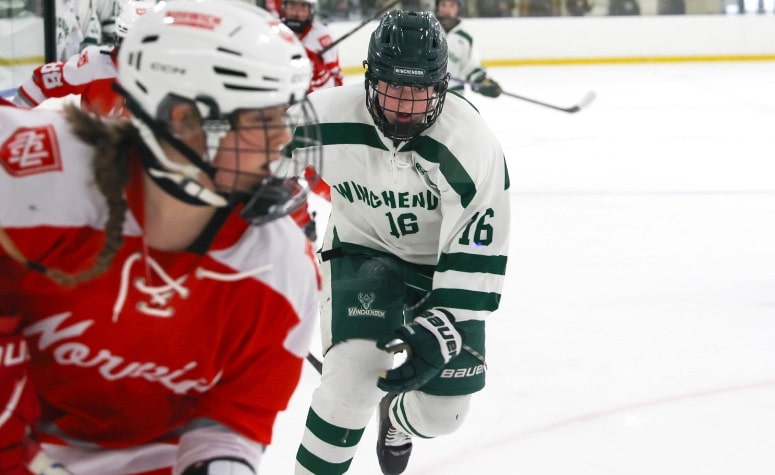

Winchendon took a chance three years ago.
The Wapiti broke from the traditional New England prep model after the 2022-23 season, implementing the full-season USA Hockey model with 16U and 19U teams and a national schedule with 50-60 games in a season.
In its last season in the NEPSAC, Winchendon went 15-15-3. This past season, the 16U squad went 37-9-1, reaching USA Hockey’s High School Girls 2A Nationals, where it lost to eventual champion Lovell Academy in the semifinals. The Wapiti boasted wins over Lovell, NAHA, Culver Academies and the BK Selects. The 19U squad was 23-23-4 this past winter, including wins over Lovell Academy and NAHA.
Winchendon also added a new leader at the helm of its hockey programming in February, bringing in Connor Brickley (Everett, Mass.) as Director of Hockey and its 19U coach after Jeff Pellegrini (Lynn, Mass.) departed for Masters Academy International.
The momentum from this past season, especially with the success of the 16Us, could help springboard the Wapiti into their fourth season with the full-season model and beyond.
“It’s great to have that opportunity where there were some players that really moved the needle forward,” Brickley said. “When you have these big wins that put your program on the map, you want to continue to be able to capitalize on that momentum.”
A logical change in direction
One of the drivers behind Winchendon’s initial decision was convenience.
The majority of players on Winchendon’s roster in 2022-23 hailed from out of state, a trend that continued last season. Even those from Massachusetts were not necessarily local to Winchendon, which is just south of the New Hampshire border in Central Mass.
“For a school like Winchendon, which is a boarding school in a remote location, there are some challenges to having students play on various outside club teams or travel teams,” said assistant head of school John Toffey (Barnstable, Mass.), who won back-to-back NEPSAC boys titles in 2014 and 2015 as an assistant with Salisbury. “We just thought there might be a better way to do it.”
It made for some headaches coordinating split-season hockey in the fall, as players had to sign out of campus, arrange rides to weekend practices and games across the region and make sure they were back in time for dorm check-ins.
“It was a little hectic,” said Ava Provenzo, a rising junior forward at Bowdoin. Provenzo played two seasons at Winchendon, one in the NEPSAC and one with the full-season 19U squad. “It was hard to coordinate the whole split-season thing.”
Provenzo played club for the East Coast Wizards in her junior season. Playing her senior year all under one program made for a more streamlined experience.
“It was pretty transformative for my development overall as a player,” Provenzo said.
NATIONAL CAMPS: Which Mass. players made it? | Who made it from the New England District?
Combine that with Winchendon’s on-campus facilities and academics, plus potential enrollment benefits, and it was a no-brainer in Toffey’s eyes. “All of those things kind of came together and really allowed us to create this program,” Toffey said.
A new voice at the helm
Brickley enters the fold after a successful run with Nauset’s boys program in the MIAA.
The former NHLer and collegiate standout at Vermont led Nauset to back-to-back MIAA finals in 2024 and 2025, winning it all the second time around to complete an undefeated 24-0-1 season. They went 18-2-3 this season under Brickley, who pulled double-duty between Nauset and Winchendon after coming aboard midseason.
Needless to say, it was a busy stretch for Brickley (Everett, Mass.).
“Things were definitely coming at me pretty fast and furious for a little bit,” Brickley said.
His new role at Winchendon includes coaching the girls 19U squad. As he settled in, finishing out the Winchendon season and sorting out next season's rosters, Brickley was also gearing up for a title defense with Nauset.
PREMIER PREP LEAGUE: Here are the rosters for summer 2026
“It was a little bit of a juggling act, for sure, just getting pulled in different directions, but trying to obviously always have the kids’ best interests, first and foremost,” Brickley said. “I think we did a pretty good job navigating the waters, and things are starting to really come out on the other side and looking really positive for this coming fall.”
As Brickley assembles his staff, which will include Boston University and Winchendon alum Lillian Braga (Winchester, Mass.), the Wapiti are confident they’ve found the right person for the job.
“(Brickley) is someone who knows exactly what it takes to get to the highest level of the sport, but also is a phenomenal teacher of the game,” Toffey, a 2002 draft pick of the Tampa Bay Lightning, said. “I’ve been really impressed with his teaching of the game.”
All eyes on development
In addition to his time coaching Nauset, Brickley brings a developmental background from his work running his Endless Potential Hockey Schools skills development program and serving as director of girls programming for the Northeast Generals.
He believes the full-season model gives everyone, players and coaches, a leg up, whether due to more on-ice reps as a team, skill work or off-ice work.
“The kids we’re recruiting are kind of already on that platform and trajectory, pushing it forward for hockey, and these kids at Winchendon have the whole platform every single day, coming in the fall, working with our coaches with our on-ice training, our practices, our skill work, our video and our strength and conditioning program,” Brickley said. “That’s all built in every single day. So, there are a lot more things I can get accomplished on a coaching standpoint for the kids.”
AWARDS: Handing out our 2026 New England women's college hockey awards
In Provenzo’s eyes, the continuity throughout the fall and winter was critical, too, especially in games and the messaging in practice.
“Overall, the chemistry we were able to build on the ice was an improvement,” Provenzo said. “We were all consistently playing together, so I think that really helped, and just being coached by the same people throughout the year kept that consistency moving forward. That’s something I was really able to see in our play on the ice and on a personal level.”
Toffey said, “That’s where you start to see really big improvements.”
One of Brickley’s biggest areas of emphasis will be strength and conditioning. If his teams hit that mark, Brickley believes the rest will translate on the ice when it comes to fine-tuning skills.
“The off-ice component is massive,” Brickley said. “I still believe that’s getting lost somehow. … If you want to build explosiveness, power and speed, that happens off the ice.”
Another key point of emphasis for Brickley’s teams is pace, which naturally helps make them a difficult matchup for any opponent, especially through the neutral zone.
“You have to be able to skate, and you have to be able to make plays at some pretty high-level speeds,” Brickley said. “One big advantage, too, with all of this ice accessible to us, we can put these kids in some situations to really develop pace.”
PWHL EXPANSION: Mass. native Meghan Duggan tabbed to lead PWHL Hamilton
Brickley also believes having separate 16U and 19U teams helps put players in more positions to succeed, especially younger players.
Competing against their own age group, underclassmen might be better-equipped to hit the ground running.
“You’re really able to track the progression of a player,” Brickley said. “They’re not rushed through things, and there’s more time to make sure there’s a strong emphasis on little things that I look for, and they don’t have to wait with limited ice time.”
“There’s obviously a big difference between a ninth-grade student and a senior,” Toffey added.
Preparing for college hockey
This past season, Wincendon’s 19U and 16U teams featured a handful of college commits, be they for Divisions 1 or 3 or even Canadian USports.
Among them were standout 16U Abby Waara (Northeastern), Haley Hasbargen (Assumption) and 19U standouts Caroline Doherty (Duxbury, Mass.; Amherst College) and Kaili Dawson (Shirley, Mass.; Manhattanville).
Since switching to the full-season model, there have been other players bound for NESCAC programs or Division 1 programs, like Holy Cross. With the feedback it has gotten from alumni, Winchendon believes those players have been prepared for the next step.
“We try to run it pretty similarly to what they’re going to see in college,” Toffey said.
‘THE REAL WORK STARTS’: What comes next after committing to play college hockey?
That also goes for the academic piece.
“If you’re trying to start something from scratch with a model like this and start a school, there are so many different moving pieces,” Toffey said. “We’re fortunate that we have a brick-and-mortar prep school. … The families we’re getting are academically focused, and if you look at the college places of the girls who are participating in the ice hockey program, they’ve been phenomenal.”
In Provenzo’s case, the increased ice time and earlier start to the season were beneficial to her transition to the collegiate ranks. “College and playing in the NESCAC is very competitive,” Provenzo said. “I saw a huge difference in my preparation during preseason, moving in as a freshman. It was definitely challenging, but I felt prepared.”
Provenzo also believed Winchendon’s national schedule helped her and her teammates get more eyes on their games. In 2025-26, the Wapiti competed in JWHL tournaments, Premier Ice Prospects tournaments and other showcases like the Roc City Girls Fest against other high-profile teams like Standstead College, Bishop Kearney, Lovell Academy, Little Caesars, Belle Tire, Culver Academies, NAHA and the Philadelphia Jr. Flyers.
“The exposure was definitely at a new level for us,” Provenzo said.
Aside from the possibility of more exposure, Brickley believes those tournaments are another critical part of the developmental aspect and preparation for college hockey.
INSIDE THE PROCESS: What it’s like to be recruited in women’s college hockey
“Winchendon is truly a showcase program. … As you get into these top tournaments and play some top teams on a consistent basis, you want to make sure you’re bringing in the right players and giving them that stage to be able to showcase themselves. As you move forward as a school and you’re really showing what you’re doing as a program, you’re making sure to continue to do right by the players by their moving on and actually achieving the goals they’re setting out to do, and that’s to be college hockey players.
“No players are able to hide here. You have to be able to compete at a high level. Being a part of the environment on a daily basis, I think it makes you want to elevate your game and want to be a part of it. Then you get to kind of have the test, per se, on the weekends when you go to those tournaments to check in and play against some of these top teams and see where you match up.”