
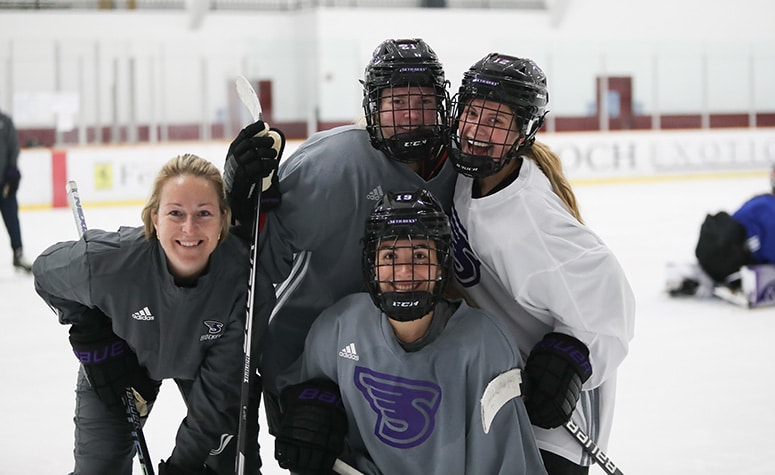

Subconsciously, Tara Watchorn knew the itch was always going to come. It just surprised her it came so quickly.
After four years as an assistant coach for the Boston University women’s team, as well as a stint as an assistant for Canada’s U18 squad, the itch that eventually strikes all ambitious assistant coaches made its mark on the Newcastle, Ontario, native: she wanted to be a head coach.
The then-30-year-old stumbled across an opportunity at the end of her fourth year at BU. Stonehill College was adding a Division 1 women’s ice hockey program and they needed a head coach.
“I’d never heard of Stonehill before,” Watchorn said.
A quick Google search led her to see the first of two main reasons why Stonehill might be the perfect fit — it’s roughly 30 minutes south of Boston. She wouldn’t have to relocate with her husband, a Boston police officer. She also wouldn’t have to stand behind the bench of a former rival program like Northeastern or Boston College.
“It was tough to ever think about moving across town to a rival school,” she said.
The second reason came from her experiences as a four-year player at BU.
Stonehill reminded her of when she was a Terrier from 2008-12. When she arrived, the program was only in its fourth season. At Stonehill, she would be in control of a blank canvas, much like longtime BU coach Brian Durocher (Longmeadow, Mass.) when he started that program.
“That ability to build a culture and create history and tradition somewhere and do something brand new has always excited me,” she said.
Throughout her interview process with Stonehill, it became clear that this job was a perfect fit.
“I felt like we had the same vision and shared a lot of the same values,” Watchorn said. “They were just as excited about my vision as I was.”
That excitement turned into a job offer, which Watchorn happily accepted. That was in May 2021. The Stonehill women’s team wasn’t slated to begin action until the fall of 2022.
Watchorn had over a year to lay the groundwork for this brand-new program she was suddenly in charge of. Durocher gave her a lot of advice, as did others. But there was one common theme throughout what he said.
“Hockey is the easy part,” Durocher said. “Trying to take care of everything else that goes on in the course of a day with 22, 24, 25 student-athletes — whether it’s recruiting, the academics, the fundraising that goes on in this world. Those are the important things.”
Recruiting a team
Good recruiting is paramount to a program finding its way to the top of college hockey, which is exactly why it’s difficult. With the amount of good, established schools in New England, getting talent from the region to commit can be a tall task.
“Honestly, we’ve struggled with the New England recruiting for a number of years,” Vermont head coach Jim Plumer (Norwood, Mass.) said. “There’s honestly a big attraction to the Beanpot schools for kids that are from this area. I think all of us end up finding our niche. We’ve gone international the last five or six years and Quebec for obvious geographic reasons.”
So if the non-Beanpot schools in Hockey East struggle recruiting top New England talent, what chances does a start-up program in Easton, Mass. have of attracting them as it seeks to fill an entire roster of 22 players?
However from Watchorn’s perspective, she felt she had an advantage over other squads. For one, Watchorn had a clean slate at Stonehill. She was offering players the opportunity to shape a program from Day 1.
“It’s a selling point,” Watchorn said. “It’s something brand new that you get to have a hand in creating. I think because it was very much a part of why I decided to go to Boston University when I was being recruited, that type of sales pitch came so naturally because it’s what I’m passionate about. It’s why I took the job. It’s what excites me.
“I think the fact that it was new, that draws a new level of excitement to a lot of players. It’s not for everyone, but the ones that are excited about it, really are excited about it.”
Fortunately for the new bench boss, there was a bigger crop of freshmen (2004 birth year) to pick from than normal due to the NCAA extending an extra year of eligibility after the COVID-19 pandemic. Rosters were backed up for most teams, leaving quality players on the market.
Add in Stonehill having extra scholarship money, more roster spots and the fresh opportunity to be a go-to player, and Watchorn had herself a destination for players in need of a Division 1 college team.
Plus, she wasn’t recruiting against her own record.
“My athletic director makes the joke that I’m the only undefeated coach in hockey,” Watchorn said.
There was also the transfer portal, which Watchorn used to supplement a core of freshmen with experience. Stonehill emerged with four transfers: sophomores Josie Mendeszoon (Methuen, Mass.) and Hanna Zukow, junior Paige Whaley and graduate student Katie Sonntag.
Mendeszoon and Sonntag came from Union, Zukow and Whaley from Mercyhurst.
“They have been amazing so far in the leadership and maturity they’ve brought and the patience and bringing along the young girls,” Watchorn said of the four transfers. “When it comes to Division 1 college experience, you can’t replace that.”
Still, the roster has 18 freshmen. Seven are from Massachusetts, with others hailing from Tennessee, California, Canada and France.
“I only get a chance to build this culture once,” Watchorn said. “It’s continually growing, but to really kick-start it once. You need to find the right people, not just the right players. We really tried to take our time and I really feel good about it.”
All about community
Throughout this summer, Stonehill’s assortment of 22 players came together for a series of video calls with their coaches. In the second meeting, they spent the entire call talking about community service.
“If you were to ask any player on our team why they chose Stonehill, the word community is in there somewhere,” Watchorn said.
One of Watchorn’s first orders of business was getting a feel for Easton and the surrounding towns. While Stonehill is close enough to Boston for Watchorn not to fully relocate, it’s far enough away to not be overshadowed by bigger, more established programs.
“That was one thing that really excited me about Stonehill as well was that small community that it does have,” she said. “That really provides a great springboard to generate excitement around a program especially when you think about the suburbs of Massachusetts. Having a Division 1 hockey team out there? That’s something that can draw a lot of youth programs and things in the area where when you get closer to the city, you’re just competing with way more things for people’s attention.”
Mixing the team with local youth hockey teams, especially girls teams, is at the top of the agenda. Once the season begins, the plan is to put together a committee of players who get involved with youth programs, as well as invite them to Stonehill home games, which will be played off-campus at Bridgewater Ice Arena in Bridgewater, Mass.
For Watchorn, the emphasis is less about youth teams watching the games, and more about letting her players serve as role models.
“When they can see how our girls carry themselves, their professionalism, their confidence, the way they are around the rinks and the way they interact with other people,” she said. “That’s the powerful thing.”
Becoming a part of the community certainly helps with getting more eyes on the program, but it also helps with fundraising.
Watchorn created the Fifth Line, which is designed after BU’s Friends of Women’s Ice Hockey — a booster club to help raise money for the program. The committee has an emphasis on networking in the community with alumni, family and friends.
“We tried to empower them as much as possible,” Watchorn said of the Fifth Line. “We’re very much still in the ground stages.”
What to expect on the ice
Since 2011, seven women’s teams have joined Division 1. Their combined first-season record is 46-155-6.
The big success story is Long Island University, which went 14-18-0 and won its conference tournament over Saint Anselm during its first season in 2019-20.
“As much as we got to see them play so much over the past few years, and I really feel like they all bring something special, there was no way of knowing until we got on the ice together,” Watchorn said of her team. “And there’s still no way of knowing until we get on the ice against a Division 1 opponent either.
“When people ask how I think we’re going to do, there’s no way of knowing.”
But Watchorn does know the on-ice identity she wants her team to bring. She wants Stonehill to play fast and believes her defensive core is mobile enough to drive play, as well as be strong enough to impact the game in every zone.
But this year is more about building the foundation for a great program, which is something the athletic department is on board with.
“If you invest any time, money or energy into anything, you want to see it succeed,” Watchorn said. “I think in that three- to five-year plan of being successful in terms of our performance, definitely. But I very much feel that the department cares about our culture and providing a good experience first and foremost.”
The roster is young and inexperienced — Watchorn knows that. The odds on the ice are stacked against Stonehill, which will compete in the New England Women’s Hockey Alliance (NEWHA). No matter the record, Year 1 will be just as important as Years 3 and 5 in terms of setting a standard.
“If we build that culture and we focus on the foundation that we want to set, and we compete,” Watchorn said. “I really think the wins will come.”