
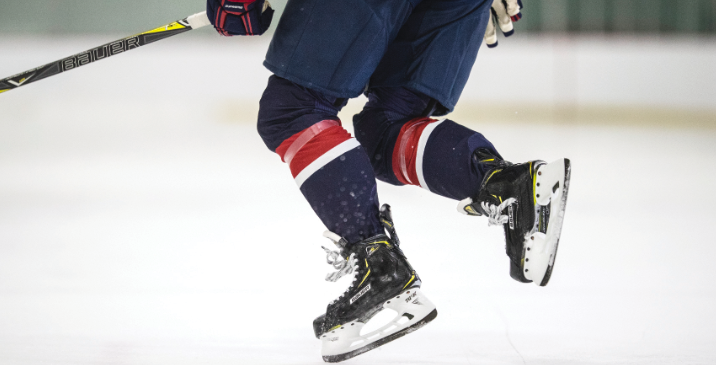

When a book is written years from now about the evolution of ice hockey player skates, the chapter devoted to 2018 will be highlighted by one word: customization.
That’s the hot trend, and it’s not cooling any time soon. On July 14, 2017, Bauer introduced its 3D Skate Lab, a scanning device that analyzes a consumer’s foot profile and recommends which line of Bauer skates — Vapor, Supreme and Nexus — provides the optimal fit. Since then, it has accumulated over 200,000 scans in its system. The 3D Skate Lab also is in about 175 stores throughout North America, up from around 100 when it was released. Clearly, it’s been a hit. But Bauer isn’t stopping there.
Next on its agenda is customizing a skate based off of a 3D scan. Allow John Davidson, senior brand manager of skates at Bauer, to explain.
“We’ve invested in numerous back-end technologies,” he said. “There’s the scanner on the front end, but we will also have 3D printing, new ways of manufacturing and a process in which we’ll be hiring more people in our facility in Blainville, Quebec, to bring customization to every elite-level player around the globe. A lot of data is coming in, and we are having a better understanding of the unique requirements out in the marketplace to produce a better-performing product.”
With that in mind, the skate company is launching a program called My Bauer, which is solely dedicated to the customization of skates using 3D scanning and 3D printing.
The process goes like this: Prospective skate purchasers go to a 3D Skate Lab retailer — remember, there’s more now than a year ago — and in a whopping five seconds will get both of their feet scanned. After an analysis of the scan, the retailer will add notes regarding specific things Bauer will need to take care of when configuring the skate, such as larger bones or sensitivities. Then the consumer can select a tongue, liner, skate blade and other attributes that will boost the performance of the skate.
“From there, the order is submitted,” Davidson said. “It’ll take roughly four weeks to complete. And all skates will come with your name and number 3D printed onto your skates as well.”
One of Bauer’s latest advancements, which remains in line with the customization trend, is Speed Plate 2.0, its second-generation aftermarket foot bed. New for 2018, it replaces Speed Plate, which was introduced in 2015.
“We learned a lot from Speed Plate and now deliver a custom fit that is very similar but better than the first generation,” Davidson said. “We worked with a podiatrist near our Blainville facility, and he showed us the areas of the foot that need to be supported better to generate more power. The Speed Plate 2.0 has a unique foam and support system that keeps your foot in a much more natural position throughout the entire skating stride. By going to this unique support system underneath your foot, a player is able to get roughly 20 percent better power output in each and every stride.
“Another thing that we worked on with Speed Plate 2.0 is the durability of the part itself," Davidson continued. "We re-engineered it and have gone with a new way of manufacturing it to ensure that durability meets the needs of the consumer.”
Bauer also has changed the material it uses for the boot of its latest Supreme model, using Carbon Curv Composite.
“The reason behind that is to maintain the same weight properties of the Supreme from past years, but also make them more thermoformable,” Davidson explained. “So, when you go through the final fitting stage, when you heat up the material, you can see that it really shapes to the foot much better than previous generation materials.”
Meanwhile, True Hockey, the company at the forefront of custom skates, continues to perfect the performance of its products.
True builds a skate from the inside out, starting with a 3D foot scan, which produces a 3D image of the consumer’s foot. Most important, the scan is taken in a weight-bearing position.
“That’s your natural skating position, and the optimal position that you should be taking a foot scan to be able to build a skate that is perfected and custom to your foot,” True Hockey senior marketing and business development manager Dave McNally said.
The data then transfers into True’s manufacturing stage. The end product is a perfectly fitting skate, which means a better-performing skate.
“We truly believe the process by which we build a custom skate is unique,” McNally asserted. “It’s patented and protected from an intellectual properties standpoint. That’s really our secret sauce — the process we use to build a skate.”
What isn’t a secret is the success True has experienced at the National Hockey League level in terms of players using its skates.
When True acquired VH in November 2016, around 68 players in the game’s top circuit were wearing its product. Now, over 130 players are roaming NHL rinks in True skates.
“We are seeing a major uptick in our business at all the major and top-tier amateur ranks,” McNally said. “The same thing is true on the retail side. We have 200 custom-fit centers open in North America with select retail partners. We continue to post record weeks. Every week that we think we’ve topped out, the next week is better than the last. The response has been amazing.”
CCM is expecting a similar response to its new 3D Fit Scanner, which is designed to give the company an extremely accurate measurement of a consumer’s foot to determine which of its skate models will provide the best fit.
On top of that, after the foot is scanned, CCM creates a 3D custom mold of it at its skate factory to help it create a perfect custom-fitting, one-piece boot skate featuring lightweight technology.
It’s that one-piece boot technology that CCM product manager Frederick Beaunoyer calls “one of the greatest technologies that we’ve developed.”
CCM first used the one-piece boot on its Super Tacks line in 2016. It then used it when it created its JetSpeed FT1 line last year.
“By removing the outsole of the boot, you save weight,” Beaunoyer said. “Also, since you have a nice, round boot shape that adjusts to your foot, it gives you a better fit and better energy transfer, because you don’t lose energy into the outsole. That’s very important for players.”
CCM already has received glowing responses to its RibCor 70K skate, launched last year. This skate didn’t include the pump, a mechanism that creates a heel lock. Instead, the boot shape creates its own heel lock, which not only has an end result of a lighter skate, but also a more comfortable skate.
“Whenever you’re stepping into a RibCor, you’re sure to love it,” Beaunoyer said. “If you don’t like the fit of our Super Tacks or JetSpeed FT1, you can just slip your foot into a RibCor and you’ll love it. That’s for sure. The materials, the foams at the ankle, are flexible and adapt to your foot. The RibCor has been appreciated because of its comfort, flexibility and adaptability.”
CCM also upgraded its Super Tacks line by partnering with Orthomove to develop insoles. Previously, CCM’s skate insoles were more suited for runners. Now, its insoles benefit hockey players.
“The Orthomove insoles can be customized for the arch and sole of a player’s foot,” Beaunoyer explained. “When you’re buying insoles at the store, you have the choice of a high-arch insole, medium-arch insole or low-arch insole. With the Orthomove, it all comes in the same package. You have two inserts that you can put under the arch area in the insole. If you have a high arch, you put the bigger insert. If you have a medium arch, you put the medium insert. If you have a low arch, you remove them altogether.”
Having that option especially benefits players who have different arch types on each foot. Most important, it’s another layer of the customization process to get the best-fitting, and thus best-performing, skate.
“You can customize your own fit with those inserts and test to see what fits the best and is most comfortable,” Beaunoyer said.
In addition to upgrading the foot bed of its newest Super Tacks, the AS1, with the Orthomove insoles, CCM also made a change to the boot. While the company still uses carbon composite material, CCM has adapted the construction of it, changing the carbon pattern and adding or removing carbon in certain spots to improve the skate’s performance.
Graf, owned by Vaughn Hockey, is also doing its part to create the best-fitting skate.
It starts with the way its skates are made.
“One of the keys of the way a Graf skate is made is the inside and the outside — the quarter panel — is two pieces,” explained Mike Vaughn, owner of Vaughn Hockey. “The reason it’s two pieces is the three-dimensional shape of your foot isn’t flat in the back. As you go down your Achilles, you go out on the top of your heel, and then back in on the bottom of your heel. If the skate is straight in the back, there’s no top to the heel pocket, so no matter what you do and how tight you get the skate, as you lean forward your heel lifts up.”
Vaughn acknowledges that the process of joining the two pieces together, especially when dealing with higher-tech materials that are stiffer and stronger, requires a lot of work. But the benefit makes it worth the while.
“What we do makes the skate more difficult to manufacture, but we put more definition into that heel pocket,” Vaughn stated.
Some of the specialty foams used in the construction of a Graf skate are actually designed for ballistic purposes. But by incorporating these foams, Graf skates provide protection without increasing thickness.
“You don’t want a skate to get bulky,” Vaughn said. “You want the skate to fit tight and close. Materials now are expensive, but they give great protection without increasing weight or thickness.”
For the consumer, the process begins at the retailer, where each foot is measured, from the ball, to the instep, to the heel.
“Usually, four pictures of each foot are taken — one each of the inside, outside, front and back of the foot,” Vaughn said. “Then any abnormalities are noted, such as bunions or previously broken toes that are rather large now.”
The boot needs to be made to accommodate each of these things.
“Usually on smaller things, they can be heated and punched out with the construction we use to fit the foot, right at the dealer,” Vaughn said.
If the issues require a skate to be made, Graf is prepared for that, too.
“We still use a traditional last, which is what the mold of the skate is made around,” Vaughn explained. “What we would do in that case is we would replicate that bunion on the last while the skate is being built. We’ll pick the last — high volume, mid volume or low volume — that fits your foot, determine the width of the forefoot and the heel, and then we’ll modify that last to accommodate your foot. We then build the boot around the last. The skate truly can be individually made to match your foot. It’s more of a handcrafted process than a pressing process.”
One of the models that Graf is currently working on has a new type of composite quarter panel that has lateral stiffness and also forward flexibility for stride.
“We spent a lot of time working on the weave in the composite,” Vaughn said. “The whole nature of composite materials is they are real stiff, which doesn’t make them very good to mold to get your ankle bumps out and your arch shape. We had to work with this a lot to get the material correct to be able to take the proper shape rather than be flat.”
The end goal is to release to market the best fitting and performing skate.
And, without a doubt, that’s the bottom line for every chapter in that future book about the evolution of ice hockey player skates.