

What happens when you eliminate leather straps and start using improved foams?
Well, if you’re talking about hockey goalie pads, specifically leg pads, they become lighter.
It’s as simple as that. Except it’s not so simple — these changes are considered successful only if performance and durability aren’t sacrificed.
That’s a constant battle for some of the top manufacturers of goalie pads. It’s also a battle they win, time and time again.
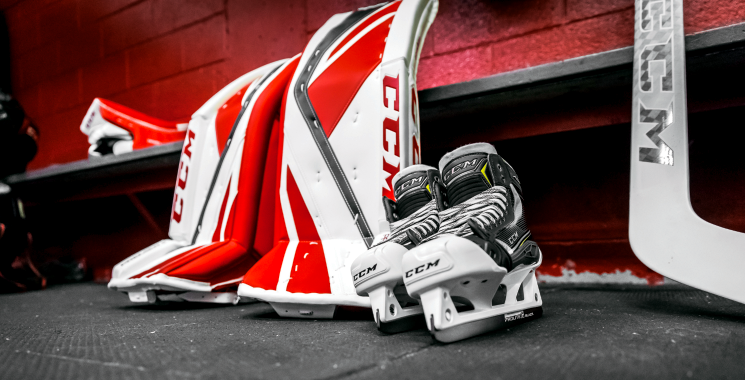
Take CCM, for example. The company just released its lightest pad series ever — the Premier II. But not before trying to figure out what works and what doesn’t.
“We played with the combination of our high-density and low-density foams, and integrated what we call rate-sensitive foam, which is in the first layer of the pad and offers the maximum rebound,” said Mathieu Filiatrault-Giroux, product manager at CCM.
“We took our core and reworked it by playing with the foams to bring the weight down, while also keeping the structural integrity and the level of performance that goalies are looking for in a Premier family pad.”
“Performance” is the operative word for CCM, and it’s a major part of its mission statement. Therefore, simply releasing its lightest pad to date for the sake of having a major player in the ultra-lightweight market isn’t good enough. The pad must perform well.
“We strive for performance. That’s our main thing,” Filiatrault-Giroux said. “We want to put out the best-performing product for goaltenders of all ages. We launched a very lightweight product that competes in the lightweight field, but we have one of the best-performing and durable goal pads within that marketplace. That was the key for us when we launched the Premier II pad.”
As for how much the Premier II pad weighs, there is no specific number, since CCM offers many custom options.
“We have different leg channels, different knee cradles, tons of custom options,” Filiatrault-Giroux explained. “Depending on the option that you go with, and also the size that you go with, the weight is going to vary a lot. What we did was take one specific size and one specific spec combination and compared it to a pad in the previous generation within that family, which is the Premier I, and it’s about 20 percent lighter.”
Meanwhile, Bauer implemented composite material into its pads to lower their weight.
“Adding composite throughout the inside core allows us to keep the pad rigid and its actual overall shape, and it helps make it lighter,” said Spencer Freer, brand manager (goal) at Bauer.
What also makes its pads so light became a pleasant surprise — the C.O.R.TechST skin, which is a solid one-piece material Bauer built for better slide ability, durability and faster rebounds.
“It actually ended up being much lighter than traditional leather,” Freer said. “A big improvement there, too, is overall durability, to the point we were able to create a new boot pad. The way that our boot pad assembly goes on the pad used to be glued on, but now with C.O.R.TechST being so durable, we were able to stitch it in, which allows the pad to be more durable overall as well.”
Bauer has the skin on both of its goalie pad families, Supreme and Vapor.
One notable difference between the two families is Vapor has Aerolite foam for its calf wing to create a lightweight leg channel, while Supreme contains Vent Armor. Both technologies were brought over from the player equipment side of the company — Aerolite from the Vapor line and Vent Armor from the Supreme and Nexus lines.
Bauer is well-aware of the fine line between pads being too light and losing performance and always makes sure not to cross it.
“Any pad can be lightweight,” Freer said. “For us, our super lightweight pad must seal the ice top to bottom when the goalie goes down. It also goes back to those key areas of performance that we’ve identified — slide ability, durability and faster rebounds — and making sure we are achieving those and keeping optimal performance for the elite goalie.”
A significant change across the goalie pad spectrum has been the elimination of leather straps. This evolution was spearheaded by Brian’s Custom Sports, and in place of the old straps is an innovation it calls the smart strap system.
“When we introduced the SubZero line about seven years ago, we created a pad that had no leather straps on it,” explained Chris Joswiak, pro service manager at Brian’s. “It was all Velcro and elastic based. Originally, people thought we were crazy, because they were used to seeing six or seven leather straps on the back side of a goalie’s leg. We ditched all of those and went to a completely Velcro-based system. We received a little hesitancy early on, but goalies and consumers alike have learned that it’s just as reliable. It’s more durable because it’s easier to be replaced, and because of the reduction of all those clips, buckles and straps, you’re losing another half a pound. It’s also easier on your legs, more comfortable and more adjustable.”
Paul Stanton, owner of Sports Etc. in Arlington, Mass., noted that the change quickly spread throughout the goalie pad manufacturing world.
“Brian’s started the trend and now every company is moving in that direction, purely for weight,” Stanton said. “If you still want a snug pad there are adjustments on those straps to make them adhere around your calf. Goalies like to have it a little looser around the calf so they can have full leg rotation of the pad when they go in the butterfly. It’s almost a foregone conclusion now that all pads are made with Velcro straps just for weight reduction.”
Joswiak considers the system and the elimination of metal buckles a “game changer” for Brian’s.
“That was the one thing that goalies were really leery of early on,” he remembered. “Fortunately, we got a couple of pro guys to try it. The straps were outdated. It was a traditional thing and what goalies knew straps to be, but it doesn’t have to be that way. I’m glad we were at the forefront of that.”
Brian’s pads contain proprietary engineered foams in the core, which also aids in weight reduction. This change helped put Brian’s back on the goalie gear map, specifically with its Zero G line, and not only causes weight to decrease, but also allows for better durability.
“That drastically reduced the weight, especially when you look back at older-style pads in the 1980s or 1990s,” Joswiak said.
Those older-style pads, which were made of leather and stuffed with kapok (a silky fiber made from the seeds of tropical plants) and deer hair, were designed by Emil “Pop” Kenesky of Hamilton, Ont., in the 1920s and were the top goalie pads for over half a century.
Now, that type of pad is ancient history.
“It was a natural progression of making the pads lighter by looking at the internals and seeing how you can make it lighter and keep a better shape and a better ice seal,” Joswiak said.
Again, performance is a key factor when reducing weight.
“With the engineered and lighter e-foam cores, you not only get a lower weight pad, but also a pad that’s more predictable, gives up better rebounds, and will hold up better,” Joswiak stated.
The lightest Brian’s pad is its Optik model, which is 4 to 4½ pounds.
“Our Optik line has a reduced outer roll, a gutted knee cradle and is flat faced,” Joswiak said. “All those little attributes to the pad aid in reducing weight and really cater to the butterfly style goaltender.”
The durability of goalie pads has increased because of the improved foams.
“Because of the engineered foams the companies now use for weight reduction, the pads are also much more rigid and less pliable, so they won’t settle as much,” Stanton said. “As a result, the core of the pads is more durable than it was a few years ago, because the integrity and the shape of the pads hold up longer than they did previously.”
While goalie pads have been the focal point when it comes to weight reduction, other equipment, such as the glove and blocker, also has lightened up.
So have goalie sticks, and that’s very important for netminders.
“The blocker and glove weigh approximately the same,” said Mike Sherman, owner of Goalies Plus in Harrisburg, Pa. “When you add in a stick, it causes a natural unbalance to the goalie. Therefore, when it comes to upper body, while blockers and gloves have gotten lighter, the sticks becoming lighter is a bigger contributing force to the overall balance of the goalie.”
Still, goalie pads have been affected most because of one reason — the proliferation of the butterfly style of goaltending.
“Goalies are going up and down many times in a game, so the weight that’s around your leg is what matters most,” Filiatrault-Giroux said.
A big question now is can goalie pads get any lighter?
“Just by experimenting with foams and new material, they evolve to get lighter and lighter,” Stanton said. “But to get lighter than 4, 4½ pounds per pad, I don’t know where they can shave off anymore than they have. They reduced the weight by eliminating straps; they reduced the weight with the material inside; they are making the core of the pad thinner and thinner. I’m not sure how much lighter they can get, but I’m sure the manufacturers will try and figure out a way. Goalies get tired and any little benefit they can get they’ll use. To say that it won’t get any lighter is not a true statement because I’m sure they’ll find a way to do it.”
In that case, how much lighter can they get?
One look in the rearview mirror shows what happens when equipment is too light.
“Weight was a big thing a couple years ago in the player stick category,” Filiatrault-Giroux said. “Going back to performance and durability, it’s easy to put out a lightweight product. Where the challenge comes in is keeping a high level of performance and durability. Six or seven years ago all companies wanted to launch the lightest sticks in the marketplace, to a point where you could watch a hockey game and see a bunch of defensemen taking one-timers at the blue line and sticks breaking like crazy. The challenge is finding that benchmark or fine line with weight without sacrificing performance and durability.”
There’s also the aforementioned balance factor.
“You might have a pad that isn’t lightweight, but doesn’t feel boot heavy,” Freer explained. “If that pad is balanced, and feels light top to bottom, and seals the ice well, goalies are a fan. If you can make a stick that isn’t super light, but is balanced in the hand and doesn’t feel blade heavy, goalies are totally OK with it.”
Of course, there is one way to lighten pads even further, but it comes with a cosmetic cost.
“Another battle we face is finding where we can take some weight out, but not lose the richness of the pad,” Joswiak said. “If you look at a Brian’s pad on the shelf, it looks very high-end and rich, and there’s no absence of materials and logos. We are always tinkering to find the fine line of making it look the best, have the best performance, and have that ultra lightweight feel as well. That’s always the challenge — finding the right combination. If we build a pad, all defender, with no graphics, and make the pad not look rich, we can get a pad down to 3 pounds. Three pounds is about the lightest we could really get a pad. If you optimize the craftsmanship, look, richness and balance, 4 pounds is about as low as you can get and is right around the sweet spot of where you want to go with ultra lightweight.”
The positive for goalies is that there will never be a shortage of lightweight pads.
“All the companies do it well in one way or another,” Sherman stated.
But here’s a warning: Never say that this is the lightest goalie pads will ever be.
“Every time I say the pads can’t get lighter, they do,” Stanton concluded.