
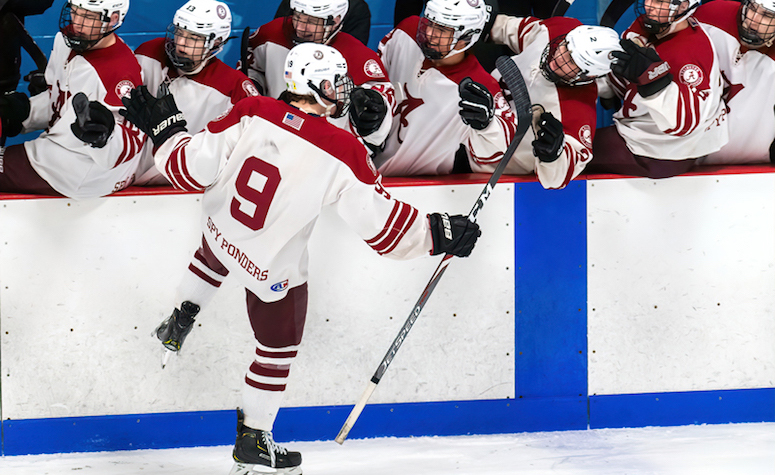

It will be at least four years until the Division 1A tournament, better known as the Super 8, has a chance to return to Massachusetts high schools sports.
In a meeting last week, the Massachusetts Interscholastic Athletic Association’s Tournament Management Committee voted 12-2 to accept the proposal from the Blue Ribbon Committee to put the playoff tournament on hold for the next four seasons to see if it should be a part of the new statewide playoff format that’s going into practice at the start of the 2021-22 school year.
The new playoff format, which begins this fall, was designed to create more divisions and better align schools based on enrollment and create equal paths to championships, as opposed to the current regional tournament format.
The Blue Ribbon Committee cited issues such as maintaining consistency, equity and Title IX compliance across all sports as the overarching factors behind the Super 8 pause.
“We’re trying to look at this and say, as we roll out this new state tournament, how do we make sure we’re doing it the right way,” said Pamela Gould, the presenter on behalf of the Blue Ribbon Committee and superintendent of Sandwich.
The high school hockey community was left reeling after the abrupt news.
“I was stunned,” Malden Catholic High School head coach Chris Kuchar told New England Hockey Journal. “I was definitely shocked. The first thing I did was call my athletic director to see if he knew anything about it and, surprisingly, he didn't.
“He didn't know anything about a vote, didn't know anything about the process, so it was a shock to me, it was a shock to him, and then that's why I started calling my other coaching colleagues around the state to find out what, if anything, they knew about it, and the answer was the same: They didn't know. So, it’s very disappointing.”
For public and private school players alike, the Super 8 was always the crowning achievement — the one slate of games that meant more than anything all season long.
“Every public-school kid and every private-school kid, they all want to get to and play in the Super 8 because it's the biggest tournament of the year,” Kuchar added. “That's what they strive for, and I don't think it's elitist to want to strive for that. And like I said, if you're going to take that away without thinking about any other alternative opportunities, I just think it's very shortsighted and very disappointing.
A 10-team, double-elimination tournament, the Super 8 first began in 1991 as an attempt to level the playing field between the public schools and ever-dominant private and Catholic schools. The 10 participants were chosen and seeded annually by a selection committee based on winning percentage and other season-long criteria. The tournament begins with two play-in games culminating with the finals.
With the addition of the Super 8, teams at all levels of the high school sport gained enhanced opportunities to win a state championship in a winner-take-all scenario between the state’s undisputed 10 best teams — no matter if they were private, public, Division 1 or Division 2.
While Catholic schools own 26 of the 29 Super 8 titles, 23 public schools have played in the tournament, with Reading (2008), Hingham (2010) and Arlington (2017, 2020 co-champion) claiming the top prize in David vs. Goliath type affairs.
High school baseball adopted a Division 1A playoff for similar reasons in 2014.
The MIAA, however, no longer sees it that way and wants to use the four-year recess to help inform its thought process that the dominance isn’t as abundant as it once was.
One way or another, the tournament that every high school player dreamed of playing in, and winning, as one of the top eight teams in the state is no more.
“After watching the 2010 team win the Super 8, all I ever dreamed of was winning it for my town,” Hingham High senior Ronan Mulkerrin said via Twitter after the news first broke. “Unfortunately, the chance was taken away from me my senior year, now it’s taken away from all my friends. The MIAA just crushed so many kids’ dreams.”
The biggest gripe from the community is that the MIAA didn’t seem to seek any outside input on the decision, including from the High School Hockey Coaches Association, which was “floored by the TMC vote,” it said in a statement.
“The D-1A boys hockey tournament that began in 1991 has been very successful,” the MSHCA continued. “Leading up to the 1A tournament, Catholic schools were dominating and winning all of the D-1 state tournaments. Since the 1A tournament existence, a large number of public schools have won D-1 state tournaments at the Garden. We have 30 years of data on how successful the 1A tournament has been.”
The tournament, which was not held in 2021 after this year’s shortened high school season, was halted on the eve of the final between Arlington High and Prep Francis due to COVID-19 in 2020, resulting in Super 8 co-champions.
Now, for the foreseeable future, BC High’s quadruple-overtime victory over Pope Francis at TD Garden in March 2019 will be the last true Super 8 title game in state history.
What happens in the wake of the pause in the next four years remains up for debate.
“I think history may repeat itself,” said Kuchar, who’s coached both private and public schools (Andover High) in Mass. “I think if you look at the genesis of the original Super 8, you saw a lot of the public-school teams going, ‘We can't win this thing.’
“I've been on both sides of it going, OK, it's definitely tough to compete against the privates, but it's something you don't mind taking on. It’s a challenge. I looked at it as a positive as a public-school coach. Since the Super 8 was added, you have public schools winning the D-1 state championships, and I think that's a positive.”
For now, the ultimate prize may be changing, but the work to get there will not.
“I got a lot of messages from my players basically saying, ‘Coach, what does this mean?’ And I said, to be honest with you, the goal hasn't changed,” Kuchar said. “We want to win a conference title; we want to win a state championship and we want to win a ring. That hasn’t changed.
“Just because it may not be under a Super 8 format, the objective is still the same. At the end of the year, we want to be one of the best teams in the state and play for title so that doesn’t change. We're going to have to play the same teams we were going to have to play to get there anyways.”
Liam Flaherty can be reached at liam.flaherty@nyhockeyjournal.com and on Twitter @_LiamFlaherty.