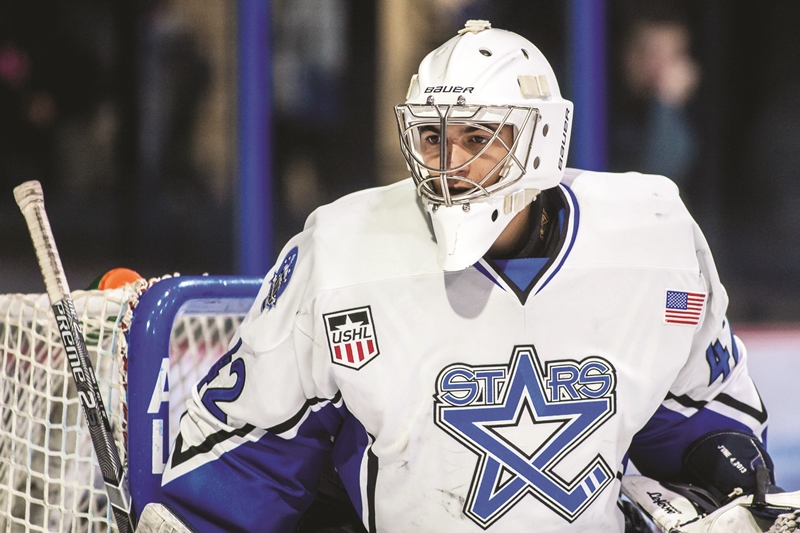
Goalies are different. The position itself is unique, but so are the players. And so is the recruitment process.
“It’s apples and oranges,” said one longtime New England goalie instructor and advisor. “They have nothing to do with one another. I would never advise a player family like a goalie family, and vice versa.”
The reasons for that are myriad. Start with the reality that most coaches, and most assistant coaches (who do most of the active scouting), don’t have goaltending backgrounds. So they’re relying on the advice of others, as well as game film and statistics. While many college teams now have goalie coaches, those “volunteer” positions are limited by NCAA rules to working with players in season, on the ice.
As a result, coaches and assistants with little goaltending experience are making decisions about the team’s most important position. Even if a coach does make it to several games to scout a goaltender, their “eyeball test” often has less to do with a goalie’s skill-set and more to do with assessing their “comfort level.”
“(Most coaches) don’t have the knowledge to really evaluate the goalie’s game from a technical perspective,” said the advisor. “What they can do is judge how they feel when they’re watching the goalie, the impact that the goalie has on the game. Does the goalie give the team a chance to win? Does the goalie give the non-goalie coach the confidence that they can simply go out and coach the game without worrying about that goalie?
“If that goalie is flopping all over the place, kicking out rebounds, misplaying the puck, that doesn’t give the coach that sense of confidence,” he said. “I think all they’re really looking for is the goalie to confirm what other people are telling them by playing well when they’re there.”
That’s a major factor why honest and dependable referrals are essential in goaltending circles. Generally speaking, coaches are confident in their ability to assess talent when they see a positional player. But when the coach isn’t a former goalie, they don’t have the same assurances, and they need their opinions validated.
“So the more people who see you play well, they can reinforce what the coach is seeing,” said the advisor. “That’s where stats come into play. If you have good stats, it will reinforce what people are saying, and it will reinforce what the coach is seeing.”
There’s also a restricted number of slots on any college roster. Unlike a minimum of 12 forwards and eight defensemen, most college squads dress, at most, three goalies. And only one of them is usually playing regularly. So coaches are looking for goalies who welcome a challenge.
“The hard part for goalies is that there aren’t enough nets to go around,” said New York Rangers assistant coach Greg Brown (Southboro, Mass.), who was an assistant for Boston College’s Jerry York (Watertown, Mass.) for 14 years before joining David Quinn’s (Cranston, R.I.) staff on Broadway. “So you’re jumping into a situation where you know you have to fight. It’s not going to be given to you. And you have to enjoy that competition, because the further you go up, the fewer nets there are.”
That situation is exacerbated at D-1 programs like Boston College, where a clear-cut starter usually is expected to play the lion’s share of the games. During Brown’s tenure, spanning from Cory Schneider (Marblehead, Mass.) to Joe Woll, there was only one season when there was a genuine “competition” between netminders. That came in 2009-10, when York’s staff knew John Muse (East Falmouth, Mass.) was coming off hip surgery. Unsure of Muse’s recovery, BC brought in Parker Milner, who played in 14 games his freshman year (going a respectable 10-2-1, with a .909 save percentage). His sophomore year, Milner took a back seat to Muse, before becoming “the man” his junior and senior seasons, playing in 34 and 37 games, respectively.
“And he got a national championship,” said Brown with a laugh.
The flip side is a goaltender like BC’s Joe Pearce, who was selected by the Tampa Bay Lightning in the fifth round of the 2002 NHL Entry Draft but played in only 10 games over three seasons behind Schneider. Still, Brown, who was an All-American defenseman at Boston College, recognizes the challenges of recruiting that starter. In fact, he acknowledged that he found Milner while recruiting another goaltender at a pair of United States Hockey League games.
“It’s a position where you can’t afford to make a mistake,” said Brown. “If you do, and you recruit a player who isn’t playing well enough, you probably have to recruit another one. It’s not something where you can say, ‘We have five other defensemen that are going to pull this one guy through.’
“There’s only one net,” he said. “You can have an average team and a great goalie, and probably have just as good a chance of winning as a great team with an average goalie.”
Today, the Eagles have a former goaltender on their staff, with Mike Ayers (an All-American at New Hampshire). That gives BC a distinct edge during scouting and recruitment, since Ayers (Hingham, Mass.) has a better grasp of the technical and emotional demands of the position.
“Everyone has their own opinion on what attributes are important, but the ones I focus on are athleticism, hockey sense, competitiveness and coachability,” Ayers said.
And although BC has had a run of young netminders who played right out of high school — including Schneider, Thatcher Demko, Woll and incoming freshman Spencer Knight (Darien, Conn.) — Ayers said many goalies can benefit from a year or two in juniors, like Muse and Milner.
“As a goalie, I don’t think it’s a bad thing to take additional time before entering school,” Ayers said. “Lots of kids do it and have success, because it allows the kid to mature and understand the game. Coming from prep school straight to college can be very challenging, due to quicker releases (on shots), a much faster game, in-game pressure, and knowing how to manage your time between hockey and school.
“The big thing is, ‘Be where your feet are,’ ” said Ayers. “If you don’t seize the opportunity where you’re currently playing, you won’t maximize your potential at that particular level. I think the time to move on is when you feel like you’ve done everything you can at a level. Then make a move.”
Goalie coach Rob Day, owner of Puckstoppers and Sports Science Solutions, said playing juniors is a “definite” for goalies who hope to continue playing in college. Like many coaches today, Day points to emerging research that shows the number of games played is a solid barometer of future success.
“You have to play a lot of games and go through a grind, because each game at college means something and you have a lot fewer of them,” said Day. “I have had a bunch of D-1 commits that have gone onto juniors. It’s an expected path now because the age of the players is older when they enter (usually 20 or 21).
“Pick a good junior program, however,” he warned. “There are a bunch of bad ones out there.”
Ayers also recommends that players take ownership of the process, learning about not only the many elements of the schools they’re considering, but also the goalie coaches they’ll be working with.
“The coaching piece is another important piece to it,” he said. “Who is going to work with the goalies? Is that a good fit?”
Goalies also should understand that coaching expectations, and goaltending profiles, vary between Division 1 and programs at the D-2, D-3 and club (ACHA) levels. According to the website Next College Student Athlete (ncsasports.org), D-1 recruits are typically 6 feet or taller, with a goals-against average under 2.00 and a save percentage above .900. At the D-2 and D-3 levels, those numbers are 5-foot-10 or taller, with a 2.33 GAA and save percentage of .880 or better. In short, the further up the ladder a goalie goes, the more complete game the coaching staff expects to see.
Furthermore, there’s a shifting dynamic between school and recruit that comes into play at different levels. For top talent — goaltenders in the upper 10 percent — D-1 schools are directly recruiting the players. That situation gets turned on its head below the D-1 level. At D-2 and D-3, players often need to engage the school.
To do that, players need to brand themselves, say many advisors. That starts with creating a web page featuring a brief video (90 seconds), a résumé (highlighting playing accomplishments and statistics, plus academic achievements), and personal references, because most coaches simply can’t scout dozens of games for each recruit.
“There’s not enough time to cover everything,” said one advisor. “So you’ve got to make it painfully easy for them to recruit you. You’ve got to provide the information.”
Another factor is that, for the vast majority of goalies, playing hockey is only part of the larger college experience. Players and parents need to remember that choosing the right school, including academic and social factors, is crucial. Selecting a school solely based on its hockey program can lead to an unfulfilling four years if a goalie’s playing time is curtailed.
New NCAA rules at the D-1 level are expected to alter the recruiting timeline in the hopes of slowing down and improving the recruiting experience. Those rules eliminate all recruiting conversations before Jan. 1 of a prospect’s sophomore year, and establish Aug. 1 prior to a prospect’s junior year as the earliest date when coaches can make a verbal offer. These changes, say coaches, should provide players, and their parents, more time to consider which schools are the best fit.
“The biggest thing for the recruits is knowing what they want in a school,” said Ayers. “Education, campus, fitting into rest of student body, how close they want to be from home, et cetera.
“To me, the new rules are going to allow these kids to mature and truly understand what they want, in regards to schooling and picking the school for the right reason,” he said. “I believe its important for the parents to help guide their son or daughter through the process, yet allow the student-athlete to make the decision on what institution they want to go.”
Finally, if a player or parents opt to hire a family advisor as an intermediary, Day strongly recommends that they “find a reputable one.”
“Find someone who shares your same goals and who can be your friend, someone you can talk to,” he said. “Sometimes they will serve as more of a mentor than a parent.
“Mostly, hire an advisor on character,” said Day. “If they’re a sneaky person, then they’ll be that way as an advisor.”