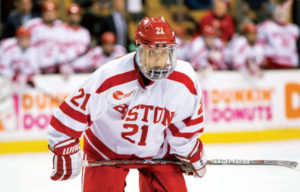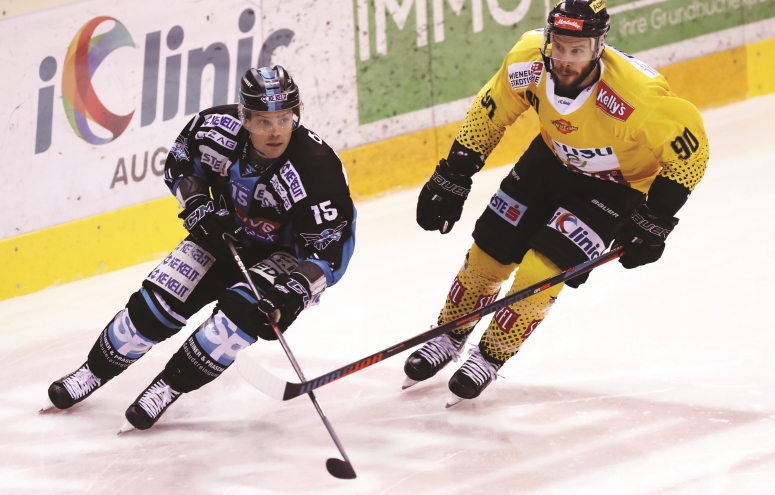
Ten seasons. 457 games. 56 goals. 195 assists. 251 points. One championship. One promotion to the top league. It’s quite the résumé for Boxboro, Mass., native Kevin Kapstad. In his decade of professional hockey in Europe, he proved himself an invaluable member of all of the five organizations he played for. The smooth-skating defenseman collected plenty of accolades over his career.
There is one other number of note: 33. That’s how old Kapstad is today.
Most of us would consider ourselves lucky if we could retire that young. Some hockey players manage to earn the financial security to pull it off. Kapstad’s former University of New Hampshire teammate James van Riemsdyk could certainly consider it upon the expiration of his current 5-year, $35 million deal. While the contracts in Europe are certainly enough to live comfortably off of, having never signed on for more than two years, Kapstad wasn’t buying chalets in the Austrian Alps. That’s not to say he wasn’t enjoying the luxuries of a professional athlete in Europe. “We (with wife Jackie) traveled a lot. I wasn’t so concerned about saving all my money. I wanted to have my life experiences, too. It’s not like you’re making a million dollars a year. You know you’re going to have to work, at some point in your life.”
Those unique possibilities are what drew Kapstad to Europe in the first place. His father, Jan, is a Norwegian national, so Kapstad always had a loose connection to the east side of the Atlantic (despite those roots, Kapstad never played in Norway). After a strong career at UNH, the undrafted prospect knew the American minor-league circuit would be a grind. He wanted hockey to continue to open doors for him — this time, in Europe. “I didn’t really think I had a chance to crack the NHL. I got a lot of interest from the American League, but I just wanted to try and travel. I had had some friends that did it, and said it was awesome.”
This past summer, he closed the door. Despite one more year remaining on his contract with Linz of the Austrian Erste Bank Eishockey League, Kapstad decided to walk away from the game. It wasn’t the burden of towing two young kids (Van and Ella, she being born this summer) around Europe. Instead, it was his dedication to his own parents. His mother, Kim (who passed away shortly after Kevin was interviewed for this feature), had been battling esophageal cancer. “(Mom’s illness) was the main reason,” Kapstad acknowledged, realizing his heart — and, at times, his actual person — might not be on the ice. “I wouldn’t have been committed with what was going on at home, and just my overall desire to play. I just didn’t think it was really fair to the team.”
That decision turned Kapstad into a 33-year-old job hunter. With a degree in healthcare management, Kapstad wasn’t overly fretful about being able to find work. However, he knew the healthcare industry had changed and that it would be a new challenge. “It’s not like you have an agent searching for your job. You have people trying to help you, but you really have no background in anything other than sports,” he said. Although he might not have had a prototypical résumé, his career certainly showcased the kind of attributes employers look for.
Kapstad learned how to battle through adversity. Making the immediate jump from Governor Dummer Academy to UNH, Kapstad wasn’t able to establish the dominance he had grown accustomed to. He dressed in only three games in that initial season (former assistant coach Scott Borek would lament that decision, as it burned a year of his eligibility). This did not deter him. Like any competitor, Kapstad showed signs of frustration, but he buckled down. As a sophomore, he dressed in all but one tilt. That one absence was the only exception in his final three tours.
Kapstad showed — plenty of times — that he was capable of taking on new challenges. Despite some interest from AHL teams, Kapstad saw his future in Europe. “It was between Norway and Germany. I took some advice to go to Germany,” Kapstad stated.
The German second league might not be the most acclaimed organization, but Kapstad entered like an eager intern. After completing his stint with Riessersee, Kapstad switched to Landshut. In his second season with the Cannibals, Kapstad was a driving force as Landshut conquered the German 2nd Bundesliga. He finished fourth on the team in scoring. His 37 points led all defensemen. He added 12 more points in the playoffs, the second highest total among participating backliners. Half of those points came in the final three games (two goals, four assists) as the Cannibals convincingly proved the champions, outscoring Rosenheim by a 13-goal margin (21-8).
That earned Kapstad a strong reference, from former NHL netminder Tommy Salo. “I got lucky, I had a really good year in an OK league,” Kapstad relayed. “I kind of got picked out of there by Tommy. He scouted me and just pulled me out of that league, and just put me right into Sweden. It was a big risk (for him) … but I ended up succeeding there.”
The frost of central Sweden didn’t cool Kapstad off. He justified Salo’s faith, leading his team in scoring from the blue line. This was a team that included former Boston Bruin Mattias Timander and current KHL standout Patrik Hersley. That being the NHL season half stalled by another lockout, Kapstad found himself competing against All-Stars such as Bobby Ryan, Anze Kopitar and Cam Fowler. It, obviously, didn’t deter him. After his productive season, Kapstad was given a tougher role in the Kvalserien, the tournament that determines who gets to climb to the Swedish Hockey League. With talents like Michael Raffl and Filip Forsberg on the roster, Leksands had plenty of offensive firepower to utilize. Often thrown on the top defensive pairing, Kapstad, instead, was shouldered with the responsibility of limiting the threats of opponents. He held up his end of the ice. Because of this, in the 2013-14 season he found himself playing in one of the top leagues in the world.
Weary of Kapstad’s fortunes, some employers might prod, “Tell me about a time you were unsuccessful.” Any professional athlete can pinpoint a few of those moments. There are the granular instances, getting beat on a one-on-one, et cetera. For Kapstad, he might point to his 2014-15 season in Leksand. His production dropped from the previous season, and the team fell with him. After rising to the SHL and then making it to the wild-card round in its first year back, Leksands found itself quickly rerelegated. The harsh realities of being a competitive, small-market organization had kicked in.
Following that, Kapstad left for Austria. An inquisitive interviewer might be intrigued. Perhaps, he had succumbed to the defeat, and wanted to settle for an easier league. This would certainly fly in the face of Borek’s observations of Kapstad. The coach praised his drive. “His best asset was how competitive he was,” Borek lauded. This, really, is what pushed Kapstad to Austria. It all started because Kapstad didn’t want to spend too much time on the “unemployed” list. “I had a weird contract in my last year (with Leksands) where I couldn’t go back until November. I had had a bad year, so I knew that I wasn’t going to stay in Sweden, essentially. I was hoping I was going to get to the KHL or Switzerland, but those leagues are tough to get into. I thought I was going to Germany — to the DEL — and that fell through. (Finally) I got a really good contract at Klagenfurt.”
Ever accustomed to making a strong first impression, Kapstad paced the KAC defensive unit with 30 points. His efforts would help propel Klagenfurt into the playoffs, where it took the eventual champions, Salzburg, to seven games. The next season saw similar contributions from Kapstad. This time, KAC would advance all the way to the finals. He gave one more attempt to take Klagenfurt to the pinnacle of the Austrian league but couldn’t obtain that elusive title.
A cynical employer might wonder why he couldn’t last longer than three years at any of his stops. However, those decisions were not based on his personality or performance. His on-ice work speaks for itself. Few teams would be eager to get rid of a productive, offensive defenseman. Besides, his departures surely weren’t because of his locker-room presence. Coach Borek remembers Kapstad as a unifying presence in the room. “He was a personality. We had a lot them back then. He was one of them, one of the leaders of them.”
Kapstad never hinted at any grudge against whomever he previously played for. In fact, he expected to play only a season with KAC, but found himself in Austria for four years because he enjoyed it so much.
Last season, Kapstad finished his career with Linz. He nearly matched his Austrian league high, scoring 27 points. He showed little signs of slowing down. Unfortunately, because of his mother’s health challenges, he walked away. Some players say it’s an easy decision, when the time is right. “When I got home, I was going to see my mom a lot,” Kapstad said. “I just had no desire to go to the gym or put my equipment on. I knew, I wasn’t excited to go back. It just happened. Then I did it, and I didn’t have a job, so I was freaking out.”
With his degree and résumé (and some guidance from former teammates), Kapstad entered the job search. With two young kids that he still needed to raise, he had little time to waste. Considering his track record, it should not come as a surprise that he was offered a job. Now, Kapstad sells medical devices. He’s still new to the tasks, but he has a favorable early impression.
“I enjoy it. It’s a good field to be in. Everyone’s going to need health care at some point in their life,” he said.
Aside from the work itself, the affable Kapstad has relished the personable nature of his new occupation. “It’s a lot of face to face,” he noted.
Given how quickly he made his impact throughout his hockey career, it is a safe assumption that his new employer has been impressed. Undoubtedly, there are many opponents in Europe who were happy with Kapstad’s decision to start his second career.