


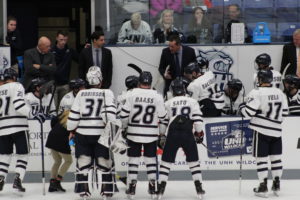
Mike Souza has a tough act to follow, taking the reins of the University of New Hampshire following the stellar 28-year tenure of Dick Umile (Melrose, Mass.). But there is no doubt Souza will expend all his passion and energy for the Wildcats.
A standout forward for the Wildcats from 1996-2000, Souza helped his team reach two Frozen Fours and was an NCAA All-Tournament honoree in 1999. The native of Wakefield, Mass., bolstered his coaching résumé with assistant gigs at Brown and UConn in addition to his alma mater. NEHJ contributor Billy Jaffe caught up with Souza during a recent Hockey East weekend.
Billy Jaffe: What’s been the biggest difference in being the head coach as opposed to assistant coach?
Mike Souza: The one thing that jumps out at me is you are getting asked to do more things than as an assistant. As an assistant you’re sort of focused on two things — maybe it’s recruiting and if you oversaw a special team, that was pretty much it, as well as your day-to-day coaching obligations. There was no meetings with donors and those types of things — all things that I don’t mind doing, but there’s definitely less time in the day to focus on hockey, and ultimately, it’s the hockey piece of it that I love.
Jaffe: Have you had to adjust your schedule and your mental approach?
Souza: A little bit. I rely heavily on our director of hockey operations, Colin Shank, who I think is the best in the business, to kind of keep things moving in the right direction. As head coach, your responsibility is to oversee everyone, which I don’t mind doing. But definitely the minutes in the days shrink when it comes to preparing, so you have to spend longer days in the office, which I’m not opposed to doing. I enjoy it. The thing that really drives me is the hockey component of it. That’s what I love. I love in the interaction with players and helping them get better.
Jaffe: Do you find yourself taking wins and losses — in particular losses — differently now from the head coaching perspective?
Souza: I said to a buddy of mine this summer, “It’s a lot different when you’re standing in the middle of the bench.” I used to feel for Coach Umile last year. It’s easier when you can kind of slide to the ends when you are an assistant, but when you are in the middle, you’re responsible for everything. I have no issue with that. You hope you can win some more games. Your focus is on more things. It’s been a learning experience but one that I think I have been adjusting to nicely.
Jaffe: You have seen UNH at many different levels — as a player, assistant coach, as an alum who went away. Now as a head coach, how do you see UNH?
Souza: I love UNH. It’s given me so much in my life. I’ve said it many times — the university owes me nothing. Looking back on my time as a player here, preparing me for life after hockey — and ultimately that’s our greatest responsibility, as a coach, is prepare these guys so the four years after they leave here are the best four years of their life. I don’t take that responsibility lightly. It’s a lifestyle for the four of us — with my wife and my two daughters.
Jaffe: Recruiting is such a major part of any college sport. There are some potential changes down the road that could impact hockey, many people think in a very good way. In particular, we’re talking about verbal commitment ages, et cetera. In your opinion, as the head coach, is that something that is needed in this sport?
Souza: I think that some reform when it comes to recruiting was necessary. For me the hardest thing is the third-party involvement in the recruiting process. The days of the coach building a relationship with the player and the family have become lessened by the involvement of third parties into the process. I think that’s also spurred on some of the verbal commitments that haven’t been fulfilled. So I think having those things addressed is huge. To get some of the more well-known guys in the business in our field involved in this decision — the recruiting committee that was put together with Scott Sandelin, Wayne Wilson, guys who have been around a long time — they have a lot to offer, and I’m fully supportive of their recommendations.
 Jaffe: You’ve seen youth hockey through the eyes of a recruiter. Are we doing player development the right way? We’re emphasizing skills, skills, skills so much. Are we making sure they’ve got enough hockey sense?
Souza: Great question. The irony is we talk about kids playing other sports, yet many of the programs in our area become 12-month commitments. How can you become a multisport athlete and enhance your athletic sense, I like to call it, your ability to know when to move, when not to move, when to be covered, how to be covered, how not to be covered? I think we’re limiting the ability for kids to do that, because it doesn’t happen naturally. Everything is structured now for our kids. The lasting question for me is, “What is actual skill?” I think it comes in all different forms and it looks different. It’s ultimately the ability to be able to make a play at a rate of speed, when it matters. It’s not toe dragging it around a tire. It’s the ability to make a play with pace.
Players play a lot of games now. I was over in Scandinavia, and those kids don’t play a lot of games, especially early in a player’s development. There’s definitely not any games in the early part of the year. There’s definitely not full-ice games in the early part of the year.
You marvel at why some of the smaller Scandinavian countries — Finland, Sweden — are able to produce so many players. With that being said, I think some of the things that USA Hockey has done, Pat Kelleher and his team have done, are awesome. My kids have benefitted from some of the ADM stuff, which I think has really positive impact on our young players today.
I’m a public school guy. I grew up playing for Wakefield (Mass.) Youth Hockey. You go out to Minnesota, and there is nothing cooler than going to an Elk River-Edina game and there’s 2,000 people and a band, and playing in front of your hometown. It’s really cool. I know those days are gone here, for the most part. It’s too bad. I’d like to see kids not play hockey 12 months a year.
Jaffe: Is there another element to you aside from hockey that helps identify you?
Souza: That’s a tough question. I’m an inquisitive person. I try to learn from as many people as I can, no matter where they are or what they do. I ask a lot of questions, and at the end of the day, the two most important things to me are my family and coaching this hockey program and UNH. My obligation is not to any one kid on this team, it’s to the entire roster.