
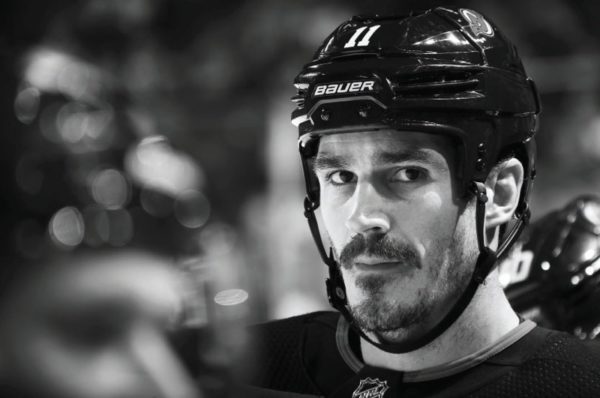

Brian Boyle, sweat dripping from his forehead, finally arrived at his locker, the last player off the ice after a nearly two-hour practice. An optional practice.
He took off his black helmet, placed it on the top shelf of his stall, sat down and took a much-needed deep breath.
It's late November and life is good for Boyle. The 11- year National Hockey League center is contributing in his first season with the New Jersey Devils after signing a two-year contract in July, and the club is an early season surprise in the hockey world. A few weeks later on Dec. 18, Boyle would celebrate his 33rd birthday with his first career three-assist game in a come-from-behind 5-3 win against the visiting Anaheim Ducks.
But beyond his smile and hulking 6-foot-6, 245-pound frame is a man who just two months earlier wasn’t sure what the future held for him and his family; wasn’t sure if he would ever play hockey again; and, quite frankly, wasn’t sure if he would be alive much longer.
That’s what happens after hearing a doctor tell you after taking routine blood work as part of your training camp physical that you probably have leukemia, type still unknown, with 20 times the normal amount of white blood cells.
He would later find out that he had chronic myeloid leukemia, a type of bone marrow cancer. But before receiving his final diagnosis, a bewildered Boyle wondered what was raging inside his body.
In the interim, and ever since, he turned to the two boulders in his life for guidance and support: his wife, Lauren, and God.
A devout Irish-Catholic, Boyle prayed for clarity, peace and answers as his mind raced a mile a minute. He wanted to make sure he was going to be in the right frame of mind in terms of being at peace with whatever follow-up news was going to head his way and to understand whatever challenges he was about to encounter. All the while he prayed for the best-case scenario, if that’s what was in the cards.
Yet, during the darkest hours of his life, he also made a commitment.
"I was going to fight like hell no matter what," Boyle stated.
Beside Boyle every step of the way has been Lauren.
"At first there were a few comments like, ‘Is this real? Is this really happening?’" he remembered. "She was very positive and has been since the first day. She said, ‘Let’s pray this away,’ and started praying as soon as there was any kind of irregularities, as soon as they told her that I had to take more tests."
Boyle smiled and added, "Then we realized it explained a few things."
Those few things included a depleted energy level and behavior that didn’t fit Boyle’s jovial demeanor. They initially attributed his fatigue to moving for the second time in half a year. Boyle, who played for the Tampa Bay Lightning since 2014, was traded to the Toronto Maple Leafs this past February before joining New Jersey in the offseason.
But it was evident his travel wasn’t the reason, and "the waiting game" between being told he likely had some type of leukemia and his final diagnosis commenced.
It was one of the lowest moments of the process.
"We didn’t know what it was going to be," Boyle said. "I didn’t know if I was going to play ever again. I didn’t know how anything was, never mind playing. I was wondering if I was going to be alive to see my kids (2½-year-old son Declan and 8-month-old daughter Isabella) grow up, if they were going to remember me at all because they’re so little. It’s scary stuff."
Compounding his battle was that he couldn’t be on the ice, which didn’t allow him to prove himself to his new team.
"I wanted to make sure that as a 32-year-old I can still contribute," Boyle said. "I got a good deal from this club to be a big part of it and I wanted to do that."
Not being on the ice also meant not being able to clear his mind.
"When things in your life go awry, playing is the one constant," he said. "When things go wrong on the ice, you at least get to come back the next day and work at it. When things go wrong off the ice, you can come to the rink and go to work and burn some energy to get it all out of you. When the doctors give you some terrible news and, oh, by the way, you can’t go do what you love to do, either — out of nowhere — it’s not like I got hurt playing — it was very difficult."
From the depths, Boyle started to ascend, and some good news finally came his way when he received his final diagnosis in a doctor’s office in Berkeley Heights, N.J., after a bone marrow biopsy.
"We were actually relieved," Boyle said. "It was a positive visit in our minds."
He finally had an answer, and on top of that a noninvasive way to combat the disease — take two Tasigna pills, twice a day.
Boyle chuckled when he flashed back to the first time he took his medication.
"I thought, ‘I hope I don’t throw up everywhere and that this works,’" he said, smiling. "That was all."
The side effects Boyle suffered included an upset stomach, dry skin and a massive headache for the first three days when he started it.
"Nothing too bad," he said. "If that’s all it is, it’s easy-peasy."
Meanwhile at Prudential Center, the Devils were on the ice preparing for the upcoming season, with Boyle nowhere near the rink. The questions about his whereabouts started to be asked.
With the reasons — or lack thereof — for his absence affecting his team, Boyle knew it was time to make his condition public. So, on Sept. 19, the Devils held a conference call with the media. On one end, the reporters. On the other, Devils general manager Ray Shero, Devils team internist Dr. Michael Farber and Boyle.
"In my head I thought, ‘Let’s do it. I’m just going to let everyone know. This is what’s up,’" he said. "I don’t know if I was naïve to it or I didn’t believe it all the way or if I thought, ‘Hey, I’m going to be able to take this treatment and be fine.’ It’s a lot bigger than that. But at the time I wanted to let everyone know what was going on. I’m not a hide things kind of guy. I’m right out there with everything in terms of my personality and how I interact with my friends and family. Instead of everybody having to keep answering questions and not giving answers, I wanted to just tell everyone what it is."
The reverberations from the news could be felt throughout the locker room.
"I was shocked," said Devils center Travis Zajac. "As professional athletes, we think we’re invincible and stuff like that can’t happen to us. After that, you’re concerned for your teammate. I told him if there was anything he needed I got all the time in the world and to let me know. With Brian, though, he’s such a positive guy from the get-go that you could tell this wasn’t going to derail him at all."
No one was going to allow the disease to hinder Boyle, either.
Immediately following the conference call, a wave of support the likes of which Boyle had never seen rushed toward him. From friends and family to people across the hockey world, including coaches dating back to his high school years, members of his former big-league clubs — the Los Angeles Kings, New York Rangers, Lightning and Maple Leafs — and NHL commissioner Gary Bettman, Boyle was flooded with prayers and well wishes.
He also received messages from players he never called teammates such as Doug Weight, Scott Gomez, Niklas Kronwall and Eric Nystrom. Among them was Jason Blake, who was diagnosed with chronic myeloid leukemia during his hockey career in 2007 and then went on to play five more seasons in the NHL.
"Jason called me and tried to ease my mind," Boyle said. "It was extremely nice of him and thoughtful of him to think of me."
The outpouring of support left the Hingham, Mass., native practically speechless.
"It’s amazing," Boyle said. "It truly is. I can’t really put it into words. I can’t. Everybody reaches out when they see somebody who needs some help. It’s nice to have that support and feel like those relationships that I got to have throughout my career are just as meaningful to other people as they are for me. I really do appreciate all of those relationships. I feel a little guilty because I can’t get back to everybody. There are a lot of friends and family I still have to get back to."
Boyle was especially grateful for the ways in which the Devils aided him.
"They gave one hundred percent support to a guy who hadn’t played a shift for them," he said. "From Ray to (head coach John Hynes), everybody has been unbelievable. (Head athletic trainer) Kevin Morley has been responding to me right away when I have questions. He’s been extremely patient with me because I’m not a good patient. They have allowed me time to check in with doctors such as Dr. Farber, let me decide however many opinions I needed. And my teammates, they had to answer a lot of questions. They’ve had to do a number of interviews on my behalf."
Boyle chuckled before continuing, "They’ve had to say nice things about me. Some probably went on longer than they felt they should’ve, but it’s nice to hear nice things. Everybody has had a piece of this they’ve had to carry along with them and I’m really thankful that they’ve helped me out because I wouldn’t have been able to do this without them."
The biggest thing Boyle learned in the immediate aftermath was that he has "a hell of a crew of teammates" in his corner.
"I’m a lucky guy with my team here in the Devils, my team at home, my family and my extended family and friends. I already knew that." Boyle paused. "But I have a better understanding of it now."
That night, following the conference call, Boyle was invited by Devils goaltender and former Boston College teammate Cory Schneider (Marblehead, Mass.) and wife Jill over to their residence for dinner and to watch football. Also there was Boyle’s longtime friend, Father Gilbert Martinez, the priest who married him and Lauren.
"He prayed over me," Boyle said. "We tried to be normal about everything. I wanted to continue to just live my life. That’s what I wanted to do and I wanted that night to be a respite for my wife. She wanted him to come over and pray over me and our family to protect us. It’s been working."
Part of continuing to live his life meant a return to the ice, and when that time finally arrived, Boyle was ecstatic, even though he was skating with only two other players, Zajac and Michael McLeod, while the rest of the team was on the road.
"My first day back after we knew what I had was a lot of fun," Boyle said, beaming. "It was hard and my body wasn’t quite responding yet, but it was a lot of fun."
Boyle’s excitement rubbed off on Zajac.
"Those skates are always tough when you’re on the ice with just a few guys, but he was always upbeat," Zajac said. "He never once made it seem like he was hindered or wanted to be treated any different because of his disease."
Even though those skates are a far cry from a normal practice, Boyle appreciated every second.
"I’ve never taken for granted a day in the NHL," he explained. "It’s hard to get here. It was especially hard for me. It’s hard to have success. It’s hard to sustain that success. As soon as you can’t do it anymore, they’re going to find somebody who will, so I never take anything here for granted. Still, everything that happened made me appreciate a practice like that with just two other guys even more."
The off-ice workouts had to feel just as good, right?
"No," Boyle stated before chuckling. "I hate those. I do it; I train a lot. But I hate those."
Boyle continued his mini-skates until late October, when he was cleared to practice with the whole team.
But before he was able to play in a game, and about three weeks after he was diagnosed, the Boyles were dealt another blow. Declan’s chin was growing in size and they weren’t sure why.
Off they traveled to Boston Children’s Hospital, where the doctors looked at Brian and Lauren with the same worried expressions the two parents had seen just a few weeks earlier.
"Declan had the gown on, was hooked up to an IV and had all these tubes sticking out of him," Boyle said softly. "Two and a half years old. And the doctors are looking me in the eyes and I can see in their faces that they’re scared and that this is going to be a lot worse than what we originally thought."
Once again, they turned to their faith and were on their knees, praying.
"I’m looking at things and it doesn’t make any sense to me," Boyle said. "They feared it was some kind of bone cancer in his chin. But he doesn’t have any symptoms; his chin just keeps getting bigger."
It turned out to be "bad wiring of the veins that were growing through his mandible."
"That was the hardest and scariest time of our lives," Boyle said. "That was our lowest point through everything."
Declan’s chin is still swollen, still requires treatment and has been operated on several times, but is improving.
"We’ve been through some stuff, but we’ve come out on the other end a lot stronger," Boyle asserted.
For Brian, the next step in his recovery was the best yet, as he made his triumphant return to game action and his Devils’ debut on Nov. 1 at the Vancouver Canucks. He recorded his first point as a Devil with an assist in his fourth game and first home game on Nov. 7 against the St. Louis Blues.
In the next contest, two days later against the Edmonton Oilers, he scored his first goal with New Jersey, after which he celebrated so loudly and powerfully that veins popped out of his neck and tears filled his eyes under the Prudential Center lights.
On Nov. 24 against Vancouver, as if he was following a Hollywood script, Boyle registered his second goal of the season when the Devils hosted Hockey Fights Cancer Awareness Night at The Rock.
The crowd, aware of the magnitude of the moment, chanted his name.
"It’s a special feeling to feel that support," Boyle said. "It says a lot about the crowd and the fans in this particular city. I felt the love in other cities, but these fans have embraced me."
Following his goal, Boyle skated to the bench and tapped his teammates’ gloves before pointing toward the heavens, which he’s done after every goal in his career, as a way to thank God for being able to play in the NHL.
"It’s my dream to play in this league," he said. "I’m very thankful to be able to do what I do, regardless of what happens."
The spotlight was on Boyle throughout the night, and he’s aware that it’s going to shine on him for the rest of his life. To no one’s surprise, he’s taken on and accepted a new role as an advocate in the fight against cancer.
"This is a responsibility and an opportunity for me to get people to donate," he said. "With my situation and with the medication I take, I can keep playing because of the research and efforts gone in to find alternate treatments instead of chemotherapy, radiation and bone marrow transplants. We have to strive to do that for all the kids with all the different kinds of leukemia, lymphomas and cancers. And it costs money."
In fact, he’s first to note that this is his calling, and he’s going to do his best to serve God.
"Before every game I pray to do just that," Boyle said. "I’ve been blessed with gifts to play hockey, and people want to watch hockey. I want to use them to the best of my ability because that’s what they are, they’re gifts. They’re not something you throw away. I’ve been blessed with many great things in my life; my family and this sport have given me so much. I’m very thankful and I do my best because of that as a way to honor God. I’ve never lost that understanding that this was given to me and it can be taken away from me at any point in time."
After Boyle was diagnosed, his father, Arthur, who survived renal cell carcinoma, a type of kidney cancer, and later lung cancer that miraculously vanished, told him, "This is me passing the torch to you. You have a platform for this."
"My dad said it a few times," Boyle revealed. "What he’s done with his life and his faith after being diagnosed, how it progressed, and how it disappeared — this miracle — is inspiring. When he tells me what to do or gives me a suggestion, I take it very seriously. We want to do this the right way and see what’s out there in terms of how we can help people."
‘It’s my dream to play in this league. I’m very thankful to be able to do what I do, regardless of what happens.’
Looking ahead, Boyle’s faith is as strong as it’s ever been despite being dealt the toughest tests of his life.
"Faith is all we had and I’m thankful we had it," Boyle said. "At that point I couldn’t play hockey; I still wasn’t feeling great; my wife is trying to keep it all together, taking care of the kids, and one of the kids is down and out. His chin is huge and it keeps growing. His speech is affected and his teeth are getting loose. You’re thinking, ‘How can this happen to this poor little kid, and what did we do exactly that brought this on?’ Plus, we have a 4-month-old at the time who needs her mom. It wasn’t easy. We were exhausted. But we kept praying."
Continued Boyle: "We realized we’re being tested. Why is our faith being tested? Because something down the pike is coming that we need to be ready for. We can tell a story about how our faith was tested and how we didn’t waver, and my wife was a big part of that. She kept praying. My mother (Judy) is a huge part of that, sending out novenas to prayer warriors, who are going to say prayers for us, for Declan."
And in case Boyle starts to stumble, his linemate through thick and thin is there to lift him back up.
"My wife is a rock star," Boyle said. "She’s put one foot in front of the other. I came home from playing in Detroit two days after Thanksgiving and she had a Christmas tree up, decorated, in the house. I couldn’t believe it. I’m very blessed and lucky to have the people in my life I do, and she’s the number one star. It’s remarkable what she can do."
And with that, Boyle removed his skates and prepared for his favorite part of the day.
The off-ice workouts.