
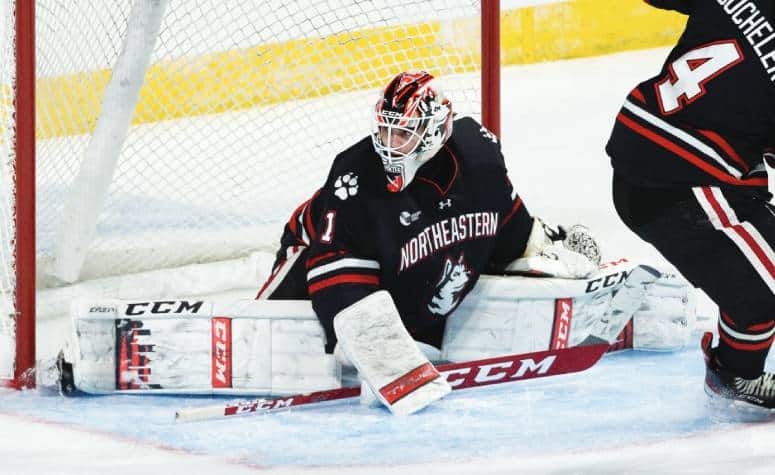

Northeastern goalie Devon Levi is the reigning Mike Richter Award winner as the best goaltender in Division 1 men’s hockey.
The native of Dollard-des-Ormeauz, Quebec, also won the National Rookie of the Year award last season. His .952 save percentage ranked first in the NCAA last season and tied for the second-best all time.
He’s a Sabres prospect who was drafted 212th in 2020 by the Florida Panthers, who then traded his rights to Buffalo. He was a member of Team Canada at the Winter Olympics this year.
Levi talked with New England Hockey Journal about his successful season and what’s ahead for him.
How would you describe yourself as a goalie? Who has been your biggest NHL influence, and why?
“Being able to watch Carey Price a lot, he definitely inspired me to be a goalie. Obviously he’s one of the greatest goalies of all time — and I met him as a kid, also — was really, really cool.
“I don't necessarily try to mimic my game after him or after anyone because I think there's a lot of really good things that a lot of NHL goalies do that guys like me and guys who want to get better can learn from. … I love how calm Price is and how easy he makes the game look. He’s really good at letting the game come to him and being patient, so I try to do that also. I really like Juuse Saros’ game also because he’s the smallest goalie in the NHL but he gets hit in the chest the most of any goalie, so that really says something about his positioning. I try to learn from him about how well he plays angles. At the end of the day, my play comes down to my reads and how well I can see plays and read players.”
What was your favorite memory from this season?
“It’s hard to pick just one because there were a bunch of great ones. I’m so happy that I got to play for Northeastern and play for my country (at the Olympics). It was a really great year, and I made some really good relationships that I’m going to have for the rest of my life. The best thing is enjoying time together after wins because you can’t beat the feeling of a hard-earned win at the end of a game. Sharing that was really, really valuable.”
As you reflect on your first season of actual college game action, how do you feel your game improved the most?
“The biggest thing was slowing my game down and having an approach that less is more, not complicating anything and just letting the game come to me. Not going to chase after pucks or chasing after plays, just really sitting back and witnessing what is going on around me. When my time comes to make a save or do something, that’s my cue — just waiting for my opportunity. I think I simplified my game and calmed it down as the year went on.”
Looking back, what did you know about Boston and New England before you arrived at Northeastern?
“I barely knew Boston when I came to school. I got to visit once playing in a showcase a few years ago, but I was just in and out. But, what I did know is that it was a great city and I had heard a lot of good things. It’s kind of my first time playing in the middle of a big city, so I was really excited to be able to explore. I don’t think I’ve explored as much as I wanted to yet, but I’ll definitely be working on that.”
What’s at the top of your checklist?
“What I did actually get to do was see a Red Sox game, which was definitely at the top of my list. I’d like to see a Celtics game, and just in general go outside of Northeastern’s campus and where we always are. I want to see what the city has to offer.”
What made Northeastern the right place for you?
“I was committed to Vermont before I committed to Northeastern, so when coach (now athletic director Jim) Madigan came to talk to me, he showed me his vision of the school and the hockey program and how it was on the rise. He wanted me, he believed in me and had the confidence in me to take part in that and help him see his vision. He sold me on the school right away and did a really good job of showing how great the college experience would be. It has lived up to every single word he said. It was a great choice coming here. I’m super happy that he had the confidence in me and came to me with the opportunity.”
It had to be so comforting to play behind guys like senior captain Jordan Harris (Haverhill, Mass.). How special was it to watch and learn from him over the last couple of seasons?
“Yeah, he's a really special kid. I say that to everyone. He’s a better kid than he is a hockey player. That says a lot about him because he's a really good hockey player. It was just great to be able to be on the same team as a guy like that — he’s an unbelievable leader and a really, really good kid. To have him as your captain and go to war alongside him, I never wanted to let him down. I really enjoyed that experience.
“Seeing him play in Montreal now is also really, really cool. I’m so happy that he got his opportunity and he made the right decisions over the past years. He’s the definition of a guy who deserves it. When I went back to Montreal after the season I had him over for dinner and we got to spend some time together in Montreal. I came to his home in Boston and it was full circle that he got to come to mine in Montreal.”
What has it been like to see him play for your hometown team?
“It was really cool. Growing up in Montreal, the hockey culture is unreal. It’s like religion. When I used to watch the games when I was little, it was like those guys were superheroes, the best to ever do it. Seeing ‘Jordo’ play and remembering how I used to look at the guys in the NHL, it was kind of crazy. I’m really happy for him that he gets to live that and be like a celebrity in Montreal because everyone in the city knows all the players. It’s really cool.”
What is your biggest takeaway from playing for Team Canada at the Olympics?
“I heard a saying that you’re the average of the people that you hang out the most with, so my experience there was unbelievable because I was spending time around such great people and great athletes, the best in the world at what they do. Being surrounded by greatness taught me so much, and I became that much better. I learned a lot and I became more mature being around those people. I’ll never forget that experience.
“When I came back, I just had a whole different perspective on hockey and everything. I got to practice with all these guys and take their shots, so I was forced to learn a lot because I had to transition from college to pro in a short period of time. I took it really seriously and made it my mission to consistently stop everyone. I think that challenge and making so many relationships really helped me grow as a hockey player.”