
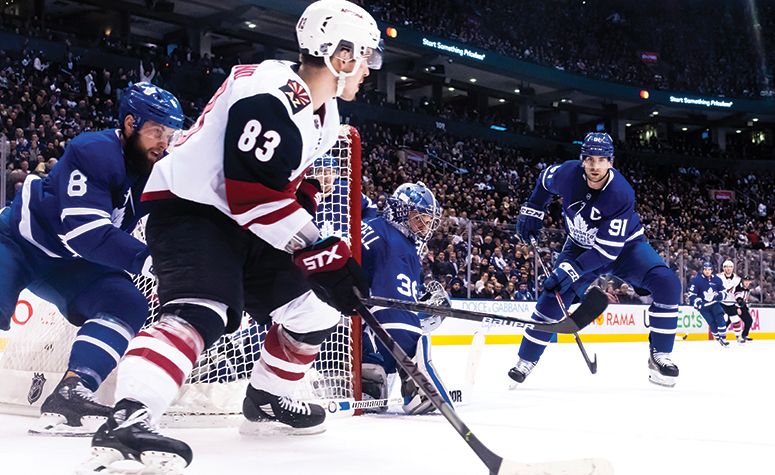

Conor Garland’s offseason workouts have been fairly consistent for the past decade. What has changed over the past four years has been the 24-year-old right wing’s mindset and the intent that he puts into those summer sessions.
As one of the Moncton Wildcats’ ace players in his four seasons, 2012-16, competing in the Quebec Major Junior Hockey League, Garland had “an easy time,” recording 328 points (104-224-328) in 206 regular-season games and 45 points (10-35-45) in 44 playoff contests. The Scituate, Mass., native captured the Canadian Hockey League scoring title in his last two junior campaigns, sharing it with Dylan Strome in 2014-15 and winning it outright in 2015-16.
“I was never really challenged to get to the next level of working hard,” Garland said. “I was always someone who was just built on my ability on the ice. I wasn’t able to be pushed around when I was younger.”
That all changed when the right-handed shooter turned pro in 2016.
“Guys are men now,” Garland said.
Yes, they are, and many of them are larger than his 5-foot-10, 165-pound frame. But Garland has been able to handle the challenge.
After spending his first two professional seasons, 2016-18, solely with the Tucson Roadrunners in the American Hockey League, Garland earned a promotion to the Arizona Coyotes, who selected him in the fifth round of the 2015 NHL draft, two months into the 2018-19 campaign. As a National Hockey League rookie, he recorded 18 points (13-5-18) in 47 games, and he didn’t return to Tucson until the Coyotes’ schedule concluded.
Garland’s only hockey home this season has been with the Coyotes, with whom he notched 39 points (22-17-39) in 68 matches before the season was paused because of the COVID-19 pandemic. Garland’s 22 goals and five game-winners led the Coyotes, who would face the Nashville Predators in a best-of-five series if the season resumes.
One reason for Garland’s breakout pro season can best be explained by famous novelist Mark Twain, who declared, “It’s not the size of the dog in the fight, it’s the size of the fight in the dog.”
In this case, it’s the size of the fight in the Desert Dog.
“I know what I want out of my career,” asserted Garland, who is now recovered from a March knee injury. “I want to be one of the top players in the NHL. And my time in the summer can help me become that.”
Garland’s offseasons start with a two-week recovery period. This is especially critical now that his job involves battling big-league opponents for most of the year.
“The NHL season is so grueling that you have to get your mind off it,” he said. “Last year, I tried not to think about hockey at all. I rested and slept in. You never get to sleep during the season, so I try to take advantage of that. I like video games, so I tend to play those a lot. I go fishing at night, which I do all summer after I’m done training for the day. I let my diet go a little bit, too.”
After not eating bagels during the season, those are at the top of Garland’s summer cheat food list.
“For those two weeks, breakfast consists of an egg sandwich or a bagel with cream cheese,” he said.
Garland also will enjoy an occasional burger and fries, and he’ll frequent Chick-fil-A.
“All that good stuff,” he chuckled.
Once those two weeks are behind him, Garland’s diet will return to healthier foods. He usually eats two eggs in the morning, “hardboiled because it’s easier to do,” and for lunch he’ll stop at two restaurants on the way home from the gym after his training sessions. He orders salad and chicken from one, chicken and rice from the other. For dinner, he walks down the street from his residence to his parents’ (Garry and Bridget) house and eats what they cook.
However, there will be one difference this offseason.
“I’m now living with my girlfriend, Meghan, so she’s going to be able to cook for us,” Garland happily proclaimed.
And on the nights Conor and Meghan go out for dinner, he notes that they “eat like normal people.”
“Fries, salmon, whatever the restaurant has,” Garland elaborated. “I’m not huge into having a crazy diet. I eat what foods I like. I understand that some foods are better than others, and I eat those.”
As for Garland’s training program following his two-week break, it begins with a two-week period of communication with his trainers about what he wants to improve and what they feel is necessary for him to upgrade.
“We have a good idea of what we are going to be doing for the summer and how we are going to go about it,” Garland said. “Those first two weeks are about evaluating where my body is at. Last summer, I wanted to focus on getting another step faster and skating, so I started on those two things right away. I went to my skating coach (former Olympic figure skater Michael Botticelli) a lot, and in the gym I worked on speed and did plyometrics.”
Although Garland’s plan for this offseason is to be determined, one guarantee is that cardio won’t be on the agenda. The reason he skips cardio off the ice is because he spends a lot of time at the rink during the summer playing games and shinny with his friends.
Instead, Garland focuses on weight and strength training and leg workouts, specifically squats.
“I’m a smaller guy, so I need to have a bigger lower body, which I do,” he stated. “I do deep squats, heavy squats, counter squats, squats where I put the bar down, walk to another bar with a lot less weight and squat with that. I do depth jumps. Having a strong lower body is huge for somebody my size, and I’m able to put a lot of weight on it.”
In the first half of his summer training regimen, Garland spends four days per week at the gym, working on his lower body on Mondays and Thursdays and his upper body on Tuesdays and Fridays. In the second half, he also heads there on Saturdays. Each day starts with a warm-up of foam rolling or a quick bike ride to get his legs going. His gym sessions are private and take place with the same trainer he’s had since he was 13 years old, Doug Fairbanks.
“It’s great that I have somebody where our dialogue is very good,” Garland said. “He knows my body just as well as I do, and we have a good relationship.”
Although Fairbanks and Garland share the same taste in music, specifically classic rock, there isn’t a radio or anything of the sort booming during his workouts.
“No, we never play music,” Garland chuckled. “I took my skills coach, Mike Kuzmich, and my dad to a Rolling Stones concert though!”
While that experience proves that you can sometimes get what you want, Garland’s true satisfaction comes when he’s on the ice. And he starts up at the rink immediately after his brief resting period by heading there two to three times per week before ramping it up to three or four times per week. Some of those on-ice sessions involve developing his skill-set under the guidance of Kuzmich, who serves a grander purpose for Garland beyond being his skills coach.
Explained Garland: “Mike is really my hockey coach. We talk about everything — thinking the game, making plays, skill, all the work that goes into trying to become a great player. We are constantly talking about off-ice work, street hockey or stickhandling at my house. We are trying to constantly improve each and every day, whether I’m on the ice or not.”
A major offseason milestone for Garland comes in early August, when he heads to Quebec City to participate in the “Boot Camp Sleeman” hockey tournament. He played in it the past two summers, and it serves as the moment when he begins entering “season mode.”
Teams play at least three games and as many as five games, which consist of three 10-minute periods with running time, although the last two minutes are timed. The players are mostly NHLers or AHLers.
Garland also competes in a summer league in Boston, where he runs his own team full of his buddies who play or played organized hockey. The intensity during these contests matches the hot temperature outside the rink.
“We have around five guys who still play, but for a lot of the guys it’s all they have left for hockey, so they take it very serious,” Garland said.
The only issue with his club is that it doesn’t have a name.
“We’ve probably had 20 tries at it!” Garland laughed. “We just can’t come up with anything that sticks. I’ll start a group chat and be like, ‘We should really get a name.’ We just never have.”
Despite being nameless, his squad has been successful, winning two out of the past three years after falling in the final last year.
“It’s one of my favorite times of the year,” Garland said, “sitting in the locker room with all my best friends and shooting the breeze, and going out and playing in a hockey game every week with them.”
And there it is — another reason why Garland is thriving with the Coyotes. Whether he’s at the gym, at the rink or somewhere else during the summer, hockey is at the forefront of his mind.
“I like to talk hockey,” Garland concluded. “Many of my friends play, and when I’m having lunch with my buddies who play, that’s usually the discussion we are having. We talk about players, playoff games, things that are happening. We don’t even think about it, that’s just where the conversations go. When you love the game and surround yourself with people who share the same feelings as you, you’re getting better because you are constantly talking about it.”