
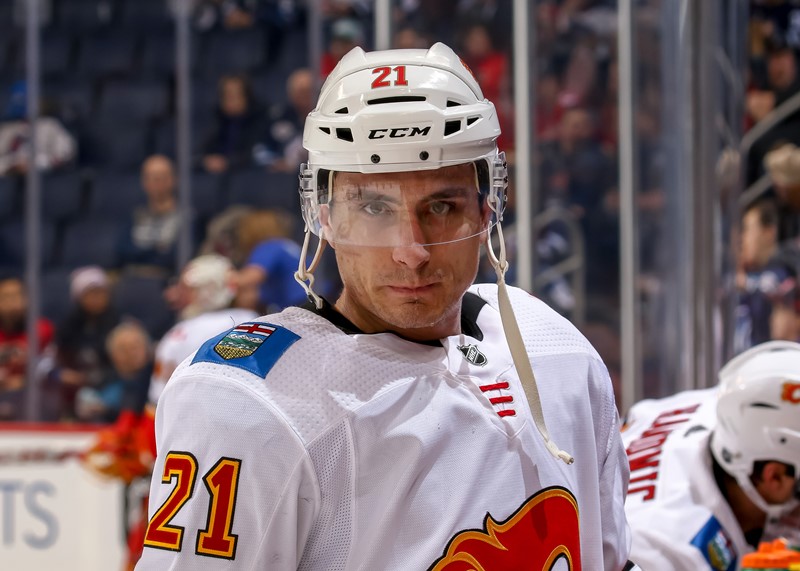

What would Garnet Hathaway’s response have been if you told the Calgary Flames right wing he would play 150 games – and counting -- in the National Hockey League after going undrafted?
“I would’ve taken it in a heartbeat,” answered the 27-year-old, who was born in Naples, Fla., and moved with his family to Kennebunkport, Maine, when he was six months old. “I’ve had a lot of support, from family, friends, coaches, strength coaches, skating coaches. It’s been a dream so far, but it’s one I want to keep living.”
Fittingly, Hathaway reached the 150th-game milestone in Florida when the Flames visited the Panthers on Feb. 14. But it would’ve been special regardless of where that contest was played considering that skating in just one NHL game seemed beyond the realm of possibility at one point for the 6-2, 210-pounder.
“Oh, yeah,” Hathaway responded when asked if he had doubts about making the NHL after never hearing his name called at an NHL draft. “I think everyone in here (the Flames’ locker room) probably had some doubts no matter where they were. That’s stuff you have to grow through. If you don’t have doubts and you don’t go through those situations, you may miss out a little bit on the growth and maturing you have to do. As any kid would at 18, I wanted to be drafted, but it hit me pretty quickly that there had to be another way if I was going to make it. So, you just have to start working hard, looking for another way and forming your own path.”
As of March 5, Hathaway, who’s in his fifth full professional season, all with the Flames organization, has 31 points (12-19—31) in 159 career NHL games, with 10 points (7-3—10) coming in 60 contests this campaign. His scoring totals are important, of course, but they don’t reflect who he is as a player and how he contributes to the Flames.
Calgary has plenty of players who pile up the points: Johnny Gaudreau, Sean Monahan, Elias Lindholm, Matthew Tkachuk and Mark Giordano to name a handful. But ask anyone in hockey about the ingredients that are needed to form a flourishing club, which Calgary is as it sits in first place in the Western Conference and second in the NHL, and you’ll hear them mention the importance of “role players.”
Exhibit A of a “role player” is Hathaway.
“For any successful team, roles are figured out and appreciated,” Hathaway said. “Everyone on this team has each other’s backs in any situation, and everyone contributes. If you don’t play for 10 games and then come in, everyone is still expecting the most out of you. And they’re always supporting you, too. I’ve been fortunate enough to take a big role on the penalty kill. Taking that defensive responsibility is something that’s really defined my role even more.”
The first time the right-handed shooting forward had an inkling that he could skate in the sport’s highest circuit was when he was teammates with Boxford, Mass., native and now-New York Rangers left wing Chris Kreider for the middle two of his four seasons (2006-10) at Phillips Andover Academy.
“That was an eye-opener for me, playing with Chris for a couple of years and seeing a guy of that caliber,” Hathaway remembered. “I was able to play alongside him, pick stuff up from him and really see a route (to the NHL) that was realistic. It wasn’t a dream anymore. He gave great advice, and you knew he was going to go far. He was the hardest working guy I’d seen. He’s a guy I learned a lot from, and I tried to keep up the pace with him.”
Kreider was selected 19th overall in the 2009 NHL draft by the Rangers and spent his next three seasons at Boston College before turning professional.
Meanwhile, Hathaway completed his fourth campaign at prep school before going to Brown University, where he spent another four years. It was there where the seeds for what would become his forte in the NHL were planted.
“The ECAC is defensive-minded, and my game focuses on the details,” Hathaway said. “That’s what’s helped me be successful in the NHL – being able to kill penalties and being responsible in the D zone. That’s what I really picked up at Brown. And, again, I played with guys at Brown who made the NHL, which just helped me work that much harder.”
During Hathaway’s junior year, NHL teams realized he had potential. After recording 14 points (5-9—14) in 31 games as a freshman and eight points (3-5—8) in 26 games in his sophomore season, he totaled 21 points (6-15—21) in 33 matches in his third year.
Following that season, he spoke with several NHL clubs and participated in back-to-back summer development camps with the Boston Bruins and Pittsburgh Penguins. It served as both a very grueling and big-time learning experience.
“That was probably the hardest and most exhausting two weeks I’ve had,” Hathaway recalled. “You go through fitness testing and five days on and off the ice in Boston and then go right to Pittsburgh. Being able to see those organizations up close, seeing what the NHL is really like and getting a taste of it just made me want it even more.”
Although his aspirations of making the NHL hit an all-time high after attending those camps, Hathaway never gave any thought to forgoing his senior season and turning professional.
“Education is huge for me,” he stated. “I was really fortunate to get into Brown, get the education and be surrounded by great people – athletes, students and teachers as well. I would do four more years if I could. Every minute was great.”
Hathaway concluded his college career by posting 15 points (6-9—15) in 31 contests as a senior, and after his final game with the Bears, he chatted with a couple NHL organizations.
He decided Calgary presented the best opportunity, so he signed an American Hockey League deal with its affiliate, the Abbotsford Heat, with whom he finished the 2013-14 campaign.
“That was a situation where you see how a team is built,” Hathaway said. “When anyone signs, they look at the team, at the organization. And Calgary is a first-class organization.”
One of the teams he turned down was the Phoenix Coyotes. Their assistant general manager was Brad Treliving, who’s now general manager of the Flames.
“It was funny. I had to call (Treliving) up and say, ‘I appreciate all the interest, but I think Calgary is a better fit,’” Hathaway recounted. “A couple weeks later he became the GM here. But everything happens for a reason.”
Hathaway remained with the Flames’ AHL affiliate – which moved to Glens Falls, N.Y., and was renamed the Adirondack Flames -- for the 2014-15 season. And after totaling 36 points (19-17—36) in 72 games, he inked an NHL contract with the parent club.
For the next three campaigns, he shuttled between Calgary and its AHL team, now the Stockton Heat. With each passing year, he earned more time in the NHL, where he utilized the lessons he was learning in the minors.
“It’s a lot more organized than college, especially the ECAC,” Hathaway said of the AHL. “You need to stick to details, and guys run around a little less. When you go up any level, that’s what the biggest step is. Everybody has skill; everybody can skate fast; everyone has good hands. The way you catch up to that and the way you can take advantage is positioning. I watched a lot and learned it as I went. Even making that step to the NHL, where it’s even more organized, you have to concentrate on the details and stay focused pretty much at all times.”
Hathaway’s only hockey home this season has been the NHL.
And if you ask him what his toughest challenge was during his trek to The Show, it’s the same one he continues to work on overcoming every day.
“I’m trying to keep making that next step and grow off stuff that I’ve already accomplished,” Hathaway concluded. “You could’ve asked me 50 games ago; would I have taken 100 games? Yeah; sure. But do I want 150? Yeah; no question. And then 151. I’m not done yet. I don’t think I’ve done my journey or my career at all. I’m trying to take advantage of every moment, learn at every second and learn stuff in each game that I’ll bring into the next one.”