
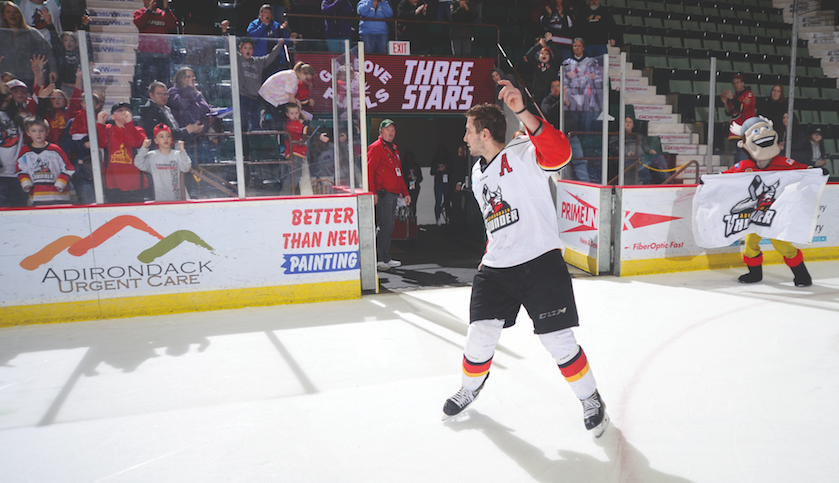

Brian Ward firmly believes success comes to those who work for it and is adamant that sustaining that hard work eventually will get you to the next level.
He’s living proof that it’s true.
Coming off his second season with the ECHL’s Adirondack Thunder, the 26-year-old forward from Haverhill, Mass., continues to climb the hockey ladder, with visions of one day skating in the National Hockey League.
“You look at all the guys who went from the ECHL to the NHL, and what you hear through the grapevine is that they worked their butts off to get better,” Ward said. “A big thing for me is adding little things to my game at a time, and then trying to improve them.”
Prior to his arrival in Glens Falls, N.Y., Ward played three seasons with the United States Hockey League’s Tri-City Storm and three campaigns at St. Lawrence University, with his points per game increasing each season from his first through his third with each club. Upon the conclusion of his college career, he made his professional hockey debut, playing one scoreless game with the American Hockey League’s Charlotte Checkers, toward the end of the 2015-16 season.
In each of his two ECHL seasons, Ward finished first on the Thunder in goals and third in points, notching 27 goals and 49 points in 49 games as a rookie, before posting 30 goals and 53 points in 59 contests this past campaign. He added three points (1-2-3) in six Kelly Cup playoff games in 2017, and nine points (5-4-9) in 17 postseason matches this spring.
Head coach and director of hockey operations Brad Tapper, who took over for Cail MacLean in those roles on Aug. 8, didn’t know many of the details on some of the players, so he relied on associate coach Alex Loh, who’s been on Adirondack’s coaching staff for all three of its ECHL campaigns, for reports.
He found out all he needed to know about Ward.
“I wanted to know the players’ thoughts, habits and priorities away from the rink, so I called them all up,” Tapper revealed. “Brian said he’s one hundred percent committed. And he showed it, in his pregame routine and practice habits. He works harder than a lot of players. When we do a drill, he’s at the front of the line. He’s out there early, and is always working on his craft.”
Tapper can thank his predecessor for being able to have Ward as one of his players.
“Cail was one reason why I signed with Adirondack,” Ward stated. “He had really good relationships with his players, and he had played in the ECHL, so he knew the ups and downs of playing in this league and what it takes to get to the next level. I’m really glad I had him as my first pro coach because he really helped me along.”
Ten days after Tapper was announced as MacLean’s replacement, Ward re-signed with the Thunder, a move that can be summarized as a win-win for both player and coach.
“I hadn’t met him before, and we spoke on the phone for about four minutes,” Ward remembered. “He laid out what he’s all about, his principles and his values. They aligned with mine, so I was excited to get to know him. Turns out, he’s one of the best coaches I’ve ever had. He has so much energy and passion for the game that it’s contagious and rubs off on all the guys.”
Said Tapper about Ward, one of the team’s alternate captains: “He’s a great leader, and that’s why he wore an ‘A.’ He’s not the most vocal guy, but when he says something, everybody listens. During a game, he’ll go to the net no matter what, and take a cross-check, a bump, a bruise. He blocks shots better than a lot of guys I’ve seen in the game. When he puts his body on the line for the team, it says a lot about the individual player. His getting to hard areas, where some players won’t, can separate him and move him up to the AHL.”
In fact, Adirondack’s close proximity to many AHL clubs and the chance of potentially being called up on a tryout contract was the other reason Ward inked with the Thunder.
This notion proved fruitful, as he played eight games last season with the Albany Devils, and then one game with the Utica Comets and two games with the Providence Bruins this past campaign.
Ward, 6-1, 200 pounds, learned that although there’s more structure and better players in the AHL, “it’s not much of a jump.”
However, his biggest takeaway goes back to work ethic.
“Those guys really work hard to get to where they are,” asserted Ward, who has two AHL assists to his credit, one with Albany and the other with Providence. “I think I could be a good player at that level.”
He paused before continuing: “Then you’re one step away from the NHL when you’re there.”
Ward witnessed how close the leap is to the game’s highest circuit while with Albany, and it’s a sight that remains seared in his memory.
“When I was there, Blake Coleman got called up to the NHL for the first time, and now he’s a regular in New Jersey,” he said. “Seeing the look on his face … any day could be the day you get called up to the NHL.”
With that in mind, Ward continues his relentless pursuit of trying to fine-tune his body and game, and he knows precisely what aspects must be upgraded.
“I need to be simpler going north with the puck, and I need to do a better job of keeping it away from the defenders’ sticks on the rush,” said Ward, who has a left-handed shot. “Another thing is being more responsible defensively — keeping my head on a swivel, knowing where everybody is, and knowing what to do with the puck before I get it — which I’ve been working on for the past couple of years.”
Tapper wants to see him improve his skating, in particular his stride, and move his feet more getting to open areas of the ice away from the puck. He adds that Ward is still in the mid-tier on faceoffs but has the potential to be a top guy.
Still, Ward’s already made significant progress as a professional. Exhibit A is his release of the puck.
“Brian doesn’t dust it off,” Tapper said. “He catches and releases it very quickly.”
Ward also has taken a step in terms of his mental approach, utilizing a breathing technique he learned from podcasts, research and sports psychology books to help him remain even-keeled through the ebbs and flows of a hockey career.
“Breathing and taking deep breathes calms me down,” Ward explained. “If something is going wrong, I’ll take a second to pause and just think about my breath, and get out of my head. Just this year, I’ve noticed huge improvements from doing that. It makes a huge difference, especially when things aren’t going my way or I need to turn something around.”
For the most part, things have gone Ward’s way, and with his work ethic and passion for hockey, it’s now a matter of when he’ll receive a promotion to a higher league, not if.