

There’s nothing quite like the Beanpot.
The first two Mondays of February are circled on the calendars of hockey fans all around Boston, but things are a little different entering the 67th edition of the tournament that will be played on Feb. 4 and 11 at TD Garden.
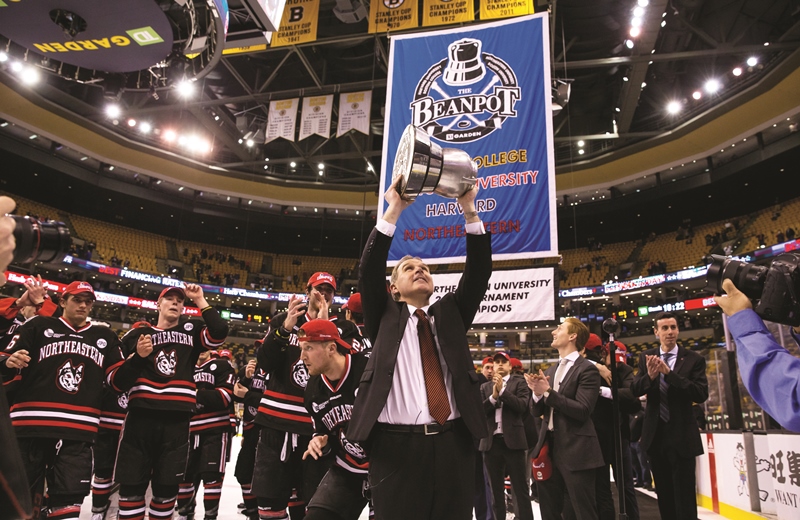
After Harvard broke a 24-year championship drought in 2017, Northeastern won its first title in three decades last winter while becoming the third straight team to edge past Boston University and claim Beanpot glory. The Terriers have won a record 30 Beanpot championships, but first-year head coach Albie O’Connell’s team is looking to avoid becoming the first team to fall in four consecutive title games.
With the two long droughts in the rearview, it’s officially anybody’s Beanpot. It especially feels that way as all four teams compete in tight Hockey East and ECAC races.
The numbers favor a Northeastern team that entered the final weekend of January with 15 wins and sitting only two points out of first place in Hockey East, but the Terriers were one of the nation’s hottest teams to start the second half. Boston College is right in the thick of the league race despite its continuing struggles in non-conference play, while Harvard can say the same thing about its ECAC position through its ups and downs.
But one ultimate equalizer always seems to shine through in short tournaments like the Beanpot. Between the former U.S. National Team Development Program duo of BC’s Joseph Woll and BU’s Jake Oettinger, Northeastern’s Cayden Primeau and Harvard’s Michael Lackey, “the goaltending in the tournament is outrageous,” O’Connell said.
All four Beanpot schools have had alumni serving as head coaches since Jim Madigan returned to Northeastern in 2011-12, adding another unique wrinkle to the annual showcase of collegiate hockey in Boston. In addition, three of the four are Massachusetts natives.
In advance of this year’s Beanpot, all four coaches discussed what the tournament means to them, memories from their playing days, recent championships and much more in a Q&A with New England Hockey Journal:
What does the Beanpot mean to you?
Ted Donato (Dedham, Mass.), Harvard: The Beanpot is such a great Boston tradition. Personally, whether it was our street hockey games, games in the basement or whatever it might be, we’d all dream of playing in the Beanpot. We actually played knee hockey with a sock back then because we didn’t have all these mini-sticks and all the video games kids have today. As a local hockey player, you remember being so excited to watch those games as a kid. As a player, getting a chance to play in the Beanpot really signified that you made it. Being one of four boys and having two older brothers not have the opportunity and me have the chance, I almost felt like I was playing for them as well. And then as a coach, it’s such a great experience and a chance to represent your school.
Jim Madigan (Milton, Mass.), Northeastern: It’s such a unique tournament because it revolves around Boston. It’s not just an athletic event. It’s a cultural event and part of the cultural fabric of the city just like the Pops on the Fourth of July and so many other great traditions. The Beanpot is one of those traditions and it touches all four schools, their hockey programs, the institutions, the students and alumni, and the friends and family. Knowing that it has this significant place in this city makes it that much more unique of an event and an event that you then want to claim, because it just carries so much weight in this city when you participate in it alone, but when you’re fortunate enough to win, it elevates the experience of being part of the Beanpot. Being part of the Beanpot is a great experience, but winning it is just at another level.
Albie O’Connell (Watertown, Mass.), Boston University: It’s special. I grew up going there as a kid. The old Garden was a little different atmosphere — hot, smoky, loud. It’s a little bit different now, obviously, but it’s always a great event for Boston and hockey in the area.
Jerry York (Watertown, Mass.), Boston College: It’s something that’s been embedded in me, I guess. I watched it as a high school student-athlete just marveling at the skill and the level that the college players reached in that time. We all looked at it like, “Wow, these are our heroes.” I remember playing street hockey and picking names, whether it was Gene Kinasewich (from Harvard) or Billy Daley (from BC). So it’s kind of an interesting dynamic that I eventually got a chance to play in it, and now I certainly cherish the opportunity to coach in it.
What are your earliest memories of the tournament?
York: I remember some of the saves Jim Logue would make when he was playing goal for BC. Like I said, Billy Daley was a center who I really tried to emulate. But there were players from other teams, too. Bobby Marquis from BU was pretty exciting, Jimmy Bell at Northeastern, and Kinasewich. Those guys stand out to me.
O’Connell: I don’t know how old I was, but just the first time I saw them carrying it around the ice on that second night. I don’t even remember who won, to be honest, but I remember thinking, “Wow, it would be so cool to play in the tournament at some point” and hopefully hold the trophy.
Donato: I just remember not making it up, awake, for some of the second games. But just the excitement of the Beanpot and college hockey was such a great thing. There weren’t as many games on TV, but you always had the chance to watch the Beanpot on Channel 38 back in the day and then on NESN. It was such a treat.
Madigan: I heard about the Beanpot prior to coming down from Toronto. A couple of my junior teammates were already at Northeastern the year before me, so I was aware of it. As you got on campus, even in September and October — my freshman roommate was a guy named Timmy Marshall, who ended up being a Beanpot MVP (in 1984), and he kept on telling me, “Wait until you see the Beanpot!” So I heard about it but didn’t realize the magnitude of it until I actually stepped on the ice. You have to be occupied and focused in on your season before you get there, but you can’t wait to get there. You don’t want to fast forward, but when you finally get there, it’s like, “Wow, this is the Beanpot.” The excitement takes over.
What do you remember about the first Beanpot you played in?
Donato: I just remember looking around before the game. I was really fortunate to play at the Boston Garden for some state championship games at Catholic Memorial, but to be at the Beanpot and be in front of a full house was really cool.
York: Just how nervous and excited I was. That night, it was all that rolled into one for me. In those days, all the players took their own transportation to the games, whether it was the T or someone dropped you off. Then we all met right at the dressing room. None of us had buses. The Garden was jam-packed. The unforgettable 13,909; that was the capacity. The building really rocked and rolled back then.
Madigan (1982): We played Boston College in the second game on the first Monday. The old Boston Garden was so great for the Beanpot because it was so intimate. It was a “wow” moment. I’d been in the Garden for a hockey exchange program when I was growing up in Montreal, but to have the experience of stepping on the Spoked B on the ice was something else. It hits you when you’re out on the ice for warm-ups, like, “Hey, this is the Beanpot.” We lost a close game in overtime, 3-2. I missed a breakaway earlier in that game that didn’t make me feel good, but we won the second game against Harvard in overtime. A lot of times the build-up to an event or a game doesn’t meet the expectations. This met it and surpassed it for me. Even though we came out on the losing side, it was just a great experience to be a part of it.
O’Connell (1996): It was a blowout. We blew Northeastern out, but it was kind of a back-and-forth game. I think Mike Grier had a hat trick, Chris Drury had a hat trick. It felt like everything we shot went in the net. It was nice. I ended up getting a goal in the game; it was kind of a cheap one, but we’ll take it.
You played at BU during a run of six consecutive Beanpot titles, including all four years of your collegiate career under Jack Parker. Can you put into words what the tournament meant to BU at that time, especially during that period of dominance?
O’Connell: You could always see Coach Parker’s intensity and excitement pick up around Beanpot time. It was always a big event for him, so he made it a big event for us and we kind of fed off that. We had good teams at that time, but we weren’t always the favorite; the first few years, yeah, but the last year I think we might have been the third choice. But we ended up beating BC and then Northeastern in the final.
Have you noticed a difference in the team’s mindset related to the Beanpot in the two years following Harvard’s first championship since 1993?
Donato: It kind of reinvigorated our team as to what the Beanpot could mean for us. ... I think it really meant a lot to that group of seniors in particular. I know Jimmy Vesey, Kyle Criscuolo had their sights on it and really wanted it, and I think they were a big part of establishing our culture. That next group of guys with Alex Kerfoot, Sean Malone, Luke Esposito and Tyler Moy, you could see that they weren’t going to be denied. I thought we were just relentless in that game against BU, but you could see that these guys wanted to be able to say they won a Beanpot. I think it can be such a great piece of your experience at any of these four schools, so I was really glad they were able to get that win. And quite honestly, for me, we hadn’t had a lot of success in it, so it was really nice to share that with the team.
It had been 30 years since Northeastern won the Beanpot before last February. What impact have you noticed that victory having around the school?
Madigan: We’ve had a tremendous amount of support with our student body, alumni and fans over the last few years, and I think we’ve had even greater support at the Beanpot because we were in three Beanpot finals earlier on in our tenure. Though we weren’t able to win, there was that “this is the year” feeling. When we were finally able to get over the hump last year, it allows everyone to feel that pride and proudness of winning the Beanpot for your institution. That touches on so many different facets from our own players, of course, and the institution, but also those groups I mentioned before with the alumni, family and friends. It kind of elevates you more in the city. I always say we’re in a city with three 800-pound gorillas in terms of traditional hockey programs, so this allows us to be on equal footing for the tournament after not being part of it in that way for many years.
What is your lasting memory from last year’s championship?
Madigan: It’s not just one. It’s Adam Gaudette scoring the empty-net goal and to see the effort and energy he possessed on that play knowing that the time was winding down. We were going to win the game either way, but I thought that play just epitomized our team. It was second effort all the way through, and that certainly was Adam throughout his whole career. That’s one lasting memory. Then there’s Nolan Stevens getting a chance to hoist the Beanpot because it had been 30 years since a Northeastern captain had hoisted the Beanpot. I was there for the last one with David O’Brien in 1988. To have that feeling, have Nolan representing our team, and then see Nolan skate over hoist it to all the Northeastern fans in that corner of the building was really just amazing. And then for our students, alumni and administration to finally be able to stand there as Beanpot champions. Those are the three lasting memories I’ll have of that win.
How has winning changed the team’s mindset entering this year’s tournament?
Madigan: The pressure’s off. The one thing we’ve had to face over the last four or five years, particularly because we were playing in the championship, is hearing, “Northeastern hasn’t won it in 25 years, 27 years, 29 years, so what’s going to be different this year?” As a team, you kind of get sick and tired of hearing that, right? It’s like the Red Sox not winning (the World Series) in 86 years. It kind of grows on you mentally and wears on you a little bit. Last year’s group was a special group that did that, so this year’s team doesn’t have to answer that question anymore. We want to win it every year, but we don’t have to answer the question of the long drought. Finally, we can answer the question, “Do you think you can repeat?” That’s a nice question to answer. That’s our goal, knowing we have three other great teams to face in this tournament.
Having been on the winning side so many times as a coach yourself, how have the last two championships for Harvard and Northeastern changed the overall outlook of the Beanpot?
York: There was a stretch there when we won five straight (2010-14) and six of seven (through 2016). It was just an unbelievable run. Now, all four teams can legitimately win it every year. I guess it was like that back then, too, but BC or BU would have a run. Harvard won it once in a while, but Northeastern has also become a viable contender every year. Now more than ever, it’s four teams and you can just pick ’em — who’s going to win this? Still, it’s always a classic event on those first two Mondays in February.
How do you compare winning the Beanpot as a player and a coach?
Donato: As a player, I probably didn’t appreciate it as much as I should have at the time. I was probably a little bit naive. While your team might not have had success, you weren’t here for a lot of it. That’s what’s neat about it — every group that comes in, it bring a new excitement. With us winning two years ago and Northeastern last year, I think that’s brought a new energy back to it. Of course, BU and BC have obviously been great in it for a lot of years, had a lot of success and are great programs, so I think there’s a lot to look forward to in the Beanpot this year.
Madigan: Winning the Beanpot is a joyous event at any time. Nothing ever compares to winning a Beanpot, a Hockey East championship, NCAA or whatever to when you’re a player. As a player, you go through the physical and mental grind that cultivates in that victory and you share it with a bond of brothers. The second-best experience and feeling is being involved as a coach. Coaches are a part of it and we work together, but nothing can take away from being a player because there’s a mental, physical and an emotional sacrifice that you go through.
O’Connell: You didn’t think about it that much as a player. You just tried to get yourself ready and compete. It was the same for the rest of the team because we didn’t worry about PairWise or where we were in the standings. It was just about who’s next up and we played. It’s different now. You sweat the wins and losses.
York: It’s much more fun as a player. There are so many different spectrums with coaches, referees, but I think we’d all say we’d rather play. It’s such a special event to get to participate in, make plays, and have those competitive juices on the ice.
The Beanpot is such a special event, especially for the locals. How do you keep the emotions in check?
Donato: You really try to prepare them for the fact that it’s a little bit of a different environment. For example, we play in the first game this year, and there aren’t a lot of games where you play in front of very few people and then have people. We don’t play a lot of games on the NHL-sized rink. There are some dynamics that help to be addressed, but I think for the guys in the room that have had the chance to play in the late game in the Beanpot and in front of a full house, that’s where the true experience comes.
Madigan: Maintaining your emotions is so important in this tournament. You want the players to play with emotion, but you have to make sure it doesn’t get carried over the line. There’s pressure in every game you play in, and there was certainly pressure in our group last year because we were having some success and hadn’t won it in 29 years. I thought we did a great job of embracing the pressure last year and just saying it’s just another hockey game. It was a big hockey game, but that group had played in a lot of big hockey games over the last few years in Hockey East, the NCAA tournament. We’ve played against St. Cloud, UMass and BU, so we’re going to go in kind of like last year, embrace the pressure and maintain emotional control, but you have to settle into the game real quick once the puck drops.
O’Connell: I think the local kids always end up doing well in it. They know more about it and have watched it growing up, so there’s always a goal to play there and an excitement level. I’m hoping that some of the local guys will carry us this year. Overall, the biggest thing is getting them in the right mindset, making sure they’re comfortable, and playing within the moment. You don’t want to make it anything bigger than it is. It’s the unsung hero who comes through a lot of the time. It’s good for guys that maybe don’t have as many goals, but they feel like they can make a big contribution.
York: I think nervous is good. Nervous is a sign that you care, that you’re anxious. There’s not many events that you go into of this nature where the emotions are a flat line. As the game starts and there’s some action and collision, you’re right back in and it’s just a game. All the participants have that excitement, nervousness and anticipation, like, “Here it comes, you know?”