
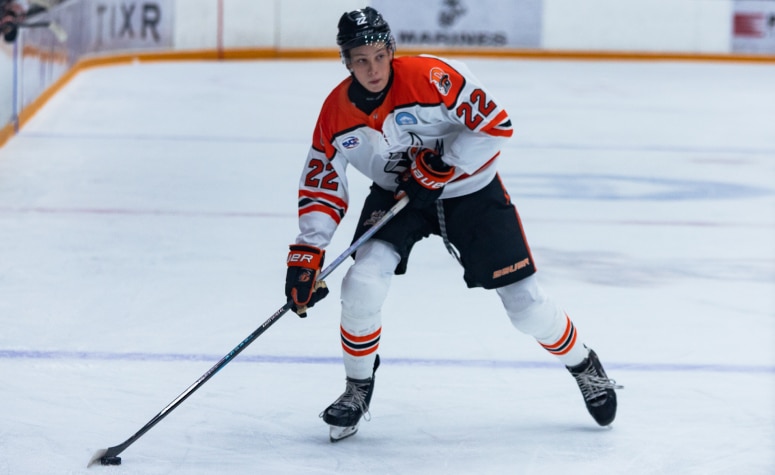

As Jack Harney was making the biggest move of his life, his mind was elsewhere.
Harney, 19, graduated from St. Sebastian’s last spring and, still uncommitted for college, opted to play for the Danbury Junior Hat Tricks in the North American Hockey League. Though it wasn’t far from home, Harney (Needham, Mass.) was set to move into a billet house prior to the current season.
Harney’s parents, Joe and Jen, had just finished moving their son’s belongings into the house and were about to say goodbye when Harney blurted out what was on his mind.
“I think there’s something wrong,” Harney said.
Harney wasn’t referring to the billet family’s home or the move to play in the NAHL.
He was talking about his body.
Harney has always been taller than the rest of his peers. He was 6-foot-3 at 16 years old, which wasn't all that dramatic despite having parents who are both roughly 5-foot-8. Most hockey players would hand over their savings account to be 6-foot-3.
“His older brother (Joe) was a late bloomer, so we just figured his height was going to stop and he would start filling out like his brother,” Jen said.
But then he was 6-foot-6 at 17 years old and 6-foot-9 at 18, and questions began to arise in Harney’s mind. The questions reached a fever pitch a week before Harney was to leave for Danbury.
Harney was evaluating his training routine in the summer. He skated five times a week. He worked out five times a week. He worked with Kinetic Fuel’s Julie Nicoletti, the Boston Bruins’ team nutritionist, to eat foods that would promote muscle growth.
“The only other player that I had worked with who was 6-foot-9 was Zdeno Chara,” Nicoletti said.
The workouts, combined with eating well, resulted in 2 1/2 pounds of skeletal muscle and a significant decrease in his body fat.
RECRUITING: 10 takeaways from college hockey recruiting over the past few months
“I felt like with all I did this summer, it should be more than that,” Harney said.
Harney’s parents had him see an endocrinologist, who ordered a blood test. The results were staggering: His growth hormone and prolactin levels were excessively high.
“Like 4,000 times higher than they should have been,” Jen said.
Harney had to take an MRI. Days later, he got a call from his doctor asking if he had time to meet virtually with a neurosurgeon — the results from the MRI were in.
A 1.8-by-1.6-centimeter non-cancerous tumor was found on his pituitary gland. Harney had gigantism, a rare condition that causes excessive growth, especially in height, during childhood.
“I was just sitting there thinking about everything I’d thought about since I was a freshman when I was 6-foot-6,” Harney said. “I’m like, ‘Oh my God. This is why.’ That tumor was causing excess growth hormone and not letting me put on any real good weight in the summer.”
Brain surgery was needed. The doctor urged them to do it immediately and not wait until the end of the season. He still could grow, and they caught the tumor before his growth plates closed.
Harney had no hesitation and scheduled the surgery for Halloween. The initial meeting was on Oct. 10, so Harney kept playing until it was time to go in.
“We were in Rochester on October 29, and it was starting to hit me a little bit,” Harney said. “Like two days from now, I’m going to be in a hospital bed, and who knows what’s going to happen.”
Then came the day of the surgery at Boston Children’s Hospital. Dr. Lisa Baird and Dr. Eelam Adil were tasked with going up Harney’s nose to remove the tumor. After an 11-hour surgery, it was over. They had successfully removed the tumor from his pituitary gland.
“That was the longest day of my life,” Jen said.
“All I remember is taking a good nap,” Jack said.
Danbury placed Harney on injured reserve, allowing him to stay on the team throughout his recovery, which took place at his parents’ home.
“You just try to be an anchor for him emotionally and mentally,” Danbury head coach Lenny Caglianone said. “You just try to be as comforting as you can and just let him know anything that he needs, we’re more than happy to help.”
The recovery process was uncomfortable. Because the surgery went through his nose, Harney couldn’t blow his nose for a month. He couldn’t do anything for the first 7-10 days. After that, if he was feeling up to it, he could go for a walk.
“That was the extent of anything he could do,” Jen said.
Because of this time spent on the shelf, Harney lost weight and fell out of playing shape, which was to be expected. Still, the recovery was successful.
“In the consult after that, they said as long as the healing goes fine, they anticipate this is one of those things where as traumatic as all this was, he will be fine going forward,” Jen said.
NTDP BOUND: How do the New Englanders look one month from NTDP Evaluation Camp?
Harney eventually was cleared in early December and returned to the ice, skating by himself and getting his puck touches back. Then he began practicing with the team again, but in a red, non-contact jersey.
“We don’t want to over-encumber him mentally,” Caglianone said. “We want to allow him to go at his own speed and assimilate back into the lineup when we feel that’s ready to be consistent in that regard. Obviously, it’s going to take time. It takes time for him to translate his game from prep to here, and then now to have that kind of speed bump with his medical issue, it’s kind of pushed that back a little bit.”
Harney’s first game back was Dec. 17 against the New Jersey Titans. He's played eight games since.
While it has been a challenge for Harney to get back to normal on the ice, especially against a higher level of competition, he has stopped growing and should begin to be able to put on muscle.
For years, college coaches wanted to wait until Harney was done growing and filling out. That box should soon be checked.
College coaches now want to see a 6-foot-9 defenseman who has efficiency in his movement, is hard to play against and moves pucks well.
“The crazy thing about him is that he’s not an ugly skater,” Caglianone said. “He’s pretty fluid. It’s just about improving the short-term interactions, getting the foot speed up and being a little bit more meaner. We want him to be a little bit heavier and a little bit harder on his stick.”
For his parents, the experience has put their son, who is normally reserved and shy, in a new light.
LATEST PREP RANKINGS: A wild week changes everything late in the season
“We’re just so impressed that he spoke up,” Jen said. “Sometimes, it’s really hard to talk about difficult things. I thought it was very mature that he could say that to us and advocate for himself. There’s something to be said for when a child feels strongly about something that you pay attention.”
Even after a whirlwind fall, the goal remains the same for Harney, an ’05.
“I know I’m going to have to play two years of junior, especially now with what’s happened, and I’m fine with that,” Harney said. “My hope is still to play Division 1 hockey.”