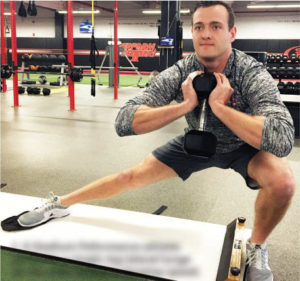
Hockey players from all different backgrounds and skill levels enter the weight room each summer with several different goals and aspirations for next season. A common target for many of these players is to increase their ability to accelerate in the first three steps. Having the ability to accelerate faster might be the edge a player needs to win more races to the puck or get to a spot first on the ice to defend. In order to improve an athlete’s first three steps of acceleration on ice, we must break down components that lead to the increase in acceleration times.
The strength that is required to start at the takeoff requires the body to produce enough force into the ground to accelerate forward. The rate of which the force is generated impacts the amount of power a player is able to generate. Power is the ability to do work over a period of time. Players manage the ability to produce power with specific motor control to generate a fast first three steps. Ice hockey is played in constant mode of acceleration where the play is changing direction often. Very little time is spent in long top-end speed where a player skates the entire length of the ice at a given time. Athletes who efficiently accelerate fast have more energy to put into the tactical and technical components of the game.
Many factors go into how well a player accelerates their first three strides on the ice. For players with little training experience looking to increase the ability, a general training program focused on improving relative strength, intramuscular coordination and mobility will serve you well. Overall, make sure you spend adequate time in each of these factors in order to maximize your ability to accelerate.
Intramuscular coordination
The ability to control the body under load and during sport-specific movements is extremely important. Creating greater movement literacy during a young age exposes athletes to learn unique motor strategies and spatial awareness. With greater movement literacy, athletes can retain from past movement context when put in a body position that deviates from the standard positions of the sport. Create a good athlete first, then teach them the game of ice hockey.
Relative strength
Strength is the prerequisite for power. Power is the ability to apply force over a certain distance by time. When breaking through the inertial force during acceleration, relative starting strength should be considered. For players with a low to moderate training age, relative strength typically increases force production. However, the player who can create greater force at a faster rate will always win. Since force is relative to time, athletes with sufficient relative strength should increase their impulse ability, which is the ability to put out force over a shorter period of time.
Proper biomechanics
Proper biomechanics is the ability to put the athlete in the best positions to enhance horizontal displacement. Several factors include forward lean/shift of mass, fast arms that carry into the front and backside of the body, long extension of the stride starting at the shoulder and finishing at the ankle and big toe, and deep knee bend.
Increasing range of motion
Increasing mobility allows the player to display efficient movements that help improve and manage the postural demand of ice hockey on the body. Players with the ability to increase stride length while the upper body remains in a relatively unaltered athletic position provides a sustainable posture that’s readily available to make adjustments based off the flow of the game. When mobility is lacking, the demand of the task can place you in a compromised position.
Creating a faster first three strides is a trainable task. Players who can produce a greater amount of force over a shorter period of time with efficiency place their bodies into better positions to make smart hockey decisions. Make sure to evaluate your game and spend time this offseason improving your weakest link.